

👋 Hey, Linas here! Every day, I break down 3 stories shaping the future of FinTech & Artificial Intelligence - plus the money movements and trends worth tracking. First time here? 400k+ FinTech and AI leaders get this daily. Join them:
Picture a 50-person R&D organization that came late to AI. Now imagine 2 AI engineers at a competitor, each running a fleet of AI coding agents. On raw throughput, the two can already outpace the fifty. But the math understates their advantage. At two people, there is barely an organization available to slow them down: no management layer or product-manager handoff, no queue of teams waiting on one another. If they also have deep domain expertise and the right architecture underneath them, they are operating in full entrepreneur mode while the 50 stop at every junction. Hence, the Age of the One-Person Company.
That scenario comes from “The Agentic Awakening,” Liran Eshel and Adam Fisher’s 2026 study for Bessemer Venture Partners of more than twenty engineering organizations. For anyone starting a company, it is the most important passage in the study. Because the asymmetry that has always favored startups, speed over mass, just widened by an order of magnitude. An incumbent still treats its codebase as a moat. To two engineers with AI agents, it’s just an excellent spec. They can rebuild an equivalent product from it, then outbuild the company that wrote it.
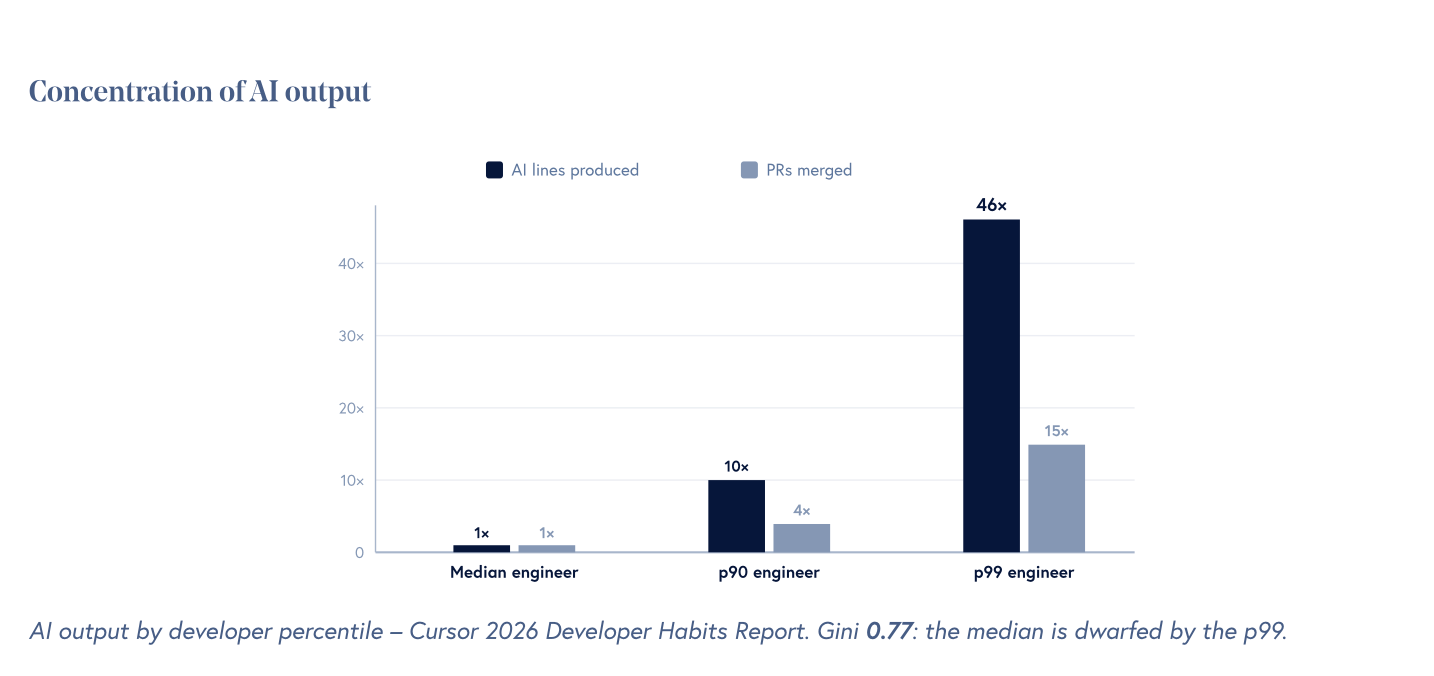
It’s worth noting that the same study also contains a warning. Companies that made their engineers 10x faster still could not push organization-level output past roughly 50%. More importantly, the output concentrates brutally: the top 1% of engineers ship 46x the median’s AI-written code. And the product you are building is itself becoming the legacy, because a general-purpose agent with a single domain skill (running, i.e., on Fable 5 or Astra) can now do what an entire specialized SaaS used to do.
The agentic transition is therefore the shift from AI that assists an engineer inside an editor to fleets of autonomous AI agents that write, test, and ship code while humans decide what to build and verify what comes back. For a founder, it completely changes what a company is: how it is built, how it is staffed, how it is shaped, what it sells, and how it is priced. The window opened in the fourth quarter of 2025, when Claude Code 2.0 & Opus 4.5 made coding agents reliable enough to delegate to. 10 months later, the public market has repriced software as a category, and the foundation labs have moved into the application layer. Salesforce is now even spending close to $300 million on Anthropic tokens this year while totally freezing engineering hires.
This playbook is the founder’s version of that study. Its argument therefore rests on five shifts: (1) code is now cheap, and judgment is the bottleneck; (2) gains concentrate rather than spread; (3) individual speed stalls at the organization; (4) the product is becoming the legacy; and (5) tokens replace headcount, with the bill arriving before anyone has measured the spend. Each one changes a decision you will make this quarter, from whom you hire to how you price.
Here is what the rest of the piece covers.
Part I. Read the clock. The transition’s 3 phases, and 7 economic signals that show where it stands today, from Anthropic’s $65B run rate to Gartner’s forecast that more than 40% of agentic AI projects will be canceled.
Part II. The five shifts. Each shift with the numbers behind it, including the 46-to-1 output distribution and the 50% ceiling that even the most advanced company in the study could not break.
Part III. The playbook. 7 plays, each with a diagnostic question, concrete moves, and the trap to avoid: the $1,000-per-engineer-per-month token floor, the hiring filter that replaces years of experience, the one approval gate worth keeping, the 4 chiefs a flat organization needs, the pricing that survives agents, the security surface that kills agentic companies, and the 2 numbers to plot every engineer on.
Part IV. The next 12 to 24 months. Fleets of hundreds, a collaboration stack rebuilt for agents, the labs moving further up the stack, open-weight models as a real option, and a labor market that is hiring senior and shrinking at the entry level.
Part V. The scorecard, the 90-day plan, and 12 rules. A self-assessment against the study’s median, a plan in three 30-day blocks, and 12 rules to run the company by.
One key question tells you where exactly you stand today. Can one engineer on your team run three agents in parallel, unattended for an hour, on your real codebase, without reading every line of what comes back?
If the answer is no, you have an IDE plugin, not an AI fleet, and the rest of this piece is about closing that gap before a competitor’s two engineers do.
Part I. Read the clock: where the transition stands
The transition has three phases, and most of the industry is still in the first.