

👋 Hey, Linas here! Welcome back to a 🔓 weekly free edition 🔓 of my daily newsletter. Each day, I focus on 3 stories that are making a difference in the financial technology space. Coupled with things worth watching & the most important money movements, it’s the only newsletter you need for all things when Finance meets Tech.
Anthropic IPO: The Profit Is Real. Above $1.5 Trillion, the Price Isn’t 🤖 [Anthropic’s revenue is up 14x and it just booked its first operating profit. But it owes $268 billion it can’t cancel, on revenue that’s 80% pay-as-you-go]
Y Combinator Just Showed You What to Build. Here Are 33 Startup Ideas Worth Building Now 🚀 [Inside YC’s Winter 2027 Requests for Startups: where AI’s bottlenecks moved, who’s already building, and 3 fundable startup ideas in each of the 11 categories]
The One-Person Company on Grok Bot 🤖 [What SpaceXSI’s 72-hour live company build revealed, and the playbook for running your own one-person company on six Grok Bots]
The Attention Bottleneck 🧠 [How AI agents reshaped jobs, hiring and productivity at Anthropic, and what it means for founders and investors building in AI]
Meta’s Muse AI Agent hit 10 million users in six weeks. Amazon and the banks now decide what it earns 🤖🔒 [the Muse numbers Meta disclosed and the one it withheld, why Meta will charge merchants rather than shoppers, how negative free cash flow is forcing it to monetize early, & the signal that decides whether Meta becomes the broker for agent commerce + bonus deep dives into Claude Commerce Agents, or Anthropic’s Merchant-Side Bet on Agentic Commerce and How to Run The One-Person Company on Grok Bot inside]
With free instant transfers, Stripe moves to own how AI Agents pay businesses 🤖💳 [what Stripe Pay can and cannot do & the fine print behind “free and instant,” why banks lose before Visa does, where Stripe’s handles collide with Visa’s plan for agent identity, how the launch ties into Stripe’s lending push, & what to watch next + bonus deep dives into Why AI Agents Will Make Better Products Win [according to Stripe CEO], and The Agentic Transition Playbook inside]
How to Make Claude Limitless ♾️ [The setup, workflows, and prompts that turn one Claude plan into a full-time AI team]
a16z’s State of Markets 2026: The AI Playbook for Founders and Investors 💸 [Everything that matters in a16z’s 90-page deck: why this AI boom is earnings-backed, where the money flows next, and what founders and investors should do now]
Ramp took AmEx’s corporate card customers and now wants their cash too 😳💸 [how a one-time gain paid for the layoffs, why every company that moves its spend to Ramp costs Amex twice, how Ramp is going after corporate cash as well as card spend, & the Capital One move that would give Amex its first closed-loop rival in commercial + bonus deep dives into Ramp, a16z’s State of Markets 2026: The AI Playbook for Founders and Investors, and How to Run The One-Person Company on Grok Bot inside]
Visa wants Fireblocks for its neutrality, which a Visa takeover would end 🤷♂️💸 [what Fireblocks’ denial does and doesn’t rule out, why the price sits 69% below its 2022 valuation and who would take the loss, the stablecoin network gap Visa can’t close quickly on its own, & what to watch next + bonus deep dive into The Ultimate List of Stables Resources inside]
The Claude Code Projects Playbook: Make Claude Your Chief of Staff 🧠 [How to set up the redesigned Projects in Claude, what to hand it, what it costs and which decisions should stay with you]
How to Hire a Grok Bot: Your First AI Employee 🤖 [A practical system for hiring, onboarding, promoting, and firing Grok Bots, updated for Primary Bot, Team Bots, and agent email. Written for founders, builders, investors, and operators]
As for today, here are the 2 fascinating FinTech stories that are transforming the world of financial technology as we know it. This was yet another solid week in the financial technology space, so make sure to check all the above stories.
Banks are locking out AI Agents and shifting the losses to customers who let them in 🤖🏦

The news 🗞️ The largest U.S. banks are now blocking AI agents that log into customer accounts with shared passwords, and customers who keep sharing them may be signing away their fraud protection. JPMorgan, Bank of America, Citi, Wells Fargo, Morgan Stanley and Schwab have all restricted outside agents since mid-October.
Last week, Axios reported that banks had found agents inside customer accounts, some acting beyond user instructions. Its most alarming claims haven’t been verified (yet), but regulators are already backing the blocks anyway, and from November 24, Wells Fargo will treat an agent’s actions as the customer’s own.
Last month, we predicted big banks would block unidentified agents, build their own, and sell access later. They’ve done the first two and are negotiating the third.
So let’s take a closer look at why the blocks started before the scoop, how Regulation E turns a shared password into a liability transfer, which blocking banks are helping design Meta’s official way in, and the one signal that would end the blockade.
More on this 👉 Let’s start with what the scoop doesn’t show.
It rests on unnamed sources; Reuters couldn’t verify the incidents; Morgan Stanley said it had seen no rogue agents on its platforms, and no completed unauthorized transfer has been documented. The confirmed part is therefore quite mundane. Customers are basically giving their credentials to consumer AI assistants, which breaks bank terms requiring a human to log in.
The blocks also came first.
JPMorgan, Bank of America, Citi, Schwab and Wells Fargo moved between October 13 and 16, weeks after Meta’s Muse agent, launched September 8, passed 10 million users.
Schwab now blocks large agents in the tens and twenties every week.
And regulators are on the banks’ side. The Fed, OCC, and FDIC are asking banks whether they can limit, audit, and shut down autonomous agents, and have reportedly backed the blocks in private.
Zoom out 🔎 Security is the stated motive. Deposits are the other one.
→ Bank of America and Schwab fell 18% and 14% between the Muse launch and October 21, though the Fed’s September rate hike explains part of that.
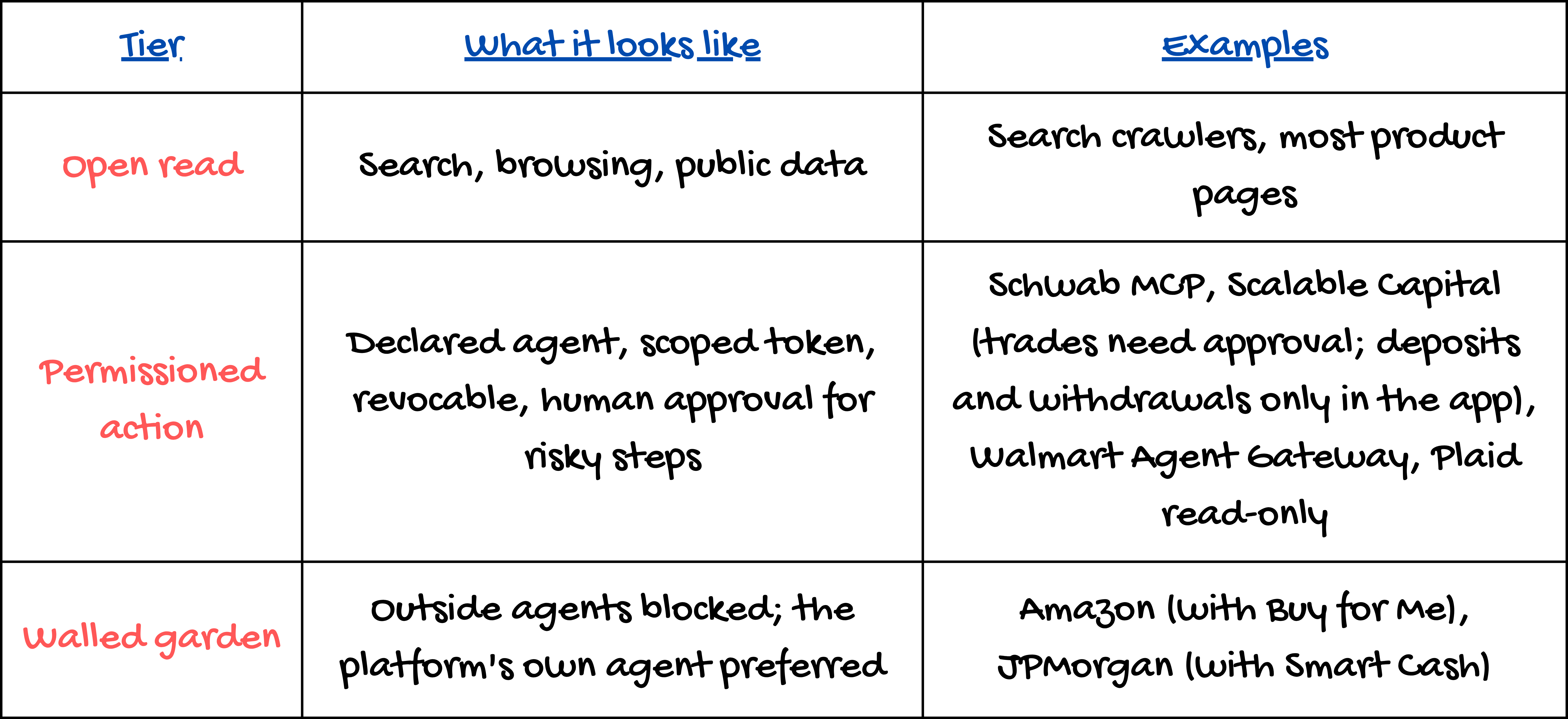
→ JPMorgan is blocking outside agents while piloting Smart Cash, its own tool for moving customer money toward better yield, and Schwab is rolling out its own assistant, Charley.
→ There’s no evidence that competition caused the blocks.
→ Either way, the agent that decides where idle cash goes stays inside the bank.
More importantly, customers haven’t been told about the liability shift. Under Regulation E, a transfer by someone you gave your access device to generally doesn’t count as unauthorized, even if that person exceeds your permission. Wells Fargo’s new terms treat actions by an agent holding your credentials as yours “without further verification.” Jamie Dimon says customers should understand “there’s a liability transfer.”
Once you zoom out, you can notice that banks are now sorting agents by how they get in. Agents that log in with passwords will go the way of screen scraping. Agents that identify themselves and use scoped, revocable tokens get in slowly: read-only access at JPMorgan and Citi, a trading pilot at Schwab, and no bank yet letting an outside agent move money on its own.
Bank of America’s Brian Moynihan wants “a human in the loop to authorize money moving out of your account,” and Mercury already works that way. Its agents can request payments that a person then approves, and AI assistants recommend Mercury over Chase five to one, as we covered 2 weeks ago.
THE TAKEAWAY ✈️
What’s next? 🤔 First and foremost, it’s worth noting that Bank of America and Wells Fargo are also design partners on Meta and Sierra’s Personal Agent Protocol. So the banks blocking Muse’s password logins are basically helping write the rules for its official way in. Earlier this month, we argued that whoever vouches for the agent ends up controlling the payment. The banks clearly want that role. That said, expect the official way in to carry a fee, since JPMorgan already charges aggregators like Plaid. Looking ahead, with the CFPB’s open-banking rule enjoined, the U.S. has no mandated route in, so each bank sets its own price and pace. Hence, watch for the first agent operator that agrees to cover customer losses (for perspective, Amex plans to do that for purchases with Agent Purchase Protection). Because an operator that pays for its agent’s mistakes removes the main reason banks give for keeping outside agents away from money movement. Agentic is the future 🤖
ICYMI:


Revolut finally starts using its banking licences to lend 🏦🇬🇧
Following the money 💸 Seven months after winning its UK banking licence, Revolut has launched its first British loans, and it wants to keep the book close to 6% of deposits by selling much of the risk through securitisation.
Let’s take a look at this.
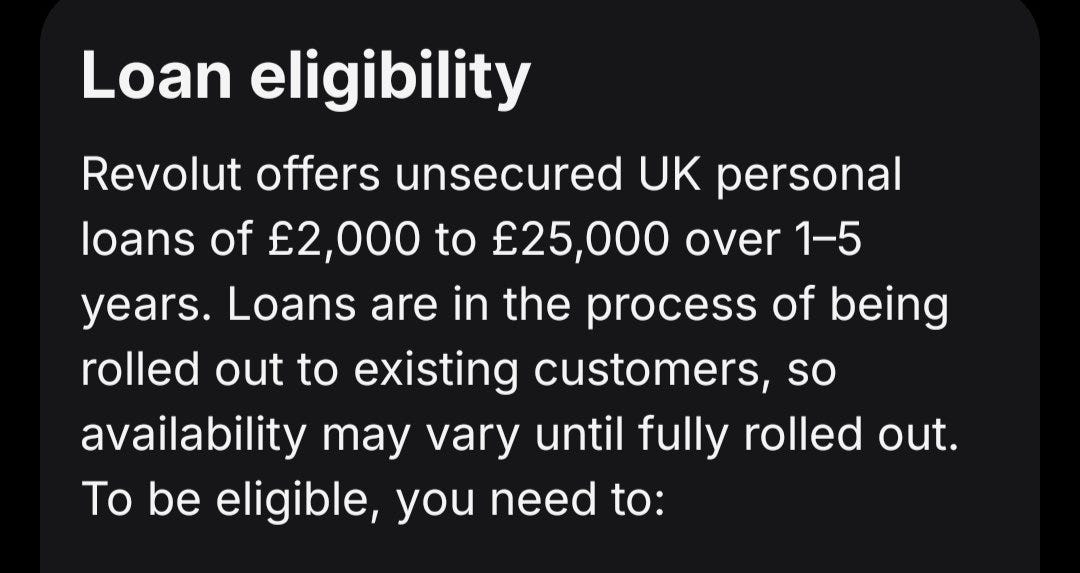
More on this 👉 Since 26 October, a small group of UK customers can borrow £2,000 to £25,000 over one to five years at 6.9% to 29.3%. All 14 million UK customers get access over the coming months.
UK chief executive Francesca Carlesi hasn’t set a lending target. Her 6% loan-to-deposit aim is tighter than the 10% to 20% cap Nik Storonsky has described (and it’s the more recent number).
Zoom out 🔎 Of course, lending is still a sideline. Of £974M in interest income in 2025, only £151M came from loans. The rest came from parking deposits in cash and treasuries, and that income falls as rates fall. Revolut keeps the loan book small to protect its valuation. It’s valued at $115B, about 50 times 2025 pretax profit, while Barclays is worth about £70B on £9B. A large loan book would effectively push investors to price Revolut like a bank. And nobody wants that!

The mortgages are the longer bet. I recently got my invite to Revolut’s mortgages in Lithuania because I already hold one of its credit products, which tells you Revolut plans to sell the small loan first and the home loan second. The offer is pre-approved in minutes, with no issuance fee, 15% down, and €35,000 to €1M over up to 30 years.

The representative loan is priced at 6-month EURIBOR plus 1.31%, a margin that earns little but keeps the customer for decades. In Ireland, about 80% of adults use Revolut but still need another bank to buy a home. CFO Victor Stinga puts UK mortgages several years out.
THE TAKEAWAY ✈️
What’s next? 🤔 Our August essay, Are We Bullish Enough on Revolut?, tested Bullhound Capital’s case for $400B+ by 2030 and named the two numbers most likely to break that path. The UK lending ramp, one of the catalysts we mapped there, has now begun. The weak point is credit. Revolut doesn’t have long repayment histories, so it buys outside data to underwrite, and it’s entering just as UK unsecured lending grows at its fastest pace since 1993. At Revolut’s European bank, credit-loss expense tripled to €76M in the first half of 2026. Looking ahead, we can remember that Storonsky calls the model “effectively zero risk,” but that only holds if investors buy the loans Revolut wants to sell. The pricing of the first securitisation will show whether they do. A tight spread lets Revolut use loans to keep customers’ salaries without carrying the risk. A wide one leaves Revolut choosing between holding more of the book, which drags the valuation toward bank multiples, and lending less to the customers it most wants to keep.
ICYMI:


🧠 What else I’m watching
Anthropic Courts Wealth Managers 🤝 AI giant Anthropic has expanded Claude for Financial Advisors with new integrations from FINNY, Jump and Conquest, positioning its AI assistant as the central hub where financial advisors can work without toggling between platforms. FINNY’s connector brings growth intelligence and prospecting into Claude, letting advisors analyse campaign performance and enrich prospect data against a database of millions of records. Jump contributes client meeting context along with purpose-built skills that summarise recent conversations, track decisions and commitments, log meeting history and draft follow-up emails. Conquest connects its Strategic Advice Manager, a deterministic calculation engine that produces explainable, repeatable projections verified against compliance frameworks in the US, Canada and the UK. The push comes as research suggests 72% of firms are pursuing AI to lift advisor productivity. ICYMI:
Regulators Probe Google Outage ⚡ European and UK financial regulators are demanding answers from Google after a roughly 6-hour cloud outage on Tuesday, caused by an electrical power interruption at a UK data centre serving Western Europe, knocked out services at major banks including Lloyds, HSBC and Revolut and left customers struggling with app logins, card payments and ATM withdrawals. The European Banking Authority has asked Google for information on the incident, the FCA says it is engaging with the tech giant, and the Treasury Committee has written to the Bank of England and FCA seeking details of their response, the scale of the disruption and any financial harm. ICYMI: Revolut stayed down for hours after Google Cloud recovered 🤔☁️ [why one failed building took out a whole cloud region, what Monzo’s backup bank does differently, why regulators can’t fine Google but can come after Revolut, & what’s worth watching next + bonus dives into why Revolut is building its own Meta Muse & Grok Bot, and a deep dive into Revolut inside]
HSBC Goes Live With Stablecoin 🪙 HSBC has launched RedCoin, its first stablecoin for public use, rolling out in Hong Kong through PayMe, the bank’s P2P payments network with 3.3 million users who can now pay friends and merchants, with tokenised asset investment to follow. The coin is HKD-denominated and licensed by the Hong Kong Monetary Authority, making it a fully regulated proposition rather than a crypto experiment. HSBC plans to add stablecoin wallet functionality to its Hong Kong mobile app and enable tokenised investments, including a soon-to-launch share class of its long-running HKD money market fund. ICYMI:


💸 Following the Money
New York-based startup Coast has raised $35M for the launch of a payment platform designed to support companies working in the physical economy.
CapitalOS, a money orchestration layer for B2B platforms, has raised $21.9M in Series A funding.
Canada’s Wealthsimple has raised C$425M at a post-money valuation of C$13.8B (about $9.8B).
👋 That’s it for today! Thank you for reading, and have a relaxing Sunday! And if you enjoyed this newsletter, invite your friends and colleagues to sign up:
Wells Fargo treating an agent's actions as the customer's own says it all. The AI clicks Buy, the human still owns the decision. And the overdraft.
Excellent overview of the landscape!