
The Android of Commerce - How Google Is Building the Interface Between AI & Money 🤖💸
FinTech is Eating the World, 18 February

Hey Everyone,
Good morning & happy Wednesday! Today’s issue is the best one yet as all eyes are on Google, which is quietly building the interface between AI and money (why recently introduced WebMCP is a game-changer, how it stacks perfectly into Google’s Android of Commerce playbook, things worth watching, what’s next for FinTechs/Banks/Payments companies, etc. + bonus deep dives into Google’s UCP, how I built an AI OS to run startup with Claude, and how AI is eating software today). So without further ado, let’s jump straight into the paradigm-defining stuff 🌶️
The Android of Commerce - How Google Is Building the Interface Between AI and Money 🤖💸

In five months, Google GOOGL 0.00%↑ shipped three open-source protocols that together form a complete operating system for AI agents to browse websites, buy things, and pay for them.
→ The Agent Payments Protocol arrived in September 2025.
→ The Universal Commerce Protocol launched at NRF in January 2026.
→ And on February 10, 2026, Chrome 146 Canary shipped WebMCP, a browser-native API that lets any website expose structured, callable tools directly to AI agents.
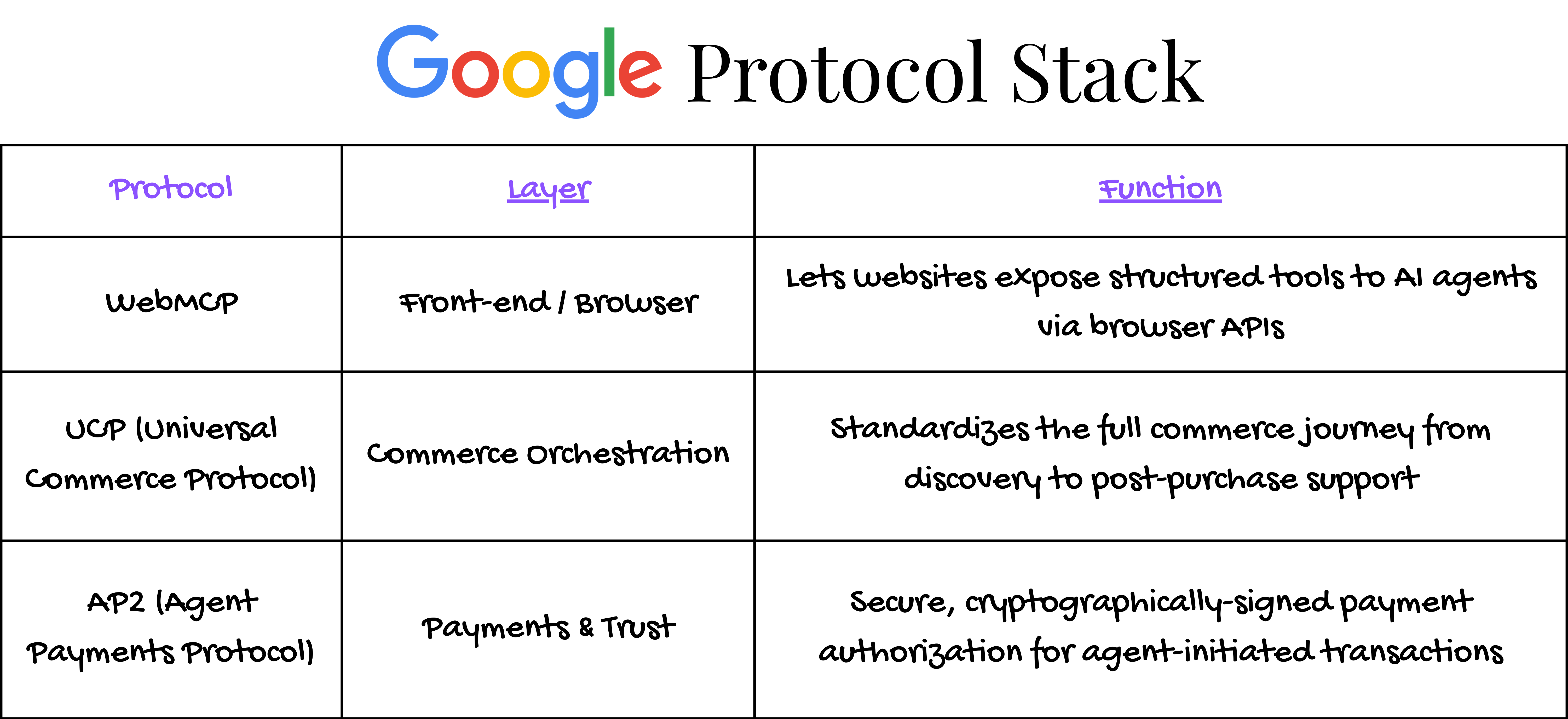
Each protocol solves a specific problem. Together, they solve a much bigger one: who controls the interface between artificial intelligence and money.
And the answer, unless something changes fast, is Google.
The standard reading of this story is all about efficiency. AI agents today interact with websites the way a tourist navigates a foreign city without speaking the language - taking screenshots, parsing HTML, guessing where to click. WebMCP replaces that guesswork with structured function calls, cutting computational overhead by roughly 67% and pushing task accuracy to around 98%.
That’s real. It matters at scale. But it’s not the story.
The story is that Google is running the Android playbook again.
→ Build the infrastructure.
→ Make it open.
→ Capture value through distribution and ecosystem control.
And this time, the stakes are higher, because the infrastructure isn’t just for phones. It’s for every transaction an AI agent will ever conduct on your behalf.
