
Productize Yourself 🧠
Naval Ravikant's framework for building a one-person company is the best startup strategy of 2026. Here's the operating system, and 13 AI prompts to run it 🚀

👋 Hey, Linas here! Welcome to another special issue of my daily newsletter. Each day, I focus on 3 stories that are making a difference in the financial technology space. Coupled with things worth watching & the most important money movements, it’s the only newsletter you need for all things when Finance meets Tech. If you’re reading this for the first time, it’s a brilliant opportunity to join a community of 370k+ FinTech leaders:
In 2012, legendary investor and entrepreneur Naval Ravikant told a room full of people that billion-dollar companies would soon be built by four or five people. The venture capital industry, he noted in that same breath, didn’t believe it. VCs still assumed the playbook was: raise hundreds of millions, hire thousands, build a campus. Facebook had just gone from a dorm room to a sprawling operation in under 8 years, and that was supposed to be the template for every ambitious startup that followed.
But Naval wasn’t making a prediction about startups.
He was describing the reversal of a 200-year organizational logic. The Industrial Revolution created economies of scale that rewarded mass. Mass production, mass employment, mass coordination. Companies got big because bigness was efficient.
Naval’s claim was that information technology had flipped that equation, and that the trend toward smaller, loosely coupled units was structural, not cyclical.
14 years later, and thanks to AI, the number isn’t 4 or 5. In many cases, it’s just one.

What makes this worth revisiting isn’t the vindication. Lots of people predicted small teams would matter more. What makes Naval’s framework truly worth studying is that he also described the operating system that those small teams would run on.
And that operating system turns out to be a better map for where economic value is migrating than most of what passes for strategy in venture capital or corporate planning.
The Two-Word Formula That Contains a Career Strategy
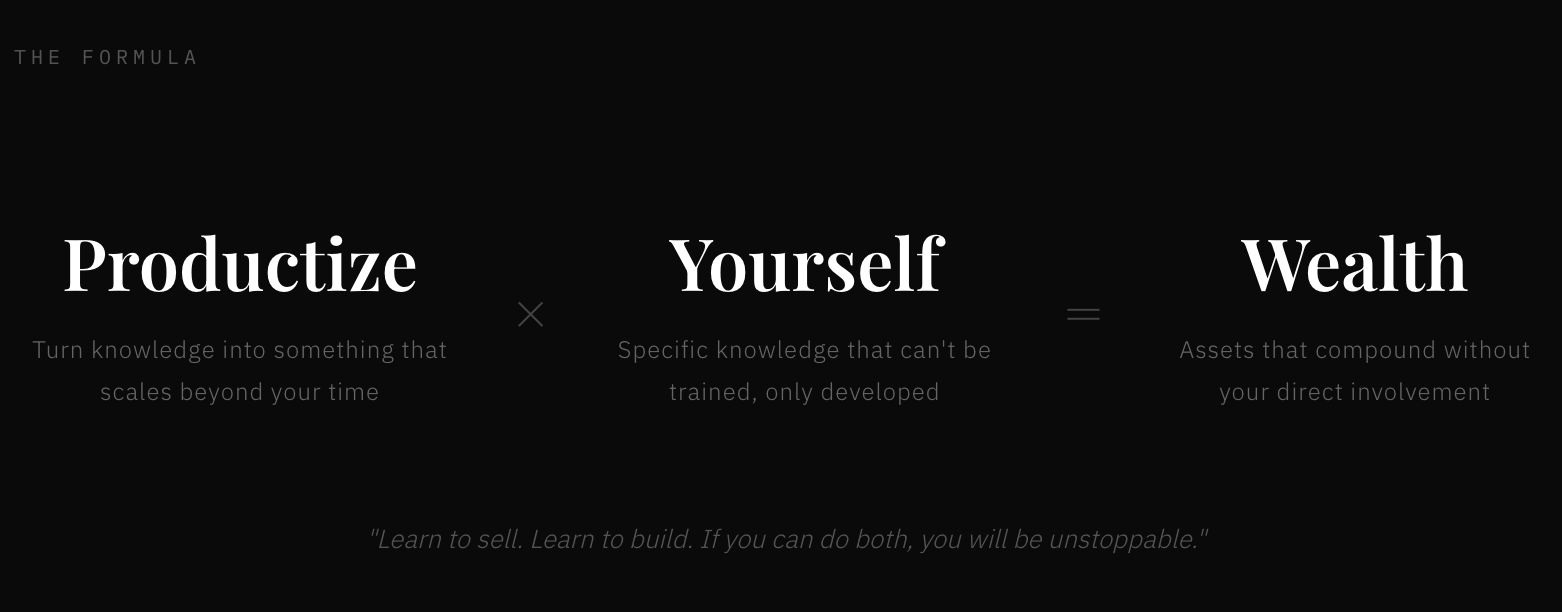
Naval compressed his philosophy into two words during an interview on Modern Wisdom: productize yourself. It sounds like the kind of thing you’d find on a motivational poster. But it’s actually a precise formula with two variables, and misunderstanding either one leads to a very different outcome.
Yourself refers to what Naval calls specific knowledge. Not skills you learned in school or credentials on your resume, but the accumulated pattern recognition that comes from living at a particular intersection of interests, obsessions, and experience. His test is direct: if society can train you for it, society can train someone cheaper. Specific knowledge tends to show up in unusual combinations. The person who understands both machine learning and supply chain logistics. The financial analyst who also has deep expertise in emerging-market regulation and can explain it clearly on camera. These aren’t job descriptions. They’re personal monopolies.
Productize is the leverage half. It means turning that irreplaceable knowledge into something that scales beyond your direct time. A piece of software. A body of content. A system that works while you’re asleep.
Without productization, specific knowledge makes you a well-paid consultant, still trading hours for dollars. Without specific knowledge, productization makes you a commodity operator running playbooks anyone could copy. The combination is where durable wealth gets created.
Naval sharpens this further: “Learn to sell. Learn to build. If you can do both, you will be unstoppable.”
Selling and building are the two fundamental expressions of leverage. Everything else in business, from management to strategy to operations, is downstream.
The Leverage Menu
Naval breaks leverage into four types, and the ordering isn’t arbitrary. It determines what kind of career or company you end up with.
→ Labor is the oldest form. Hire people, extend your output. It’s powerful but expensive, scales linearly with cost, and every additional person creates coordination overhead.
→ Capital is next. Use money to make money. Powerful when you have it, but access is gated. You need someone’s permission to start.
The two newer forms are what Naval keeps returning to, because they share a property the first two don’t: zero marginal cost of replication.
→ Code means software. Write it once, serve a million users at roughly the same cost as serving 10.
→ Media means content. Write, record, or publish once, and it can be consumed infinitely. Naval’s own X/Twitter thread “How to Get Rich (Without Getting Lucky),” written once in 2018, has been read by millions and still generates deal flow and opportunities years later. The thread itself is a proof of concept for media leverage.
Most aspiring entrepreneurs default to labor or capital first because those are the forms with the most cultural prestige and the longest history. But for someone trying to build alone or with a tiny team, code and media are far more accessible.
You don’t need permission. You don’t need funding. You need a laptop and consistency. The sequence matters more than most people realize.
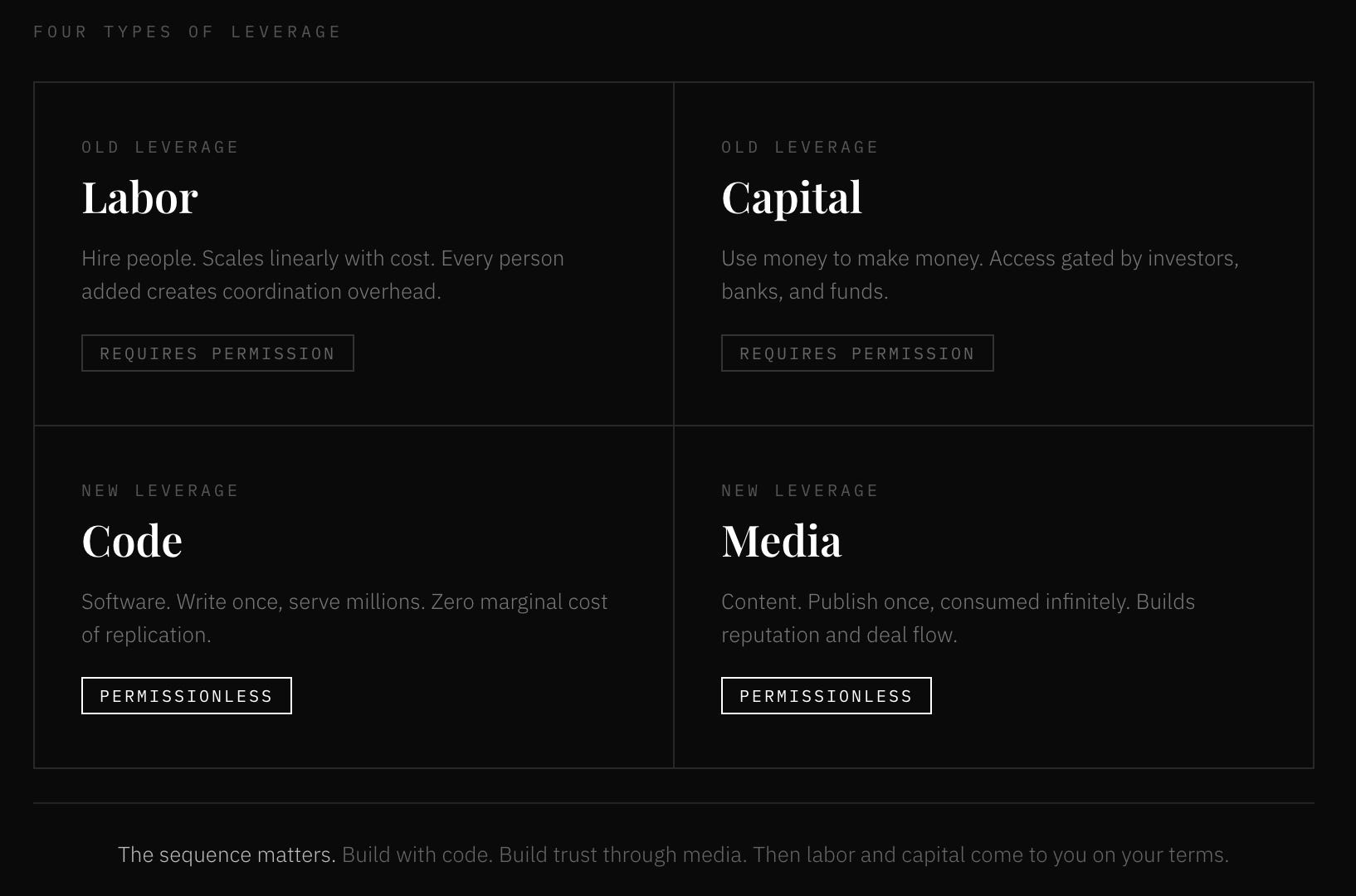
Build something with code. Build trust through media. Then labor wants to join you and capital wants to fund you, on your terms rather than theirs.
The Structural Shift That VCs Keep Misreading
Naval’s 2012 talk contained a specific challenge to venture capital orthodoxy. “The venture capital industry still believes that you’re gonna have to put a couple of hundred million dollars into some company at some point to continue scaling it,” he said. “I don’t think that’s true.”
His argument was that functions previously kept in-house would get outsourced through APIs and interfaces. Sales, revenue collection, bookkeeping, and early-stage hiring. The company of the future wouldn’t employ all these people. It would plug into services that handle them.
The API economy proved him right in the 2010s. Stripe handled payments. Twilio handled communications. AWS handled infrastructure. A startup in 2018 could access capabilities that would have required entire departments in 2008.
But the venture model didn’t meaningfully change. Funds still looked for companies that would absorb large checks, hire aggressively, and aim for the kind of scale that justifies a traditional exit.
AI has now pushed Naval’s thesis past the point where the old model can no longer ignore it. Design, copywriting, data analysis, code generation, legal research, financial modeling. These used to be headcount lines on a budget. Now they’re prompts. The person with deep knowledge of healthcare compliance can build the software tool themselves instead of hiring a development team. The person who understands a market can produce the content, the analysis, and the product without a staff.

Upwork data from recent surveys shows roughly 40% of U.S. freelancers report using AI tools in their work. The no-code and low-code platform market has grown alongside this, turning people who previously needed technical co-founders into people who can ship products alone. And the gap between having expertise and deploying it has collapsed, which is exactly what Naval predicted would happen when he talked about APIs and interfaces and loosely coupled small companies.
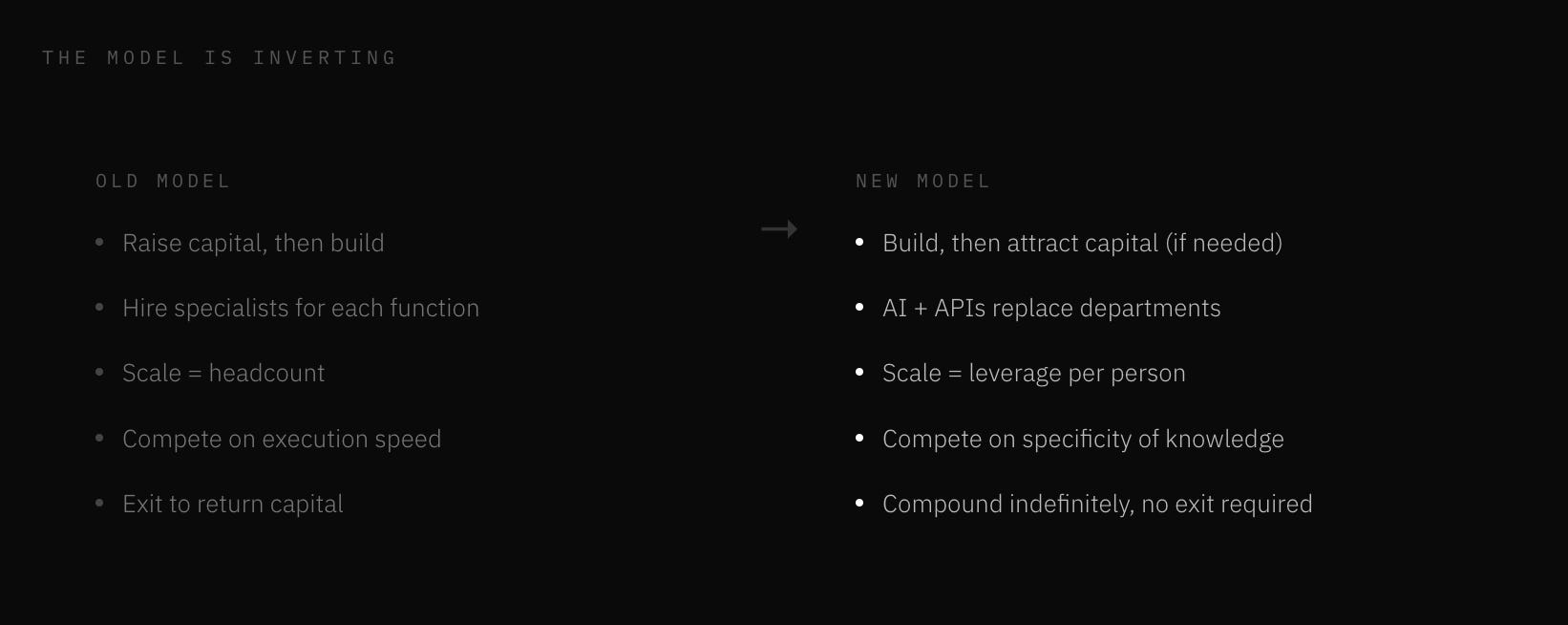
The implication for capital allocators is uncomfortable here. If the most capital-efficient companies are the ones built by one or two people with specific knowledge and AI-powered leverage, the traditional venture model of writing large checks for large teams solving large problems starts to look like it’s optimizing for the wrong variable.
The best new companies may not need your money. And if they don’t need your money, they don’t need your terms.
Competition as a Diagnostic
Naval’s line about competition is easy to dismiss as motivational fluff. “You escape competition through authenticity.” But applied to business strategy, it’s one of the sharper ideas in his framework.
If you’re competing directly with others on the same axis, you’re in a commoditized space. The way out isn’t to compete harder. It’s to recombine your skills until comparison becomes irrelevant. You don’t need to be the world’s best at any single thing. You need to combine capabilities in a way nobody else can replicate, because nobody else has your specific history.
Naval connects this to intrinsic motivation in a way that sounds soft but has hard strategic consequences. “Find what feels like play to you but looks like work to others,” he says. Not as a lifestyle hack, but as a competitive strategy.
If the thing you do effortlessly requires genuine effort from your competitors, you will outlast them. Not through discipline, but through endurance. You won’t burn out doing something that energizes you. They will, doing something that drains them. Research on intrinsic motivation and flow states, going back to Csikszentmihalyi’s work, supports this: intrinsic enjoyment correlates with higher productivity and persistence over time.
For solo operators, the usual advice is to find a niche. Naval’s version is more specific: find the niche that only you can occupy because of who you already are. Don’t manufacture a positioning. Discover the one that’s authentic, and then go narrower until you’re the obvious choice for a specific problem.
Wealth Creation vs. Wealth Capture
Naval draws a line between creating wealth and capturing it that shapes everything downstream.
Wealth creation is positive-sum. You make something new that people want. The pie gets bigger. Wealth capture is zero-sum. You take a slice of an existing pie.
Most of what looks like business is actually capture. Rent-seeking, middlemen extracting tolls, status games where one person’s gain is another’s loss. The one-person company, built right, is almost always a creation vehicle. You’re building a product, a tool, a body of work that adds value that didn’t exist before. Positive-sum games attract collaborators. Zero-sum games attract adversaries. The game you’re playing determines the people you attract.

Naval’s test for whether you’re creating or capturing: can this scale without my direct time? If yes, you’re building an asset. If no, you’re earning income.
Both have their place, but only assets compound. The solo consultant billing $500 an hour is capturing value, well, but linearly. The solo consultant who turns their methodology into software or a course has created something that scales independently.
Same knowledge, different leverage, different trajectory.
What This Means Going Forward
Three things to watch.
First, the definition of a “fundable” company is shifting. The best solo and micro-team operators are reaching revenue thresholds that used to require institutional backing, and they’re doing it without dilution. If this continues, expect a bifurcation in venture: large funds doubling down on capital-intensive sectors where scale still requires money (biotech, hardware, infrastructure), and a growing class of companies that simply opt out of the venture model entirely because they don’t need it.

Second, the polymath advantage is widening. The 2012 interview’s underlying assumption was that generalists who can ship and sell would beat specialists who can only do one. AI amplifies this asymmetry. A person with broad skills and AI tools can now cover ground that used to require a team of specialists. The counterargument, that deep expertise still wins, is valid in research-heavy or frontier-science domains. But for the vast middle of the economy, good-enough breadth plus AI is beating deep-but-narrow.
Third, the talent market is reorganizing. Naval described a future where people would wake up to job offers on their phones, pick the one they want, do it for a few days, get rated, and move on. We’re not there yet, but the trajectory toward more fluid, project-based, reputation-driven work is clear. The platforms that enable this kind of matching, especially with AI-verified skill signals, are likely to be some of the more consequential companies of the next decade (hint: another startup idea for 2026).
Naval didn’t design his framework as a startup playbook. He designed it as a life philosophy, organized around the idea that the best work comes from people who have figured out what only they can do and built systems to do it at scale. But it turns out that in 2026, the best life philosophy and the best business strategy converge on the same point.
The company of the future may not be a company at all. It may be a person with specific knowledge, the right leverage, and no reason to stop.
The Prompts: 13 Ways to Run Naval’s Operating System With AI

Reading about Naval’s framework is one thing. Running it on your own career is another.
I built 13 prompts, designed to work with Claude, that turn each piece of Naval’s philosophy into a working diagnostic you can use today.
Not motivational exercises. Structured tools that take your specific situation as input and produce an honest, personalized output.
Here’s what’s inside:
Find your edge. The Specific Knowledge Audit forces you to identify the 2-3 intersections in your background that nobody else combines. If your input is too generic, it tells you that too.
Pick your leverage. The Leverage Identification prompt rates your current access to code, media, labor, and capital on a 0-10 scale and tells you which to pursue first based on where you actually are, not where you wish you were.
Stress-test your opportunities. The Long-Term Games Validator scores any job, partnership, or project on five compounding dimensions and gives you a verdict: strong yes, conditional yes, or no.
Build the roadmap. The Productize Yourself prompt generates a 12-month plan, specific to your profile, that moves you from trading time for money to building assets that scale without you.
Escape competition. The Authenticity prompt maps your skill combinations, estimates how rare each intersection is, and crafts a positioning statement that makes you the obvious choice for a specific problem.
Plus eight more covering accountability, wealth creation vs. capture, niche selection, building in public, and Naval’s retirement test applied to your actual work life.
Each prompt is engineered for Claude with XML-tagged inputs, step-by-step reasoning, and anti-generic guardrails that push back if you’re being vague. They’re designed to chain together so the output of one feeds into the next.
To make this even more powerful, I’m also sharing the ultimate guide on how to turn Claude Sonnet 4.6 into a financial analyst that never sleeps, and how I built an AI operating system to run a startup with Claude. It has everything you need to build the one-person unicorn 🦄