
Sony’s stablecoin gambit to reshape entertainment payments 🪙🎮; Polymarket’s $1M mystery trader exposes prediction markets’ regulatory blind spot 😳📊; AI for wealth management? 🤔🤖
You're missing out big time... Weekly Recap 🔁

👋 Hey, Linas here! Welcome back to a 🔓 weekly free edition 🔓 of my daily newsletter. Each day, I focus on 3 stories that are making a difference in the financial technology space. Coupled with things worth watching & most important money movements, it’s the only newsletter you need for all things when Finance meets Tech.
If you’re not a subscriber, here’s what you missed this week:
The Ultimate List of Resources about Stablecoins 🪙 [your one-stop resource list for understanding the most disruptive force in global finance]
The Ultimate LLM Toolkit for Unleashing AI Innovation 🤖📚 [100+ battle‑tested tools and frameworks to accelerate your AI projects and stay ahead in the LLM race]
Agents 20: Top AI Agent Startups of 2025 🤖💸 [these AI Agent startups are defining 2025. Find who’s backing them, unlock their exclusive pitch decks, and learn from the best]
Revolut’s trillion-token reckoning signals a new era of AI Economics in FinTech 🤖📊 [what it’s all about & what it indicates about how FinTechs will be using AI in the future + bonus deep dive into Revolut inside]
Stripe’s strategic bet on becoming the financial backbone of the AI economy 💸🤖 [what the acquisition of Metronome is all about & how it stacks into Stripe’s bigger strategy, why the FinTech giant wants to own the full AI stack of financial services + bonus dives into Agentic Payments/Finance & the ultimate list of M&A resources to save you $$$]
From $5 billion to $11 billion in 60 days: inside the most aggressive valuation jump in FinTech history 🤯📈 [latest $1 billion fundraise & what it indicates, what to expect next + bonus deep dive into Robinhood and how it’s building the Nasdaq of Reality]
eToro, or social investing’s hidden gem trading at a discount 👀📉 [breaking down their most important 3Q 2025 financial facts & figures, understanding what they mean, and why eToro might be worth your time and money + bonus deep dive into Robinhood]
Klarna wants to challenge premium credit card giants with a debt-free membership model 🤔💳 [can it really challenge AmEx Platinum & Chase Sapphire Reserve with a debt-free membership model, why it matters + bonus deep dive into Klarna inside]
The Ultimate List of 790+ Seed Funds 💰 [a curated, data-rich directory built to save you weeks of research and help founders get in front of the right investors, faster]
How this AI startup sold compliance automation to VCs: the $14M pitch deck breakdown 💸🤖 [In the age of vibe coding, anyone can build an app. But can you keep it compliant with 50+ regulations without hiring an army of lawyers? Feroot bet $14M you can’t and won 👏]
The $400 billion problem nobody talks about: inside AI startup’s pitch to fix the internet 🤖🌐 [How Vibranium Labs is building the AI that prevents your 3 am wake-up calls 💤]
The 75% Problem, or How This AI Startup Raised $13M in One Week 💸🤖 [How ex-Monzo founders are automating the complex customer operations work financial services companies thought impossible 📈]
As for today, here are the 3 incredible FinTech stories that are transforming the world of financial technology as we know it. This was yet another wild week in the financial technology space, so make sure to check all the above stories.
Sony’s stablecoin gambit to reshape entertainment payments 🪙🎮

The news 🗞️ Sony Bank is preparing to launch a U.S. dollar-pegged stablecoin as early as fiscal 2026, marking one of the most significant entries by a global entertainment conglomerate into the digital currency space.
The initiative aims to enable American consumers to pay for PlayStation games, subscriptions, Crunchyroll anime, and other Sony digital content using blockchain-based payments rather than traditional credit cards.
Let’s take a look at this, understand why it matters, and what to expect next.
More on this 👉 The financial rationale is straightforward. Credit card processing fees typically range from 1.5% to 3.5% per transaction, and with Sony generating approximately $30 billion annually from U.S. customers, even modest fee reductions could translate to hundreds of millions in savings.
The stablecoin would be fully backed 1:1 by U.S. dollar reserves, mirroring established players like Circle’s USDC.
ICYMI: Circle’s 3Q 2025: minting dollars while printing questions 🤔💸 [deep dive into Circle’s 3Q 2025, breaking down the most financial facts & figures, and whether it’s worth your time and money in 2025 & beyond]
Zoom out 🔎 Sony Bank applied for a U.S. banking license with the Office of the Comptroller of the Currency in October 2025 and has partnered with Bastion, a stablecoin infrastructure provider backed by Coinbase Ventures and Sony’s own venture arm. The timing also perfectly aligns with the GENIUS Act, signed into law in July 2025, which established the first comprehensive federal framework for stablecoin issuance.
Zooming out, we must note that this initiative forms part of Sony’s broader Web3 strategy, which includes its Soneium blockchain network and the BlockBloom subsidiary focused on digital asset services. The September 2025 spin-off of Sony Financial Group provided the banking arm with greater strategic autonomy to pursue aggressive blockchain expansion.
THE TAKEAWAY ✈️
What’s next? 🤔 First and foremost, Sony’s move could establish a template for further corporate stablecoin adoption across the entertainment sector. If regulatory approval proceeds smoothly, competitors such as Microsoft and Nintendo may accelerate their own digital payment initiatives. More broadly, Sony’s success or failure will also serve as a critical test case for international firms seeking to operate under the new U.S. stablecoin framework, thus potentially reshaping how global entertainment companies approach payment infrastructure in the Web3 era. Stables are eating finance.
ICYMI:


Polymarket’s $1 million mystery trader exposes prediction markets’ regulatory blind spot 😳📊
Following the money 💸 A Polymarket trader operating under the handle “AlphaRaccoon” has recently ignited a firestorm of controversy after netting over $1 million in less than 24 hours through remarkably precise bets on Google’s 2025 Year in Search rankings.
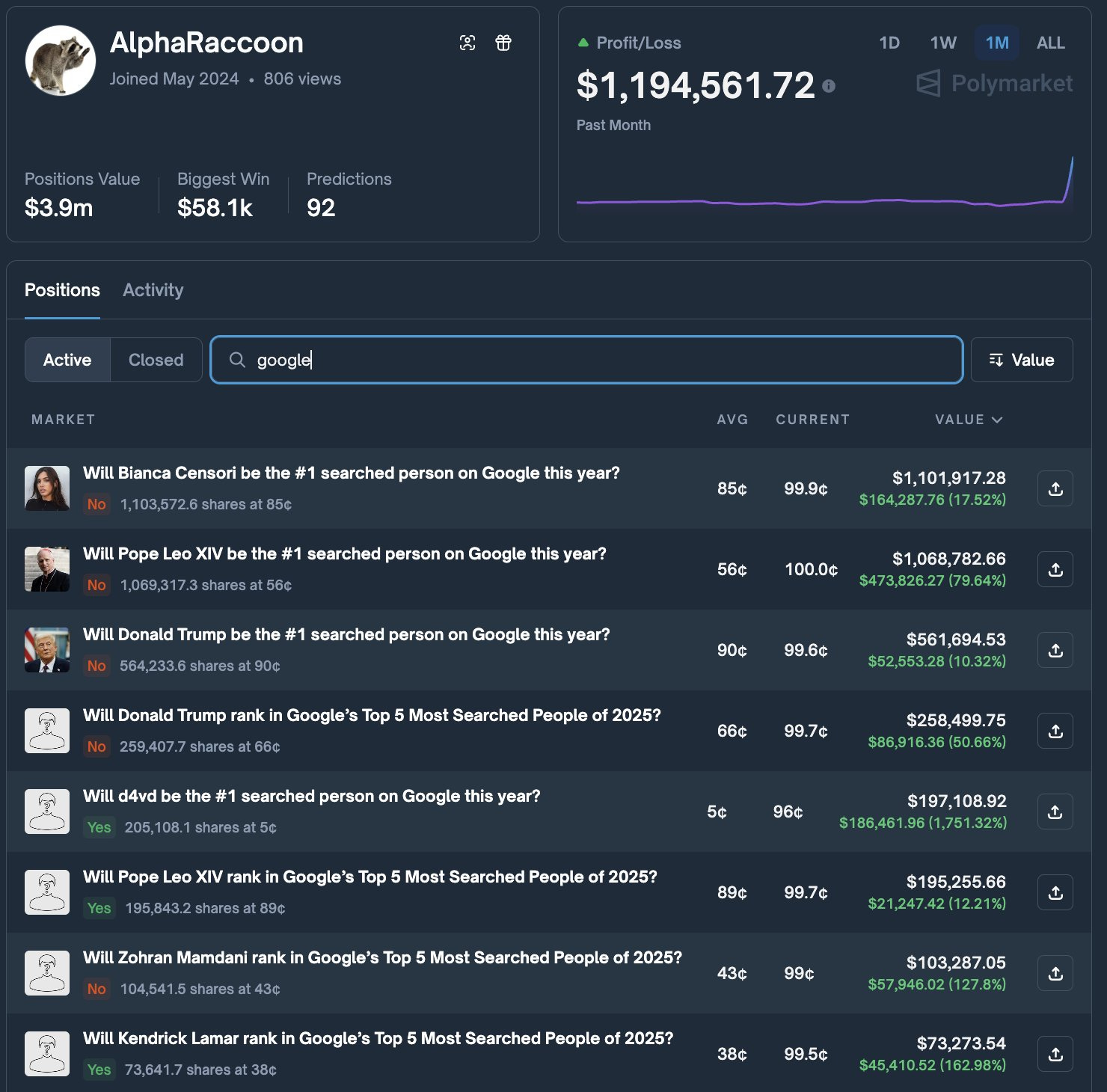
The trader correctly predicted 22 of 23 outcomes across highly specific markets, accumulating $3.9 million in open positions and prompting widespread accusations of insider trading.
Let’s take a look at this, uncover the key details, and see why it matters.
More on this 👉 The timing proved particularly suspicious. Google briefly published its Year in Search results early before retracting them within approximately 20 minutes. However, observers noted that AlphaRaccoon had placed bets before this public leak occurred. The trader wagered on granular outcomes, including whether musician d4vd would claim the top search spot, whether Pope Leo XIV would rank in the top five, and how various public figures would place in the rankings. One bet alone turned a $10,647 wager into $200,000.
The interesting part? This incident follows a troubling pattern. The same account allegedly earned over $150,000 in November 2025 by predicting the exact release date of Google’s Gemini 3.0 AI model.
Zoom out 🔎 The controversy arrives at an inopportune moment for Polymarket. Intercontinental Exchange recently invested $2 billion in the platform, valuing it at $8 billion. The company has secured partnerships with Yahoo Finance and integration into Google Search, positioning prediction markets as mainstream financial tools.
Yet this scandal exposes a fundamental regulatory gap: while the SEC prohibits insider trading in securities markets with penalties including prison time, the CFTC’s oversight of prediction markets contains no equivalent provisions. A corporate employee who would face criminal prosecution for trading company stock on material nonpublic information could theoretically exploit prediction markets with minimal legal risk.
And Polymarket’s decentralized architecture compounds the challenge. Smart contracts on the Polygon blockchain execute automatically, preventing the platform from reversing suspicious trades without undermining its core value proposition.
THE TAKEAWAY ✈️
What’s next? 🤔 This incident will likely only accelerate regulatory scrutiny of prediction markets. The CFTC may thus pursue expanded oversight mechanisms, potentially implementing surveillance requirements similar to traditional securities markets. Platforms may also preemptively develop AI-driven anomaly detection systems or restrict markets vulnerable to insider exploitation. For institutional investors, this case underscores that prediction markets, despite their promise as information aggregation tools, require significantly more mature integrity safeguards before they can reliably serve as solid financial instruments. We’re still early.
ICYMI: From $5 billion to $11 billion in 60 days: inside the most aggressive valuation jump in FinTech history 🤯📈 [latest $1 billion fundraise & what it indicates, what to expect next + bonus deep dive into Robinhood and how it’s building the Nasdaq of Reality]
AI for wealth management? 🤔🤖
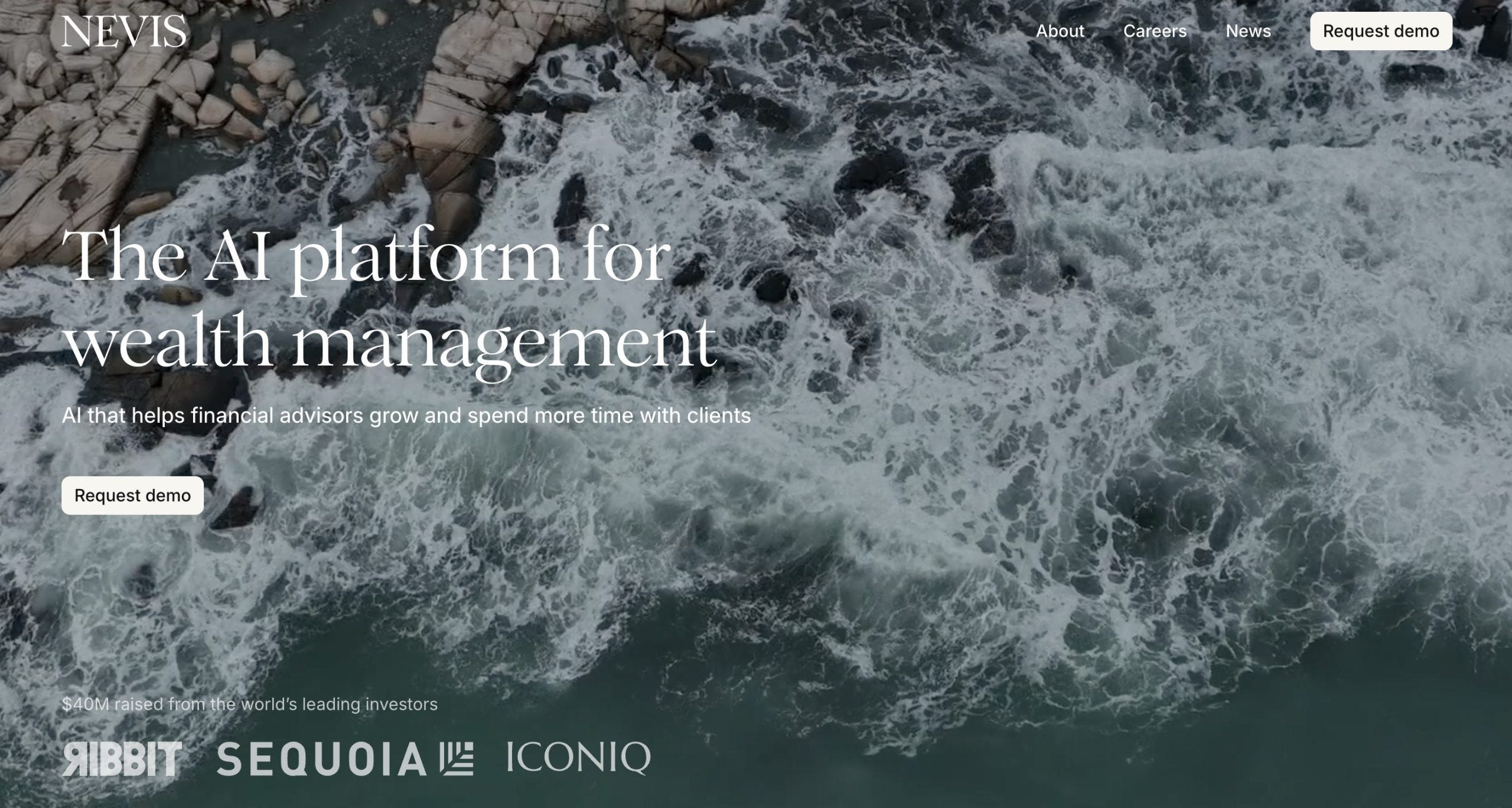
The news 🗞️ Nevis, a New York-based startup founded by former Revolut executives, has just emerged from stealth with $40 million in funding to deploy artificial intelligence across the wealth management industry.
The company’s $35 million Series A round, led by Sequoia Capital alongside Iconiq Capital and Ribbit Capital, values the firm at approximately $200 million - a notable achievement for a company founded less than a year ago.
Let’s take a quick look at this.
More on this 👉 The founding team of Mark Swan (CEO), Philipp Burda (CPO), and Ivan Chalov (COO) built their thesis around a contrarian view: while many predict AI will replace human financial advisors, Nevis believes the opposite. Swan, 27, even argues that human-led advice will become more valuable in an AI-dominated world, not less. His conviction stems from recognizing what the company calls the “80/20 problem” - financial advisors spend roughly 80% of their time on administrative tasks, leaving only 20% for meaningful client relationships.
Nevis positions itself as the first unified AI platform for wealth management, differentiating from competitors offering point solutions for specific tasks. The platform connects to an advisor’s existing technology stack - CRMs, email systems, custodian platforms, and document storage - and automates operational workflows end-to-end. Current capabilities include meeting preparation, personalized email drafting, follow-up task generation, and investment performance reporting, with account opening features planned for early 2026.
Zoom out 🔎 The company targets U.S.-based Registered Investment Advisors and has already signed approximately ten clients, including United Capital Financial Advisors and Apollon Wealth Management, collectively overseeing more than $50 billion in assets. Swan expects this figure to reach $100 billion in early 2026.
The timing also addresses a structural challenge: McKinsey predicts the U.S. wealth management industry will face a shortage of 100,000 advisors by 2034 as retirements outpace recruitment while demand for financial advice accelerates.
THE TAKEAWAY ✈️
What’s next? 🤔 First and foremost, Nevis’s trajectory suggests a broader shift in how AI integrates with professional services. Swan drew good parallels to legal technology, where Harvey recently achieved an $8 billion valuation, positioning wealth tech as the next sector ripe for similar disruption. If Nevis succeeds in demonstrating that AI augmentation increases advisor capacity without compromising client trust, expect accelerated consolidation among competing point solutions and increased pressure on legacy wealth management platforms to modernize. More importantly, the company’s emphasis on trust-first AI deployment may establish a template for how regulated industries adopt these technologies - enhancing rather than replacing human judgment in high-stakes decisions.
ICYMI:

🔎 What else I’m watching
Visa Expands Digital Wallets in Europe 💳 Visa is launching several digital wallet initiatives across Europe, following EU regulatory changes that allow NFC for third-party wallets. With mobile payments making up over half of e-commerce transactions and expected to grow, Visa’s projects include partnerships with BBVA Pay, Klarna, and Vipps Mobile Pay, as well as a pilot to expand Bancomat outside Italy. These efforts aim to increase choice and innovation in mobile wallets. ICYMI: Visa’s payment processing throne is a masterclass in network economics 👏😤 [deep dive into their 4Q 2025 earnings, breaking down the most important facts & figures, and what’s next for the payments heavyweight + bonus dives into Visa’s Trusted Agent Protocol & more reads on agentic finance inside]
Nomura and LSEG Integrate ChatGPT 📊 The London Stock Exchange Group (LSEG) is integrating its licensed data with ChatGPT to enhance insights and workflows for users. This initiative is part of LSEG’s broader AI strategy and includes partnerships with major tech firms. Meanwhile, Nomura is collaborating with OpenAI to leverage generative AI for advanced investment advice and market analysis, aiming to transform financial services and create new revenue opportunities. ICYMI:
RBC Aims for C$1B AI Value 💰 Royal Bank of Canada expects to generate up to C$1 billion in enterprise value from AI by 2027. The bank has launched several AI initiatives this year, including the proprietary Atom model for credit adjudication and loyalty program personalization. Despite offsetting investments in 2025, RBC is on track to meet its target, highlighting its commitment to AI innovation. ICYMI:


💸 Following the Money
NatWest is buying a minority stake in Bourn, a London-based small business financing fintech, according to Sky News.
Crypto exchange Kraken has agreed to acquire Backed Finance, the tokenized asset issuer behind its xStocks offering, tightening its grip on a segment that has become a fast-growing corner of digital assets as the exchange moves toward a planned 2026 IPO.
Axis has raised $5M in an oversubscribed private funding round as it prepares to launch an onchain yield protocol for USD, bitcoin, and gold.
👋 That’s it for today! Thank you for reading, and have a relaxing Sunday! And if you enjoyed this newsletter, invite your friends and colleagues to sign up:
This is great - thank you for sharing this one here, another fabulous read.