
Cross-border payments’ Kodak Moment? Visa embeds stablecoins into core rails 📸🪙; Coinbase's betting big on prediction markets infra 💸📈; London VC firm just made European venture capital history 🤯
You're missing out big time... Weekly Recap 🔁

👋 Hey, Linas here! Welcome back to a 🔓 weekly free edition 🔓 of my daily newsletter. Each day, I focus on 3 stories that are making a difference in the financial technology space. Coupled with things worth watching & most important money movements, it’s the only newsletter you need for all things when Finance meets Tech.
If you’re not a subscriber, here’s what you missed this week:
Top 10 AI Startups to Watch in 2026 🤖🦄 [Strategies, stories, and GTM blueprints from the fastest-growing AI companies that have collectively raised $500M+]
120+ AI Use Cases From Leading Startups & Internet Companies 🚀🧠 [Learn how real companies are using AI to ship products, cut costs, and change entire industries]
The Ultimate List of Resources about Stablecoins 🪙 [your one-stop resource list for understanding the most disruptive force in global finance]
The AI Leader Playbook 📚🧠 [A First-Principles Guide to Building AI-Powered Engineering Teams and Products]
Google’s Universal Commerce Protocol: the new default for how AI buys things 🤖🛍️ [2,000+ words dive into Universal Commerce Protocol (UCP), why it’s huge, how it changes everything, and how each player needs to adapt to the new AI-first economy + bonus list of top 10 AI startups to watch in 2026 & AI leader playbook inside]
OpenAI’s Platform Play: is it the end of finance apps as we know them? 🤔💸 [why it matters and what Generative UI is all about + bonus deep dive into OpenAI’s Super App ambitions & the top 10 AI startups to watch in 2026 inside]
The robo-advisor that actually makes money, or why Wealthfront’s unit economics could turn it into the Berkshire of millennial wealth 🤑📈 [deep dive into their Q3 2026 breaking down the most important financial facts & figures, what they mean, and why Wealthfront is worth your time & money in 2026 + bonus deep dives into competitors SoFi & Robinhood inside]
Trump’s credit card rate cap shakes Wall Street, but Klarna CEO sees opportunity 👀💳 [what’s happening, why it matters and what it could mean for banks, card companies & where’s the opportunity for FinTech + bonus deep dives into Klarna & SoFi inside, and why I’m bullish on both of them]
The Ultimate List of 340+ Real-World AI Systems 🧠⚙️ [How the world’s most important companies actually use AI - in products, payments, risk, healthcare, and everyday decisions]
The Ultimate AI Agent Stack 🤖📚 [The real operating system for AI agents, and the blueprints everyone serious about AI is already studying]
As for today, here are the 3 incredible FinTech stories that are transforming the world of financial technology as we know it. This was yet another wild week in the financial technology space, so make sure to check all the above stories.
Cross-border payments’ Kodak Moment? Visa embeds stablecoins into core rails 📸🪙

The news 🗞️ Finance giant Visa has just deepened its partnership with London-based BVNK to embed stablecoin capabilities directly into Visa Direct, its real-time payment network that moves approximately $1.7 trillion annually.
Let’s take a look at this, understand why it matters, and why it marks another shift for stables from experimental crypto rails to core infra.
More on this 👉 Under the partnership, BVNK will provide the technical backbone enabling businesses to fund payouts using stablecoins rather than traditional currencies, and to deliver payments straight to recipients’ digital wallets. The arrangement builds on Visa Ventures’ strategic investment in BVNK from May 2025, signaling a deepening commitment rather than a tentative pilot.
The practical appeal here is more than straightforward. Traditional cross-border payments often face delays, high fees, and limited availability outside banking hours. Stablecoin rails operate continuously, settling transactions in seconds rather than days. For gig economy platforms paying international contractors or e-commerce companies settling supplier invoices, this represents a meaningful operational improvement.
One must note that merchants and end users need not interact with cryptocurrency directly. Visa and BVNK handle the blockchain complexity behind the scenes, allowing businesses to experience what feels like a standard Visa transaction while benefiting from blockchain efficiency.
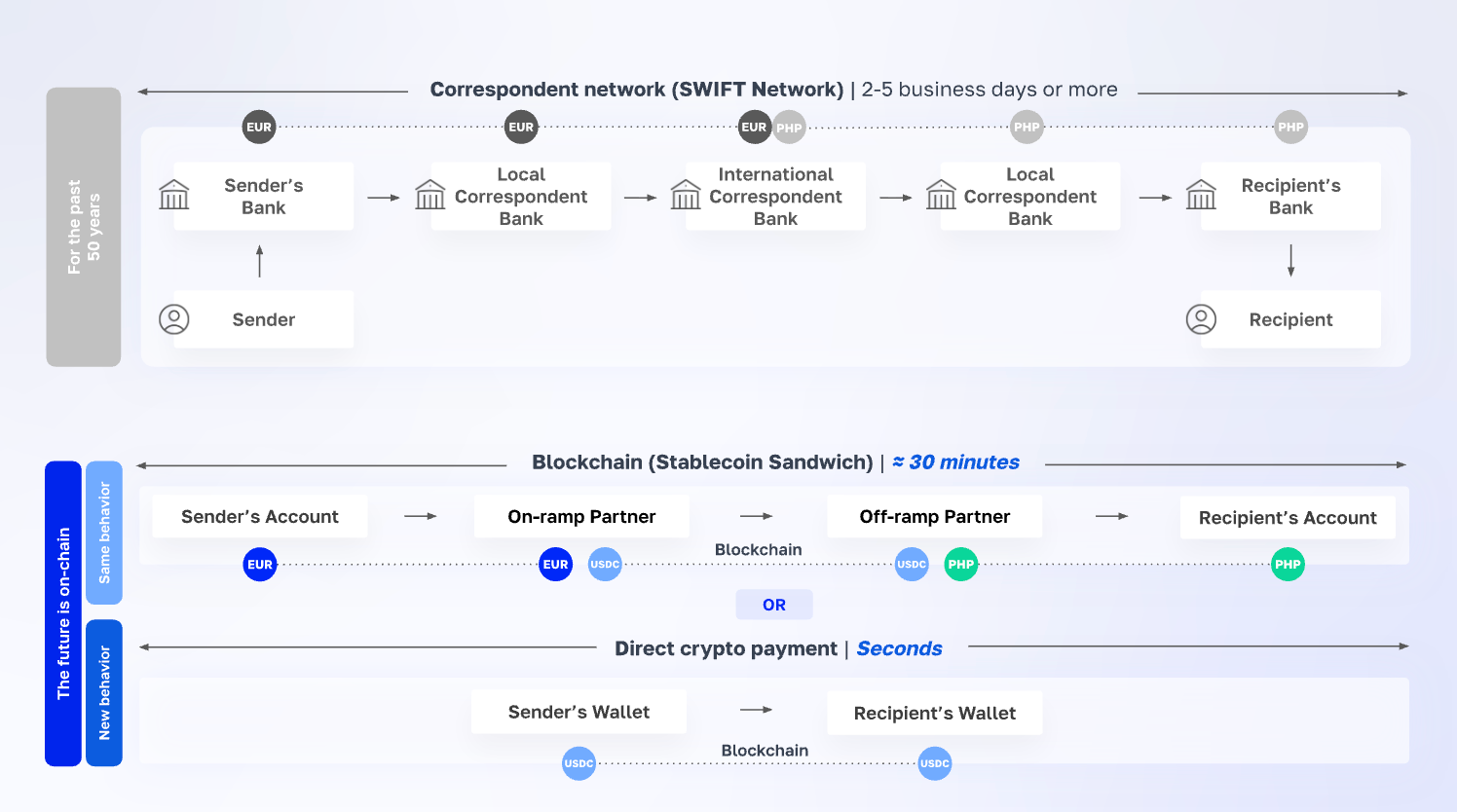
This “stablecoin sandwich” approach - fiat in, stablecoin transfer, fiat out - removes friction without demanding technical sophistication from users.
THE TAKEAWAY ✈️
What’s next? 🤔 This deal yet again signals that stablecoins have crossed a threshold from questionable instruments to legitimate payment infrastructure. For Visa, success here could accelerate transformation from a card-centric network into a multi-asset payment orchestrator (or the Network of Networks), well-positioned against FinTech challengers and crypto-native competitors alike. Zooming out, the broader implications are also substantial. Competing networks like Mastercard will face pressure to develop similar capabilities (though it has been having discussions and/or M&A interests in stables infra startups). Banks must now develop coherent stablecoin strategies or risk disintermediation in cross-border corridors. Meanwhile, regulatory frameworks like Europe’s MiCA are creating clearer rules that favor transparent, fully-backed stablecoins, precisely the segment this partnership targets. If it succeeds, expect stablecoins to capture a meaningful share of global cross-border payments within this decade, fundamentally reshaping how money moves internationally.
ICYMI: Visa’s payment processing throne is a masterclass in network economics 👏😤 [deep dive into their 4Q 2025 earnings, breaking down the most important facts & figures, and what’s next for the payments heavyweight + bonus dives into Visa’s Trusted Agent Protocol & more reads on agentic finance inside]

Coinbase is betting big on prediction markets infrastructure 💸📈
The news 🗞️ Right before the end of last year, digital assets giant Coinbase made a quiet yet very important acquisition. It bought The Clearing Company, and this marks a strategic infrastructure play in the exploding prediction markets sector, which grew from under $100 million in monthly volumes in early 2024 to over $13 billion by November 2025.

The deal, expected to close this month, gives Coinbase control over the backend technology that powers event-based trading - from elections to sports to macroeconomic outcomes.
Let’s take a look at this.
More on this 👉 The Clearing Company (which is Coinbase’s 10th M&A in 2026) isn’t a consumer app - it’s the plumbing that makes prediction markets work. Founded by Toni Gemayel, who previously led growth at both Polymarket and Kalshi, the startup uses blockchain to settle trades instantly in stablecoins rather than the traditional 2-day settlement cycle. This aligns perfectly with Coinbase’s $355 million quarterly USDC revenue and its “Everything Exchange” strategy to blend crypto, stocks, and prediction markets into one seamless platform.
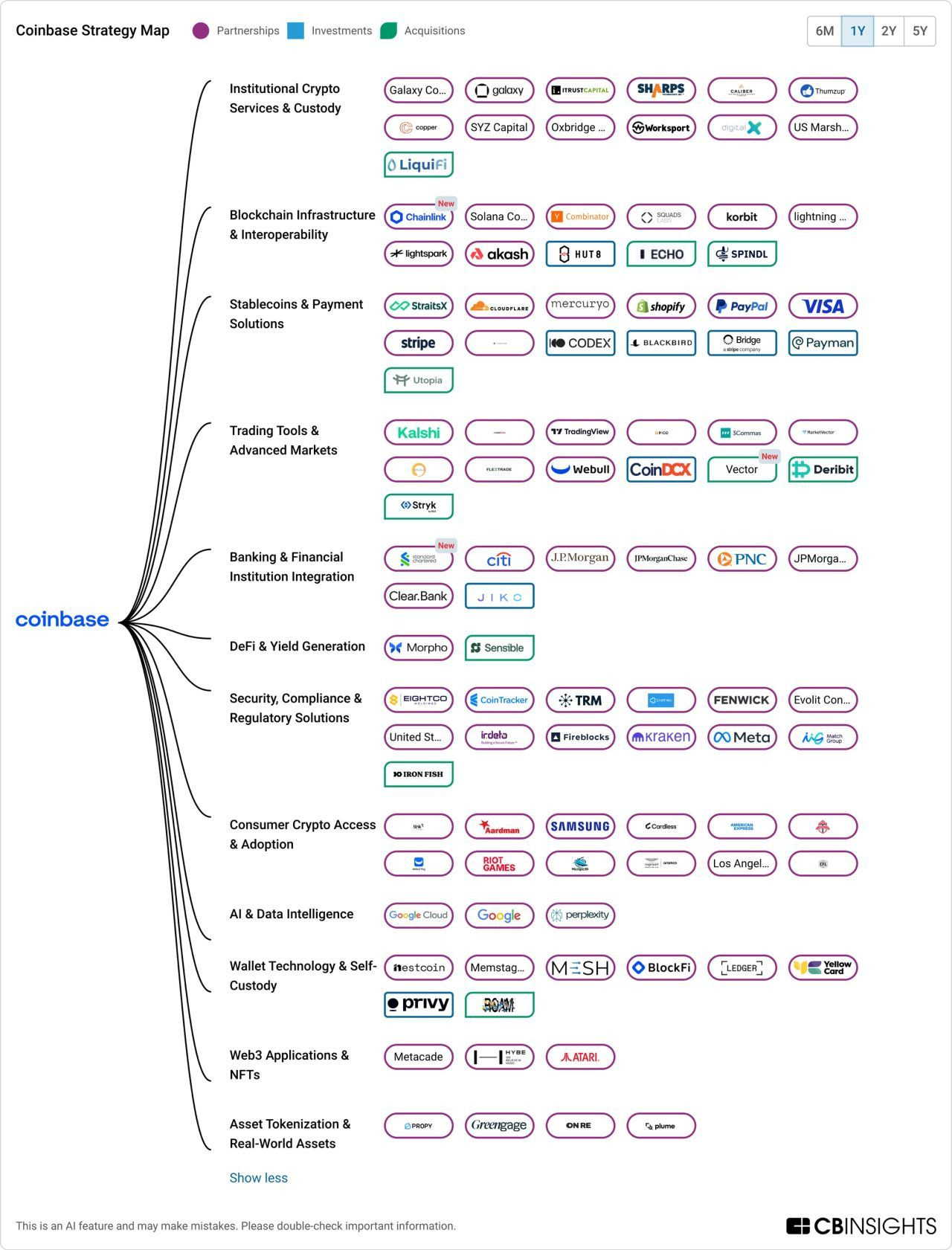
More importantly, The Clearing Company applied for CFTC clearinghouse and exchange licenses, targeting a late 2026 launch. This regulatory infrastructure lets Coinbase operate prediction markets under full U.S. compliance while building proprietary markets beyond its current Kalshi partnership. By owning the clearing layer, Coinbase can control economics and potentially sell backend services to other brokerages, thus mirroring how Nasdaq evolved from an exchange to a market infrastructure provider. Huge W.
Zoom out 🔎 Prediction markets generated $44 billion in 2025 volume and could reach $2 billion in annual revenue, with 5x growth projected by 2030. But Coinbase faces intense competition. Robinhood launched prediction markets a year earlier and already has 1 million+ traders generating $100M in annualized revenue (its highest-growing business segment now). Kalshi dominates with 62% market share and $4.54 billion in November volume, while Polymarket follows as close second.
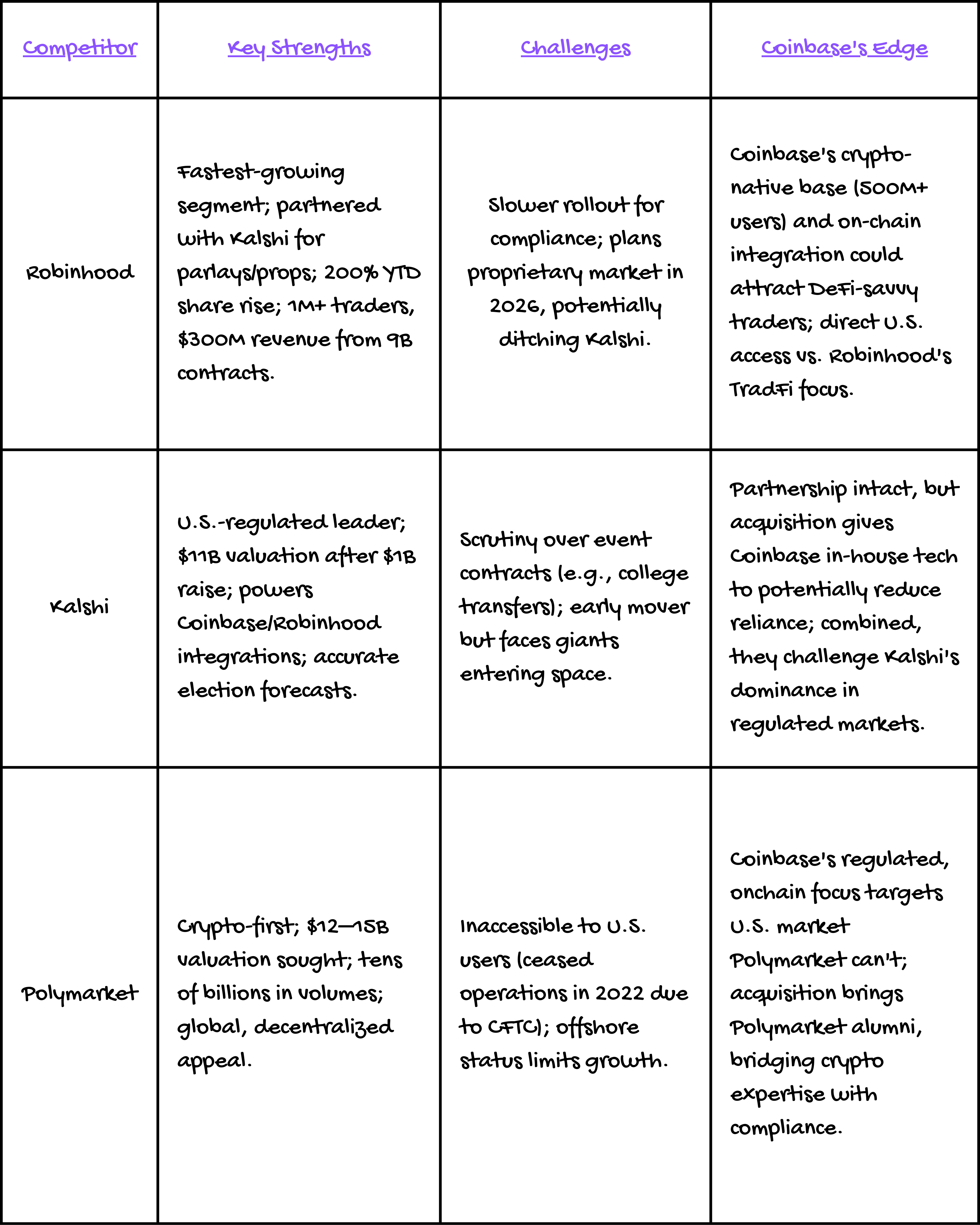
Yet, the catch is this: only 37% of Coinbase users plan to allocate new capital to prediction markets versus 50% for Robinhood users, raising concerns about cannibalization of higher-margin crypto trading. Robinhood’s 200%+ stock gain in 2025 - partly fueled by prediction markets success - shows the stakes are really high here.
THE TAKEAWAY ✈️
What’s next? 🤔 First and foremost, for Coinbase, this acquisition accelerates its shift from crypto exchange to financial infrastructure provider. Integration with its Base blockchain could enable onchain prediction markets with full transparency, creating a hybrid between regulated TradFi markets and permissionless DeFi - something neither Kalshi nor Polymarket can easily replicate. Zooming out, Coinbase’s entry with regulated clearing infrastructure yet again validates prediction markets as a legitimate asset class ready for institutional adoption. The sector is transitioning from niche speculation to core financial infrastructure, with major players like Robinhood, Coinbase, and traditional sportsbooks all competing for market share. The critical thing here (as always) will be regulatory uncertainty - particularly state challenges to CFTC-regulated sports betting - and whether Coinbase can convert its crypto-native users to multi-asset traders fast enough to compete with Robinhood’s momentum. If The Clearing Company secures its CFTC licenses by late 2026 and Coinbase successfully scales proprietary markets, this $15 million seed-stage acquisition could position the company as the dominant infrastructure provider in a multi-billion-dollar market. That said, the real bet here isn’t on NFL games - it’s on blockchain-based settlement infrastructure outcompeting legacy financial systems. And Coinbase wants to own this.
ICYMI: Inside Coinbase’s blueprint to become the Operating System for Global Finance ⚙️💸 [unpacking their System Update 2025 event, key new products/features and why they matter + bonus deep dive into Coinbase’s latest financials & their pitch deck teardown that started it all inside]
Robinhood is building the Nasdaq of Reality, where every headline becomes a trade 🤑📈 [why the latest M&A of LedgerX is a masterstroke and how it ties into their bigger vision in the space + bonus deep dive into Robinhood’s latest financials, why I’m bullish & more reads on their biggest competitor Coinbase inside]
A London VC firm just made European venture capital history 🤯💸
Following the money 💸 According to FT reports, Balderton Capital has recently transformed a modest £1 million seed investment into one of the most spectacular returns in European venture capital, yet again proving that world-class startup wins aren’t exclusive to Silicon Valley.
Let’s take a quick look at this.
More on this 👉 The London-based firm led Revolut’s first external funding round in 2015, when the digital banking startup was valued at just £6.7 million. A decade later, Revolut commands a $75 billion valuation, making it Europe’s most valuable private technology company.
Balderton has already cashed out approximately $2B from its stake over the past year while retaining a significant ownership position worth billions more. Let that sink in 😳

The investment resided in Balderton’s fifth fund, a $305 million vehicle that has now returned more than 25 times its original capital to investors. This performance places it among the top-performing venture funds globally, rivaling legendary American deals.
Zoom out 🔎 But what makes this success particularly noteworthy is the strategic conviction behind it.
Tim Bunting, the former Goldman Sachs partner who championed the investment, recognized that Europe held a competitive advantage in FinTech at a time when the continent had ceded ground to American tech giants in other sectors. Fund 5 allocated nearly half its capital to financial technology - an unusually concentrated bet that paid off dramatically.
Balderton’s winning streak therefore extends beyond Revolut. The firm has recently celebrated exits, including GoCardless’s $1.1 billion sale and Dream Games reaching a $5 billion valuation. Portfolio companies like autonomous driving firm Wayve and drone manufacturer Quantum Systems continue gaining momentum.
ICYMI: Mollie seals GoCardless takeover, creating European payments powerhouse to rival Stripe and Adyen 💳🇪🇺 [what it’s all about & why it makes a ton of sense + bonus dive into Stripe’s recent M&A game, and how they want to own the full AI payments stack]
THE TAKEAWAY ✈️
What’s next? 🤔 At the core, these whopping returns demonstrate that patient, thesis-driven investing can yield returns comparable to America’s best, thus potentially attracting more institutional capital to European startups. More importantly, the success also validates FinTech as Europe’s breakthrough sector. With Revolut eyeing a potential IPO within two years - likely favoring a US listing - and competitors like Monzo following similar trajectories, Europe may finally witness an unprecedented wave of public offerings that could reshape perception of the region’s tech ecosystem. Zooming out and thinking about emerging founders, the message is clear: Europe can build and scale world-class technology companies. For investors, Balderton’s playbook suggests that sector conviction and founder quality matter more than geographic proximity to Sand Hill Road. LFG! 🇪🇺🚀
ICYMI: Revolut’s first seed pitch deck that started it all.
What else I’m watching
PayPal Enhances Ad Platform 📊 PayPal has boosted its advertising platform with a new program that provides a cross-merchant view of real shopper behavior, campaign effectiveness, and data-driven recommendations. Leveraging its transaction data, PayPal aims to help merchants better target their ads. The Transaction Graph Insights & Measurement program offers a full-funnel view of actual purchase behavior, connecting search, shop, and share signals across over 430M consumer accounts and tens of millions of merchants. This allows brands to identify high-intent shoppers, understand true category market share, and measure real sales lift rather than relying on modeled estimates. ICYMI: PayPal doubles down on Agentic Commerce as it aims to become the trust layer for AI Shopping 🤖🛍️ [why their Microsoft Copilot Checkout partnership could be huge & what’s next for agentic commerce + bonus deep dives into PayPal, PayPal Bank and the 120+ AI use cases from the world’s leading startups & top internet companies inside]
Klarna Enters P2P Payments 💸 Klarna has launched instant peer-to-peer payments in 13 European countries, allowing users to send money to friends and family directly from the Klarna app. This move positions Klarna as a central hub for daily spending and money management. Users can send money via phone number, email, QR code, or saved contact, with fraud and eligibility checks in place. Initially, transfers are between Klarna users, with plans to expand to non-Klarna customers and cross-border payments. CEO Sebastian Siemiatkowski emphasizes the goal of making money management quicker, easier, and cheaper. Klarna is also exploring stablecoin-based options for money transfers. ICYMI: Trump’s credit card rate cap shakes Wall Street, but Klarna CEO sees opportunity 👀💳 [what’s happening, why it matters and what it could mean for banks, card companies & where’s the opportunity for FinTech + bonus deep dives into Klarna & SoFi inside, and why I’m bullish on both of them]
Keye Launches AI Co-Pilot 🤖 Keye has launched Odin, an AI co-pilot designed for private equity due diligence. Odin allows deal teams to ask questions in plain English and receive deterministic, audit-ready analysis instantly. Powered by Keye’s proprietary technology, Deterministic Creativity, Odin combines natural-language understanding with code-based execution, ensuring zero hallucinations, complete transparency, and repeatable outputs. The platform also includes codified investor intuition, embedding heuristics, pattern recognition, and risk-assessment logic used by experienced professionals. ICYMI:

💸 Following the Money
OpenAI acquired health-care technology startup Torch for $60M, source says. Torch was building a “unified medical memory” for AI that aimed to bring a patient’s health data into one place. ICYMI: OpenAI did what Apple couldn’t, and now it’s coming for Everything Else ❤️📱[why it’s bigger than health, what’s next & why FinTechs should pay close attention here + bonus deep dive into OpenAI’s Super App strategy and The AI Leaders Playbook inside]
Polygon Labs to acquire Coinme and Sequence for over $250M.
Alpaca, a full-stack global brokerage infrastructure provider, has raised $150M at $1.15B valuation in a Series D funding round led by Drive Capital.
👋 That’s it for today! Thank you for reading, and have a relaxing Sunday! And if you enjoyed this newsletter, invite your friends and colleagues to sign up:
Loved this recap. The common thread is the unsexy part winning: plumbing. Visa + BVNK is basically “stablecoin sandwich” settlement hiding the crypto UX, which is exactly how new rails go mainstream. Coinbase buying the clearing layer is the same move in markets: own the settlement and compliance stack, not just the front-end app. And the Balderton-Revolut story is a reminder that Europe’s edge has been FinTech when it commits to a thesis and holds through cycles.
Curious how you see the next bottleneck: regulatory clarity (MiCA, CFTC), liquidity and on/off-ramps, or distribution (incumbents embedding vs crypto-native scaling)?
This is free?! Epic stuff - thx.