
Musk’s $1.25T merger is either a bailout or a moat - possibly both 👨🚀🤖; OpenAI’s social network is a Trojan Horse for owning the AI era identity 🐴🪪; PicPay’s $2.5B IPO 🔔🇧🇷
You're missing out big time... Weekly Recap 🔁

👋 Hey, Linas here! Welcome back to a 🔓 weekly free edition 🔓 of my daily newsletter. Each day, I focus on 3 stories that are making a difference in the financial technology space. Coupled with things worth watching & most important money movements, it’s the only newsletter you need for all things when Finance meets Tech.
If you’re not a subscriber, here’s what you missed this week:
The One-Person Unicorn 🦄 [I built an AI operating system to run a startup with Claude]
AI Just Killed the User Interface 🧠🖥️ [Anthropic AI launched an app layer inside Claude, & it changed the role of SaaS entirely]
The Agentic Singularity 🤖🌀 [Deconstructing OpenAI’s operating system strategy and the eclipse of the application era]
Software Ate the World. Is AI Eating Software Now? 🤖 [Wall Street is pricing the death of SaaS when it should be pricing the death of the middleman]
The Stock Picks That Quietly Beat the Market (Again) 📈💸 [My 2025 portfolio outperformed the S&P 500 by 2× and surpassed most top hedge funds. Here’s how each company actually performed & what it means for investing in 2026]
The Institutionalization of FinTech 💳🏦 [Capital One bought Brex for $5B. Ramp is worth $32B. What happened? 🤔]
World’s Tollbooth: Visa’s unbeatable moat justifies premium valuation, but upside is limited 🤷♂️💳 [breaking down the most important Q1 2026 financial facts & figures, understanding what they mean, and what’s next for Visa]
Google’s Universal Commerce Protocol: the new default for how AI buys things 🤖🛍️ [2,000+ words dive into Universal Commerce Protocol (UCP), why it’s huge, how it changes everything, and how each player needs to adapt to the new AI-first economy + bonus list of top 10 AI startups to watch in 2026 & AI leader playbook inside]
Permanent Number Two: Mastercard’s quality is unquestionable, but so is the valuation 🤔📈 [deep dive into their Q4 2026, what stood out and whether Mastercard is worth your time & money in the years to come]
The most important post-mortem in FinTech 😳💸 [breaking down former PayPal CEO’s brilliant take on what happened to PayPal, why the company is struggling & what’s next]
Top 10 AI Startups to Watch in 2026 🤖🦄 [Strategies, stories, and GTM blueprints from the fastest-growing AI companies that have collectively raised $500M+]
The AI Leader Playbook 📚🧠 [A First-Principles Guide to Building AI-Powered Engineering Teams and Products]
As for today, here are the 3 fascinating FinTech stories that are changing the world of financial technology as we know it. This was yet another solid week in the financial technology space, so make sure to check all the above stories.
Musk’s $1.25 trillion merger is either a bailout or a moat - possibly both 👨🚀🤖
The BIG News 🗞️ Elon Musk just negotiated the largest private acquisition in history with himself - SpaceX officially acquired artificial intelligence startup xAI for $250 billion to create a $1.25 trillion space and AI powerhouse.
The cynical read is obvious. The interesting question is whether that’s the complete story.
Let’s unpack this, understand why it matters, and what’s next.
More on this 👉 SpaceX announced Monday it would acquire xAI in an all-stock transaction valuing the combined entity at $1.25 trillion. SpaceX gets marked up to $1 trillion from its December valuation of $800 billion. xAI slides in at $250 billion, unchanged from its January funding round.
The deal dilutes SpaceX’s longtime backers by roughly 20% to accommodate xAI shareholders, who gain access to a June IPO that could raise $50 billion.
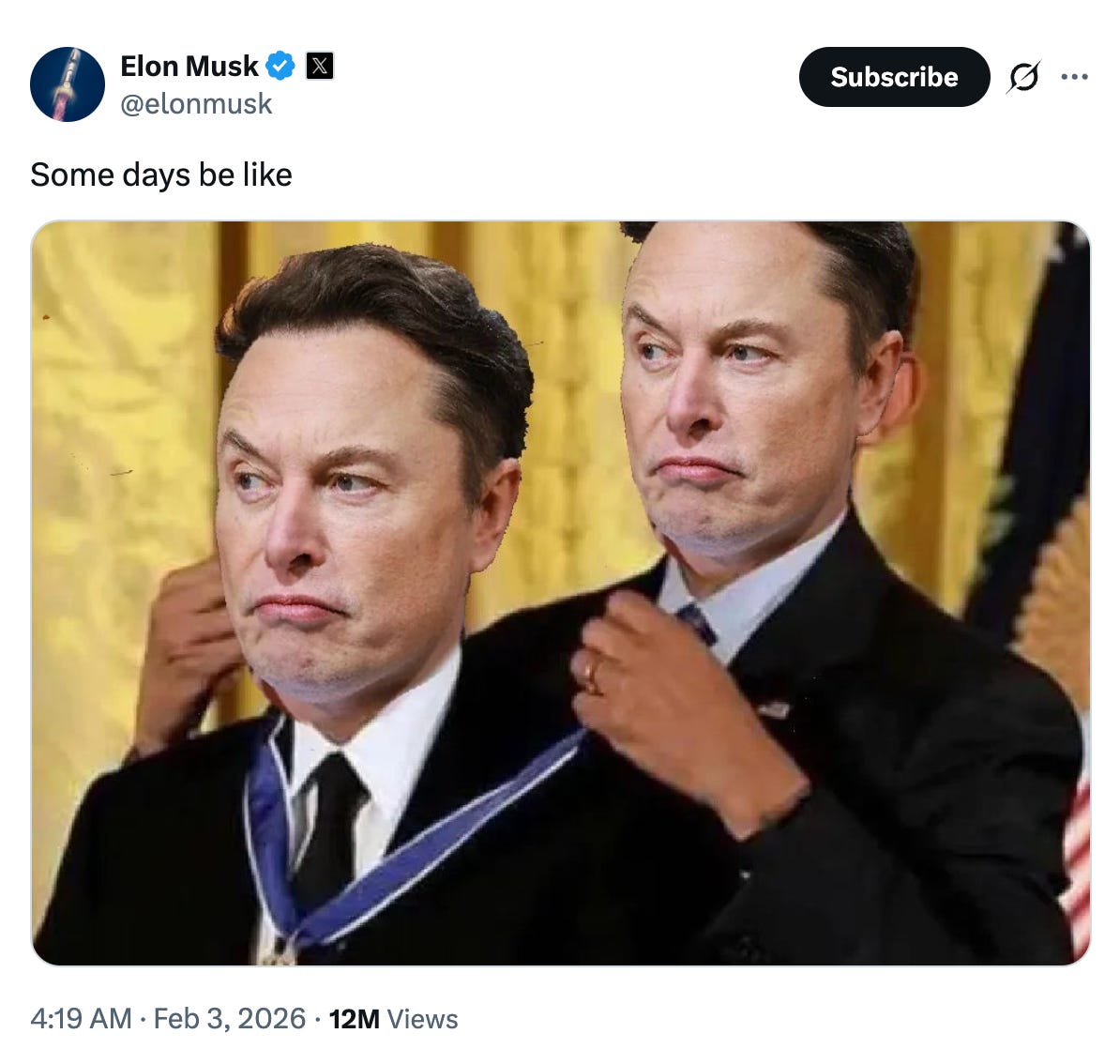
The financial engineering is transparent. xAI burns roughly $1 billion per month on data centers and earns comparatively little from Grok subscriptions. SpaceX prints cash from government contracts and Starlink. Ross Gerber summarized it cleanly:
“After a short negotiation with himself, Elon has decided to merge SpaceX and xAI.”
Zoom out 🔎 But the physics argument deserves more than dismissal. xAI’s Colossus cluster in Memphis runs over 100,000 Nvidia H100 GPUs. At full capacity, these facilities demand hundreds of megawatts. Next-generation training runs will need gigawatts. The power exists; the grid connections don’t. Upgrades take a decade of permitting while compute demands double annually.
Space changes the math. Solar panels in sun-synchronous orbit generate 4-5x the annual energy of equivalent terrestrial arrays. Cooling becomes passive radiation into 3-degree Kelvin vacuum. At Starship’s target of under $50 per kilogram, launching a data center to orbit approaches cost parity with building in Northern Virginia. No other AI company has direct access to a launch vehicle with these economics. OpenAI, Anthropic, Google, and Meta all pay retail for constrained terrestrial infrastructure.
Then there’s X Money, the piece most coverage missed. X holds money transmitter licenses in over 40 states and has a Visa partnership for merchant acceptance. Migrate Starlink’s millions of subscribers onto X Money rails, and you capture the 3% currently paid to processors. Build micropayment infrastructure for AI agent transactions, and you’ve created a machine-to-machine economy that card networks can’t easily serve.
THE TAKEAWAY ✈️
What’s next? 🤔 Looking ahead, three signals will reveal whether this is narrative or strategy. First, Starlink V3 specifications - if next-generation satellites include onboard compute, the orbital thesis is moving to implementation. Second, any orbital data center pilot, however small, validates the physics operationally. Third, X Money licensing momentum: broad regulatory approval means the financial rails are real; sustained resistance impairs one leg of the closed loop. Most importantly, the IPO prospectus will show how these pieces actually fit together. Until then, this is either the most audacious infrastructure play in tech history or a $250 billion bailout dressed in a spacesuit. The unsatisfying truth is it might be both.
ICYMI: Rockets, AI, and rails: the closed-loop economy no bank can touch 🚀🔒 [deep dive into SpaceX & xAI [& X Money] merger, what everyone’s missing about the biggest IPO of all time + bonus deep dive into Elon’s Super App ambitions]
OpenAI’s social network is a Trojan Horse for owning the AI era identity 🐴🪪
The news 🗞️ Sam Altman isn’t building a Twitter/X competitor. He’s building the passport office for the agentic internet.
According to Forbes recent reporting, OpenAI has a small team - fewer than ten people - working on a humans-only social network that would require biometric verification to join.
The options being considered: Apple’s Face ID or the World Orb, the iris-scanning device from Tools for Humanity, the company Altman founded and still chairs. World has already scanned over 17 million people globally, which means the infrastructure exists.
Let’s break this down, understand why it matters, how it fits into OpenAI’s broader ambitions, and what’s next.
More on this 👉 The immediate pitch is obvious. Bots have made X (or LinkedIn for that matter) nearly unusable for serious discourse, and Altman has been vocal about it. “I never took the dead internet theory that seriously but it seems like there are really a lot of LLM-run twitter accounts now,” he posted in September.
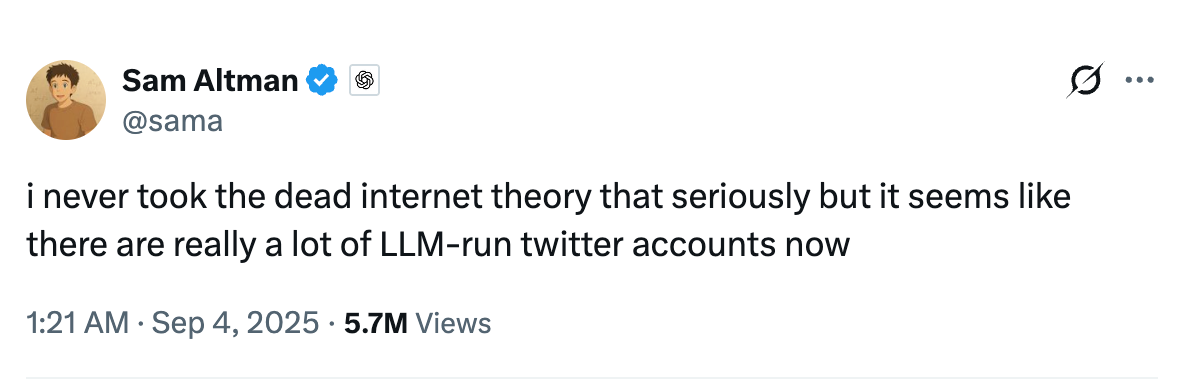
A platform where every interaction is mathematically guaranteed to come from a biological human would thus be a genuine product differentiator.
But that framing undersells what’s actually happening.
Consider the context: OpenAI recently acquired Torch (healthcare data infrastructure) and Roi (personal finance aggregation). They hired Max Stoiber, Shopify’s former Engineering Director and a pioneer in component-based UI systems, explicitly to “turn ChatGPT into an OS.” They launched mini apps with partners like Spotify, Zillow, and Booking.com. They’re collaborating with Jony Ive on dedicated hardware. And they’ve been pushing MCP, a protocol that lets external services plug directly into ChatGPT.
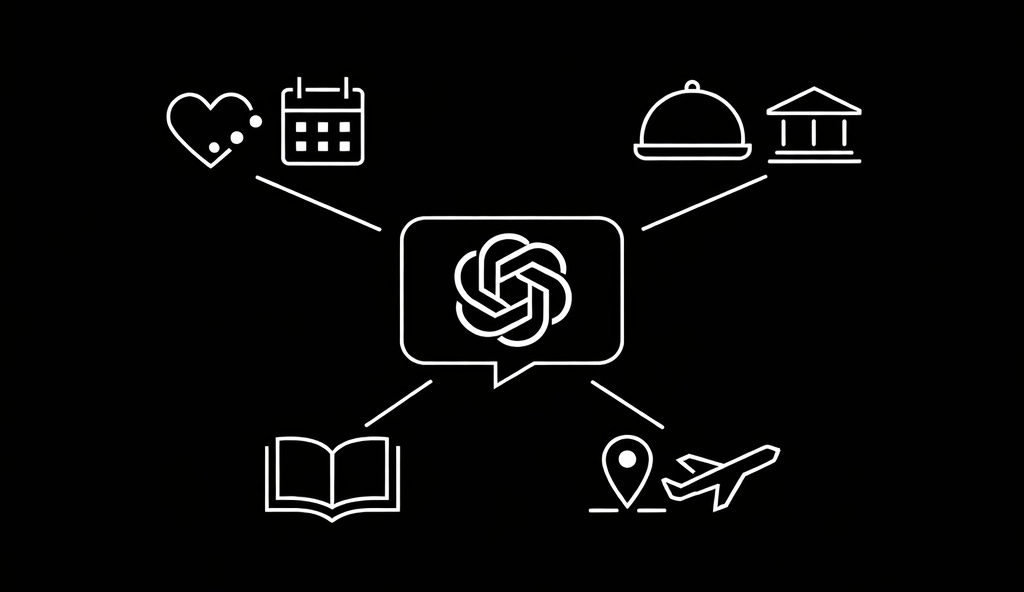
See the pattern?
OpenAI is building an Agentic Operating System - a layer that sits above your phone’s OS and mediates your entire digital life through a single conversational interface. The acquisitions give it memory (your health records, your financial data). Stoiber’s Generative UI gives it the ability to render custom interfaces on demand. MCP gives it hands to interact with external services.
Zoom out 🔎 Once you zoom out, the key question is this - so what’s missing? Trust infrastructure. The verified identity layer that proves a human authorized this agent to act.
When your AI agent tries to book a flight, make a purchase, or access your medical records, the receiving system needs to know it’s actually you - not a rogue bot, not a spoofed request. A cryptographic token tied to your biometric identity solves this. The “social network” is really an identity primitive that unlocks agent access to the entire commercial internet.
The strategic elegance is truly striking here. By framing this as a social product, OpenAI gets users to voluntarily verify their identity for the privilege of bot-free discourse.
Once verified, that identity becomes portable across the entire OpenAI ecosystem - and potentially beyond, if World ID becomes a standard. Chess move ♟
THE TAKEAWAY ✈️
What’s next? 🤔 Of course, the risks are real here. Biometric data can’t be reset like a password. Regulatory scrutiny of World’s iris scanning continues in multiple jurisdictions. And if OpenAI controls who counts as “verified human,” getting banned doesn’t just cost you a social feed - it could lock you out of effective AI assistance entirely. Looking ahead, watch for two things: whether enterprise customers start requesting verified-human authentication for agent deployments, and how tightly this integrates with World versus staying OpenAI-native. The former signals market demand; the latter signals whether Altman sees this as a ChatGPT feature or a standalone identity play.
The deep dive below unpacks the full Agentic OS architecture - how Stoiber’s Generative UI, the Torch and Roi acquisitions, and the MCP protocol fit together to potentially commoditize the smartphone itself. The social network is just the front door:

PicPay’s $2.5B IPO reopens the Brazil-to-NYSE pipeline 🔔🇧🇷
Following the money 💸 Four years of silence from Brazilian fintechs on US exchanges ended last week, and the market’s appetite suggests pent-up demand was real.
Let’s take a look at this.
More on this 👉 PicPay priced its Nasdaq debut at $19, the top of its range, with demand running 12x oversubscribed. The Brazilian digital bank raised $434 million at a $2.5 billion valuation, marking the first major Brazilian IPO in New York since Nubank’s December 2021 listing.
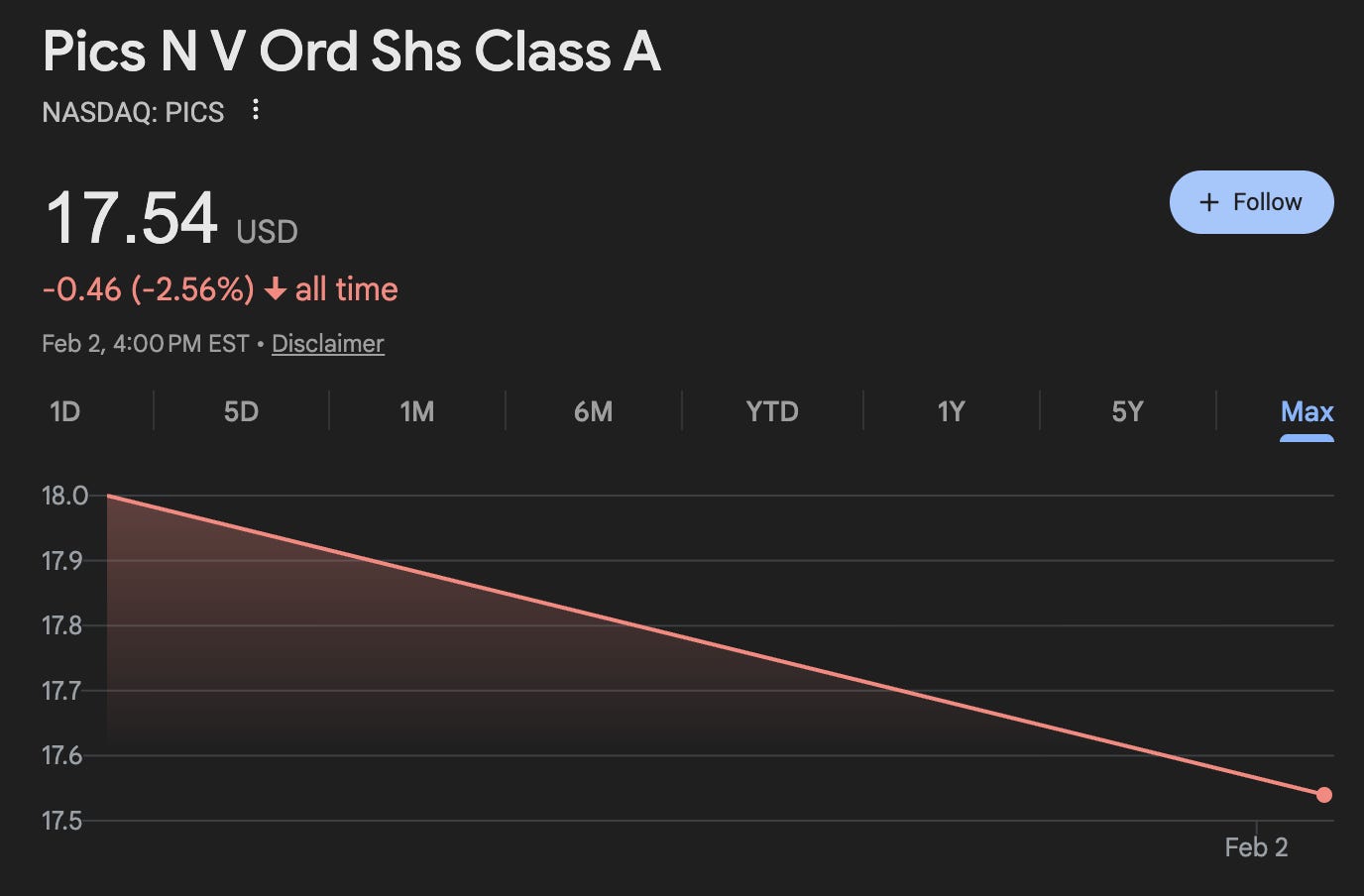
That gap wasn’t a coincidence. With Brazilian real interest rates among the world’s highest, domestic capital markets froze - no company has listed on Brazil’s B3 exchange since September 2021. Ups 🤷♂️
Zoom out 🔎 The numbers tell a turnaround story. PicPay was loss-making until 2023. In the first nine months of 2025, it posted R$270.4 million (~$50 million) in net profit on R$7.26 billion in revenue, with profit nearly doubling year-over-year. At roughly 12x estimated 2026 earnings, the market is paying for growth, not just current profitability.
The Batista brothers - Wesley and Joesley, who built meatpacking giant JBS - acquired PicPay in 2015 when it was still a digital wallet. They’ve since pushed it into lending, cards, investments, and now insurance: part of the IPO proceeds will fund the acquisition of insurer Kovr. Cross-selling insurance to 66 million existing customers is the playbook. J&F, the family holding company, retains about 70% ownership with supervoting control.
THE TAKEAWAY ✈️
What’s next? 🤔 The obvious comparison that comes to mind first is obviously Nubank, currently valued at around $87 billion. PicPay trades at roughly 3% of that despite operating the same basic model in the same market. Some of that discount reflects scale and execution - Nubank has built a more sophisticated credit operation. But it also reflects timing: Nubank went public when growth multiples were forgiving. PicPay had to prove profitability first. Looking ahead, we must note that the early returns are mixed. Shares have slipped to around $17.50, roughly 8% below the IPO price, as broader market volatility tests investor conviction. But the pipeline is already forming: Agibank filed for a NYSE listing this month, and a UBS survey of institutional investors anticipates more than ten Brazilian IPOs in 2026. Whether that window stays open depends on whether PicPay can hold its ground.
ICYMI:

What else I’m watching
Klarna Joins Google’s UCP 🛒 Klarna is backing Google’s Universal Commerce Protocol (UCP) to enable seamless AI-driven shopping. The partnership builds on Klarna’s support for Google’s Agent Payments Protocol (AP2) and aims to advance open standards in commerce. ICYMI: Google’s Universal Commerce Protocol: the new default for how AI buys things 🤖🛍️ [2,000+ words dive into Universal Commerce Protocol (UCP), why it’s huge, how it changes everything, and how each player needs to adapt to the new AI-first economy + bonus list of top 10 AI startups to watch in 2026 & AI leader playbook inside]
APP Reimbursement Rises 💰 The UK’s Payment Systems Regulator reports that 88% (£173M) of money lost to authorised push payment (APP) fraud has been reimbursed to victims. This marks a significant increase from the 65% reimbursement rate in 2024. APP fraud losses hit £257.5M in the first half of 2025, a 12% increase from last year. Consumers reported around 269,000 claims, with 188,000 being eligible for reimbursement. Firms responded promptly, with 82% of claims closed within five business days and 98% within 35 days. The PSR notes no significant decrease in consumer caution.
FTSE 100 Slides on AI Fears 📉 The FTSE 100 index slid from a record high due to fears that new AI technology from Anthropic could disrupt business models. Anthropic’s legal plug-in aims to automate tasks like contract reviewing and compliance workflows, leading to a sell-off in software companies. Relx fell nearly 11%, Pearson dropped around 4%, and London Stock Exchange Group and Experian were down more than 7%. ICYMI:

💸 Following the Money
Capital markets infrastructure platform Axiology has secured €5M in seed funding to introduce new tokenised securities capabilities under the EU DLT Pilot Regime.
Canadian fintech Neo Financial has raised C$68.5M in equity to fund a securitisation programme designed to boost its lending portfolio.
OneDome, the UK-based housing and fintech platform, has raised $25M in a Pre-Series C funding round, taking total funding raised to date to $40M.
👋 That’s it for today! Thank you for reading, and have a relaxing Sunday! And if you enjoyed this newsletter, invite your friends and colleagues to sign up:
Interesting read... Is PicPay worth the money?
What a week... Elon clearly stole the show haha