
Nuvei’s $2.75B Payoneer M&A completes Advent’s quiet payments empire 🤑💸; Is Cursor SpaceX’s Instagram Moment? 🤔📸; Robinhood cut 10% of jobs without mentioning AI once 😳🤖
You're missing out big time... Weekly Recap 🔁

👋 Hey, Linas here! Welcome back to a 🔓 weekly free edition 🔓 of my daily newsletter. Each day, I focus on 3 stories that are making a difference in the financial technology space. Coupled with things worth watching & most important money movements, it’s the only newsletter you need for all things when Finance meets Tech.
If you’re not a subscriber, here’s what you missed this week:
Unlock Claude Fable 5 Lite on Claude Opus 4.8 🔓 [The full Fable 5 system prompt and the step-by-step guide to turn Claude Opus 4.8 into a Fable-class AI assistant after Anthropic shut it down]
Loop Engineering: How to Design AI Loops That Build, Ship, and Improve While You Sleep 🔁 [From a three-line bash script to multi-day Claude Fable 5 autonomy — everything founders, builders, and investors need to stop prompting agents and start designing the systems that prompt them]
How to Pre-Mortem Any Decision With AI: The Future Failure Audit Skill for Claude 🔮 [The highest-leverage Claude skill most founders are missing. It assumes your plan has already failed, finds the hidden assumption that kills it, and rewrites it before you commit a single dollar]
Coinbase is replacing the crypto exchange model with a Financial OS built for AI Agents 🤖⚙️ [Coinbase’s System Update with a focus on key products & launches, what does it all tell us & which competitors should worry the most + bonus deep dive into Coinbase’s latest financials & how Anthropic wants to be the AI OS for Wall Street inside]
Adyen and Stripe push deeper into Agentic Commerce after OpenAI’s checkout failure 🤖💳 [what Adyen Agentic is all about, how it compares with Stripe’s Agentic AI initiatives, & what’s one thing nobody talks about here + bonus dives into Visa & Mastercard’s AI challenges & how to build your first AI Agent from scratch inside]
Zelle just made stablecoins a banking feature 🏦🪙 [why Zelle’s expansion into India 🇮🇳 and ZelleUSD is a very calculated bet & what it means for their competitors in the space + bonus dive into why Coinbase, Visa, Mastercard, & Stripe are thinking of launching their own stablecoin & the ultimate list of stables resources inside]
Ex-OpenAI’s Aschenbrenner Bet $5.5B on AI Chips. Now He’s Betting $8.5B Against Them 💸 [Leopold Aschenbrenner’s AI hedge fund Situational Awareness went from pure AI long to 62% short semiconductors in one quarter. Here’s what changed and why the thesis still holds]
Adyen spent $1.2B in two months. The build-only era is over 👋💸 [what their acquisition of Orb is all about, & how it strengthens Adyen’s positions for the AI-first era + bonus deep dive into Coatue, which just told founders exactly where the next $12 trillion in AI spend is going inside]
Coatue’s May 2026 Report: The $12 Trillion AI Bet and Who Ends Up on the Wrong Side 📊 [Coatue’s latest public markets report reveals the most extreme winner/loser split in tech stock history, a $12 trillion AI capex wave, and one brutal framework that predicts exactly who wins]
Anthropic Just Told AI Founders Exactly What to Build in 2026 🦄 [1 million conversations. 9 consumer AI domains. A full founder playbook - plus where Anthropic’s own products will and won’t compete]
The Top 100 AI & Tech Investors of 2026 💸 [The venture capitalists behind Anthropic, OpenAI, SpaceX, Stripe, and Revolut - who they are, what they’re backing now, and exactly how to reach them]
As for today, here are the 3 incredible FinTech stories that are changing the world of financial technology as we know it. This was yet another solid week in the financial technology space, so make sure to check all the above stories.
Nuvei’s $2.75B Payoneer acquisition completes Advent’s quiet payments empire 🤑💸
The BIG News 🗞️ Two months after Capital One closed its $5.15 billion purchase of Brex, the second major fintech acquisition of 2026 has landed. Nuvei will now acquire Payoneer for $2.75 billion in all cash, creating a cross-border payments platform giant processing over $500 billion in annual volume on roughly $3 billion in revenue across 190 countries. Not too shabby!
But while Capital One bought Brex to own the CFO’s software stack, this deal is about owning the full cross-border money lifecycle, from payment acceptance to payout in Shenzhen or São Paulo. Thus, the real story isn’t the M&A itself. It’s who’s behind it, what they actually paid, and what a pending stablecoin bank charter could mean for the combined platform.
Ultimately, Nuvei’s $2.75 billion acquisition of Payoneer is a payments deal on the surface and a private equity masterclass underneath.
Let’s unpack it.
More on this 👉 Here’s the sequence.
→ Advent International took Nuvei private for $6.3 billion in 2024.
→ Away from quarterly earnings calls, it bought Paya for $1.3 billion.
→ Now it’s adding Payoneer at $7.40 per share, a 44% premium to the pre-rumor price but only 10% above the prior close, because Payoneer’s stock had already fallen 35% in 2025 on fears that U.S.-China tariffs would gut its Greater China business (roughly 35% of revenue).
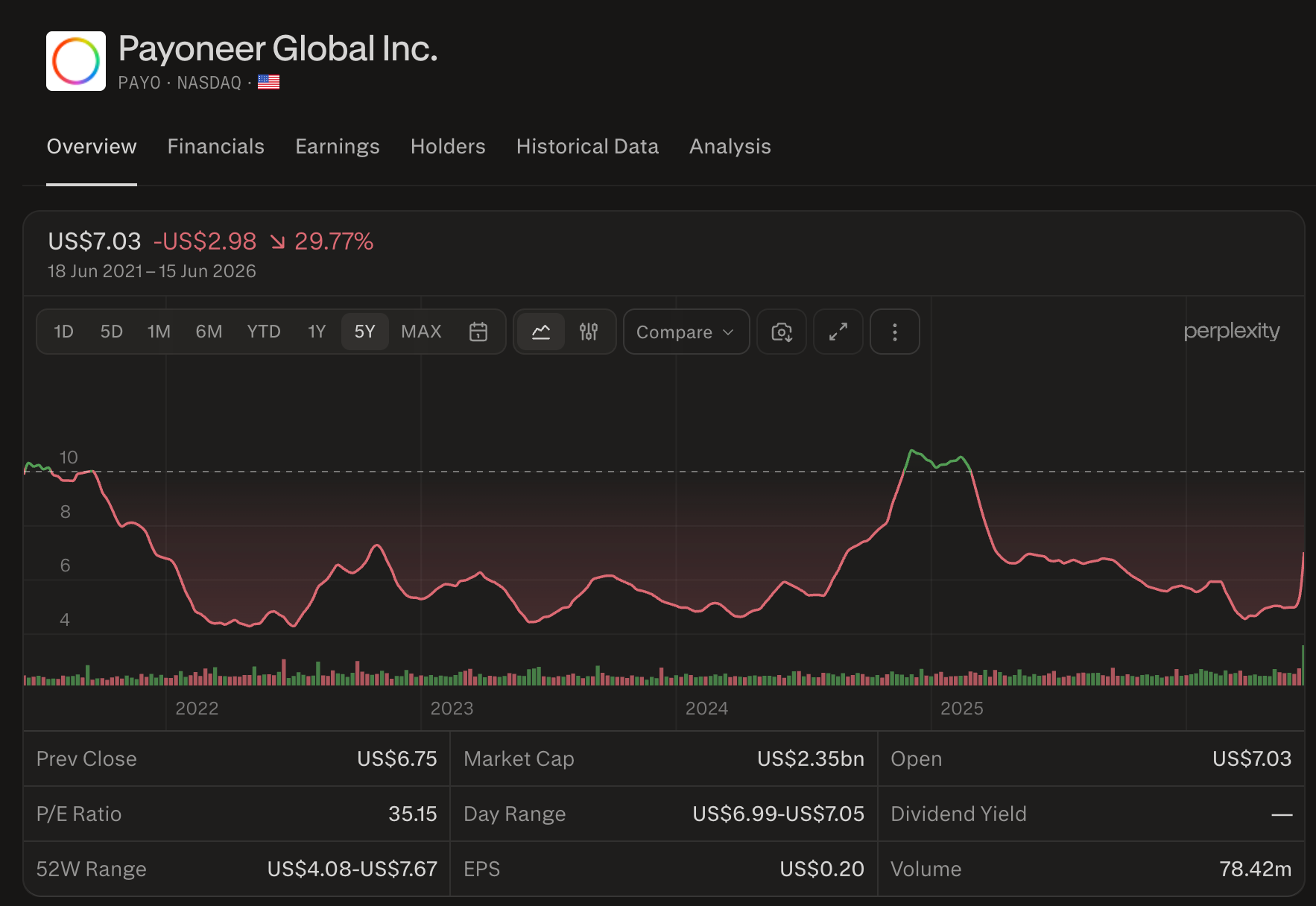
That said, Advent is buying battle-tested cross-border infrastructure at about 2.2x revenue while the underlying business keeps compounding: Q1 2026 SMB revenue was up 12% year-over-year to $189 million. Win-win.
Zoom out 🔎 What’s interesting is that the strategic logic here is cleaner than most big payments mergers.
Nuvei is the money in company: merchant acquiring in 52 markets, 150 currencies, 720 alternative payment methods. Payoneer is primarily the money out company: cross-border payouts to sellers, freelancers, and SMBs in 150+ markets with real-time settlement. Combining them thus creates a closed loop where the FX spread, float yield, and take rates on both sides of a transaction stay in-house. That’s structurally different from the FIS-Worldpay debacle, for example, which tried to merge two companies on opposite sides of the bank-merchant divide with minimal complementarity.
Then there’s the stablecoin angle, which deserves more attention than it’s getting. We can remember that Payoneer filed with the OCC in February 2026 to charter a national trust bank explicitly to anchor a stablecoin strategy. Nuvei already holds crypto service provider licenses in Europe and has built stablecoin B2B payment rails in Latin America. Together, they have the raw ingredients for a stablecoin settlement network purpose-built for global SMBs, a product nobody offers at scale yet. The optionality thus came cheap either way.
ICYMI:

THE TAKEAWAY ✈️
What’s next? 🤔 Looking ahead, watch two things. First and foremost, whether this triggers defensive M&A from Stripe, Adyen, or PayPal, all of whom now face a privately held competitor free from quarterly earnings pressure. Second, how China plays out. If tariff fears prove overblown, Advent bought Payoneer’s most valuable emerging-market corridor at a steep discount. All in all, the PE playbook is brilliant here: assemble a platform worth $15-20 billion from parts costing under $11 billion. Of course, the math works only if integration goes better than FIS-Worldpay. But the starting position, complementary capabilities rather than overlapping ones, gives them a real and strong shot.
ICYMI:


Is Cursor really SpaceX’s Instagram Moment? 🤔📸

Following the money 💸 Days after a $1.8 trillion IPO, Elon Musk is already spending the paper. SpaceX announced Tuesday it will acquire Anysphere, parent company of AI coding tool Cursor, for $60 billion in all-stock.
The FT’s Lex column quickly framed it as Musk’s potential Instagram moment, noting that the deal, at roughly 2% of SpaceX’s market cap, mirrors the ratio Zuckerberg paid for the photo-sharing app in 2012, weeks before Facebook’s own debut.
Yes, it’s a flattering comparison. It also obscures the more interesting story.
Let’s take a look at this.
More on this 👉 First and foremost, Cursor is not Instagram. Instagram had 30 million users, 13 employees, and zero revenue when Zuckerberg bought it. Meanwhile, Cursor runs at roughly $2–3 billion ARR, serves over 50,000 businesses, and has real Fortune 500 penetration.
So Musk isn’t buying potential. He’s buying a functioning enterprise software business in a domain where his revenue today is effectively zero. He has pegged the enterprise applications market at $22.7 trillion. Cursor is his entry ticket.
Zoom out 🔎 The acquisition logic tightens when you factor in SpaceX’s earlier merger with xAI. Cursor now thus gives xAI a polished distribution layer and a captive developer audience. xAI gives Cursor access to Colossus compute and proprietary models. The intended flywheel: developers use Cursor, Cursor routes through Grok, usage data improves the models, better models attract more developers.
Win-win? Not so fast.
The problem is that Cursor’s appeal rests partly on model agnosticism. Developers today route tasks through Anthropic, OpenAI, DeepSeek, and others. If Musk pushes xAI to the front of the queue, and his track record across Twitter, Tesla, and xAI suggests he will, paying customers will notice.
The thing is that developer tools are ruthlessly meritocratic. Switching costs are low, and alternatives are multiplying: Claude Code, GitHub Copilot, a growing roster of open-source agents.
THE TAKEAWAY ✈️
What’s next? 🤔 Ultimately, the deal structure itself is smart: all-stock at peak valuation with minimal dilution, built on an option that gave SpaceX pricing power. But financial engineering doesn’t answer the management question. Remember that Zuckerberg let Instagram operate independently for years, and that restraint was the deal’s secret weapon. Musk’s instinct runs opposite. That said, watch two things over the next 12 months: whether Cursor keeps multi-model support, and whether Anysphere’s founding team stays. If either changes, the Instagram analogy dies on contact. All in all, Musk bought a product developers love for $60 billion. Keeping it will cost something harder: patience.
ICYMI:


Robinhood cut 10% of jobs without mentioning AI once 😳🤖
The news 🗞️ Robinhood laid off 290 people yesterday while posting record trading volumes, and went out of its way to avoid the three letters every other fintech CEO can’t stop saying.
Let’s take a look at this.
More on this 👉 Vlad Tenev’s memo to staff hit all the familiar notes: flatten the org, raise the performance bar, increase talent density. The company is taking a $28 million charge on severance and benefits. Robinhood framed the 10% headcount reduction as proactive, born from strength rather than stress.
All of which is true, and none of which is the complete picture.
Zoom out 🔎 We can remember that six weeks ago, Coinbase cut 700 jobs and Brian Armstrong said the quiet part loud:
“Engineers use AI to ship in days what used to take a team weeks.”
He flattened Coinbase to five management layers, killed pure-manager roles, and started experimenting with one-person teams backed by AI agents. Block cut 40% of staff on the same logic. Intuit trimmed 17%.
Robinhood’s memo mentions “frontier technologies” exactly once, buried in a forward-looking paragraph about future hiring. The actual cuts are dressed in the language of culture and discipline.
But the org chart restructuring is identical to Coinbase’s. The target is also the same: middle management, coordination roles, anyone whose output can be replicated by better tooling. Robinhood just read the room on the framing. Weeks before these cuts, TechCrunch observed that public skepticism around AI-justified layoffs was rising. So Robinhood ran the same play with different packaging 🤷♂️
But the tell isn’t what Tenev said. It’s what he carefully didn’t. And if you look at which roles survived across every one of these flattenings, the profile is very consistent: irreplaceable domain knowledge paired with the ability to ship. Naval Ravikant has a name for that profile: productize yourself. In a flattened org, that’s no longer just a career philosophy. It’s the new job description.

THE TAKEAWAY ✈️
What’s next? 🤔 Looking ahead, here’s what to watch next. Robinhood will almost certainly backfill selectively with AI-native hires in engineering and product, mirroring Coinbase’s playbook - the “lean” headcount becomes permanent, not transitional. If prediction markets and expanded trading keep performing, the per-employee revenue math gets very attractive for investors. But the second-order effect most will miss is this: when every fintech converges on the same flat, AI-augmented model, differentiation shifts entirely to execution speed and product taste. The companies that win won’t be the ones that cut deepest. They’ll be the ones whose remaining teams actually build faster. That said, Robinhood’s shipping cadence over the next six months is the real scorecard - not yesterday’s headcount number.
ICYMI: Robinhood’s Q1 2026: the best brokerage, the wrong price 🤷♂️💸 [breaking down the most important facts & figures from Robinhood’s Q1 2026 to see whether Robinhood is worth your time & money + bonus deep dive into the latest financials of its bigget competitor Coinbase, and why Robinhood’s Agentic AI play is exactly what Anthropic recently told AI founders to build in 2026]
🧠 What else I’m watching
SpaceX IPO Soars 🚀 SpaceX’s IPO raised $85.7 billion, surpassing initial expectations by $10 billion due to a fully exercised greenshoe option by underwriters Goldman Sachs, Bank of America, and JPMorgan. The historic listing, the largest ever, valued SpaceX at $1.8 trillion, propelling Elon Musk to trillionaire status. Shares surged 19% to $192 on debut, though analysts caution the sky-high valuation leaves little room for error amid regulatory scrutiny and rising competition in the commercial space sector. ICYMI:
EU AI Sovereignty Push 🇪🇺 The US government’s order for Anthropic to cut off foreign access to its Fable 5 and Mythos 5 models - citing national security - has intensified Europe’s push for tech sovereignty. Anthropic complied but criticized the move, arguing it sets a precedent that could halt all frontier AI deployments. But when you look at the bigger picture, this shutdown yet again underscores Europe’s vulnerability to US tech dominance, thus bolstering arguments for a digital euro and homegrown cloud/AI infrastructure. For example, UK AI Minister Kanishka Narayan emphasized that sovereign AI is key to national security, while the European Payments Initiative (EPI) highlighted ongoing reliance on non-European providers despite efforts to localize critical services. Will this be a wake-up call for Europe? We’re yet to find out… In the meantime, check out the best option available today, ICYMI:
Visa Tokenises Deposits 💳 Visa is developing a tech layer to enable banks to tokenise traditional deposits, combining the speed and flexibility of stablecoins with on-balance-sheet security. The move complements Visa’s expanding stablecoin settlement pilots and 160+ stablecoin-linked card programs globally. At its recent payments forum, CPSO Jack Forestell highlighted Visa’s focus on trust, security, and global reach, unveiling tools like Agent Score and Agent Directory to prepare merchants for agentic commerce, while partnering with OpenAI to advance AI-driven payment innovations. ICYMI: Visa and Mastercard’s Agentic AI payment platforms have a volume problem 🤖📊 [what it’s all about, why it matters & why payment titans have a volume problem here + bonus reads into other Visa & Mastercard’s agentic AI moves inside]

💸 Following the Money
African payments powerhouse Flutterwave has hit a $3.25B valuation on its Series E funding round after an investment from US blockchain firm Ripple.
Current has raised $80M in a Series E equity financing round valuing the US personal finance app at $1.5B.
Capsa AI, a startup building what it calls an artificial intelligence operating system for private capital, has raised $18M in Series A funding.
👋 That’s it for today! Thank you for reading, and have a relaxing Sunday! And if you enjoyed this newsletter, invite your friends and colleagues to sign up:
this is brilliant - thanks Linas
my favourite read for Sunday - thank you!