
Ramp’s free LLM Router isn’t the product 🤖📊; FinTech funding topped $29B in H1 2026, but most founders got left behind 📈💸
You're missing out big time... Weekly Recap 🔁

👋 Hey, Linas here! Welcome back to a 🔓 weekly free edition 🔓 of my daily newsletter. Each day, I focus on 3 stories that are making a difference in the financial technology space. Coupled with things worth watching & most important money movements, it’s the only newsletter you need for all things when Finance meets Tech.
If you’re not a subscriber, here’s what you missed this week:
How to Build an AI Monopoly: The New Rules of Startup Strategy 🦄 [Anyone can build an AI product now. Almost no one can build an AI company. Here is how to escape competition, build moats that compound, and capture the value you create]
The Ultimate Guide to Kimi K3 🤖 [Moonshot’s 2.8T open model is now #1 in the world for frontend coding and AI agents at a third of Claude’s price. What it changes for founders, builders, and investors, and exactly how to operate it]
DeepSeek’s leaked investor call: inside the AI Playbook that erased $589 billion of Nvidia’s value 📉 [Liang Wenfeng walks investors through DeepSeek’s 6x pricing rule, its 20,000-GPU fleet, the Huawei plan to break CUDA, and an AGI roadmap with dates attached]
How to Build an Agentic OS with Claude Fable 5 🤖 [The complete guide to building an autonomous AI agent operating system with Claude Fable 5 — architecture, working code, cost control, security, and the economics of agentic labor]
Attention Is the New Startup Infrastructure: The Founder’s Playbook for Winning in the AI Age 📚 [Inside a16z’s “go-direct as a service” model — and the exact moves founders need to turn attention into customers, hires, and capital]
Robinhood’s Agentic Trading turns the broker into a backend for AI Agents 🤖💰 [how this turns the WealthTech giant into a backend for AI Agents, why it matters and what it tells us about the future + bonus deep dive into Robinhood’s latest financials, and the end-to-end guide to building Agentic OS with Claude Fable 5 inside]
Visa’s Stablecoin Platform launches with Open USD, sending Circle down 6% 😳🪙 [why Visa followed the same pattern Anthropic set with Claude Managed Agents, & what’s the bigger play here + bonus deep dives into Coinbase, Circle, and the Ultimate List of Stables Resources inside]
Nubank just bought a $6.3 million bank to keep calling itself one 🤑🏦 [why NU spent pocket change for yet another licence in LatAm, why it’s important for their long-term strategy + bonus deep dive into FinTech funding trends from H1 2026 inside]
GLM-5.2: The ChatGPT Moment for Local AI 🤖 [Why the first open-weight model that rivals Claude Opus 4.8 and GPT-5.5 — and runs on a single Mac — changes the game for every founder, builder, and investor]
Loop Engineering: How to Design AI Loops That Build, Ship, and Improve While You Sleep 🔁 [From a three-line bash script to multi-day Claude Fable 5 autonomy — everything founders, builders, and investors need to stop prompting agents and start designing the systems that prompt them]
Anthropic Just Told AI Founders Exactly What to Build in 2026 🦄 [1 million conversations. 9 consumer AI domains. A full founder playbook - plus where Anthropic’s own products will and won’t compete]
Who Actually Makes Money When AI Eats the World? 💸 [$700 billion a year in AI capex. A 128x collapse in the price of intelligence. Converging models. Here is where the value actually goes, and the playbook for founders, operators, and investors]
As for today, here are the 2 fascinating FinTech stories that are changing the world of financial technology as we know it. This was yet another incredible week in the financial technology space, so make sure to check all the above stories.
Ramp’s free LLM Router isn’t the product 🤖📊

The news 🗞️ The $44 billion fintech giant that built its name on controlling corporate card spend just started giving away free AI infrastructure. That should tell you everything about where the money is moving.
Let’s unpack this.
More on this 👉 On Monday, Ramp opened public access to its LLM Router: an OpenAI-compatible proxy that sits between your app and every major model provider, routing each request to the cheapest option that meets a quality threshold.
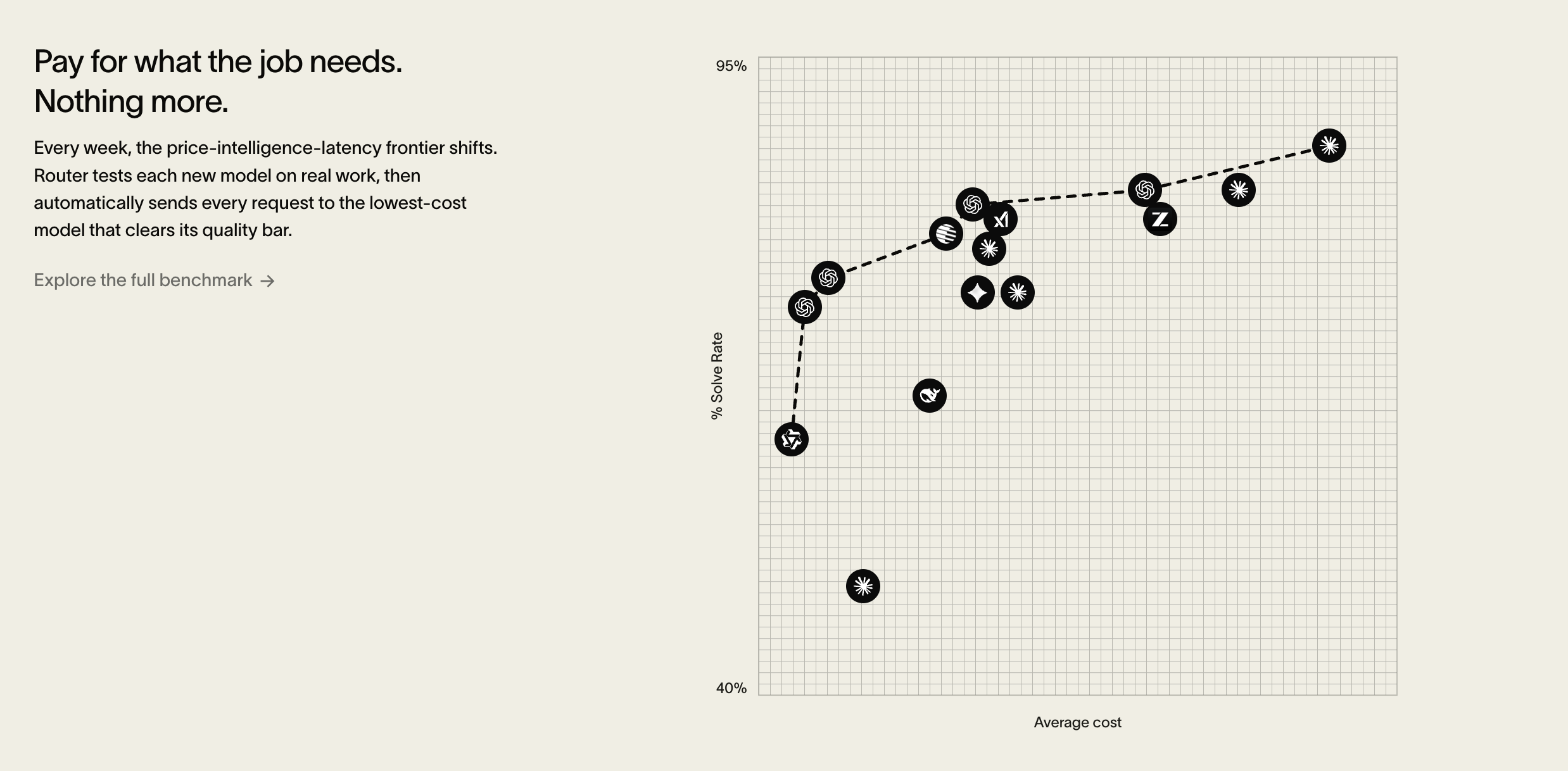
Simply swap your base URL, and it handles model selection, caching, compression, and fallbacks when providers go down. It adds 30ms of latency and, by Ramp’s internal numbers, cuts LLM costs by 30%. Not too shabby! 👏
Those numbers carry weight. Ramp has run this router for three years across 100+ AI features serving 70,000 customers, pushing 2.75 trillion tokens a month through it. The company’s 2023 acquisition of Cohere.io brought in co-founder Rahul Sengottuvelu, now CTO, who built much of the underlying infrastructure. So it’s clearly not a hackathon project.
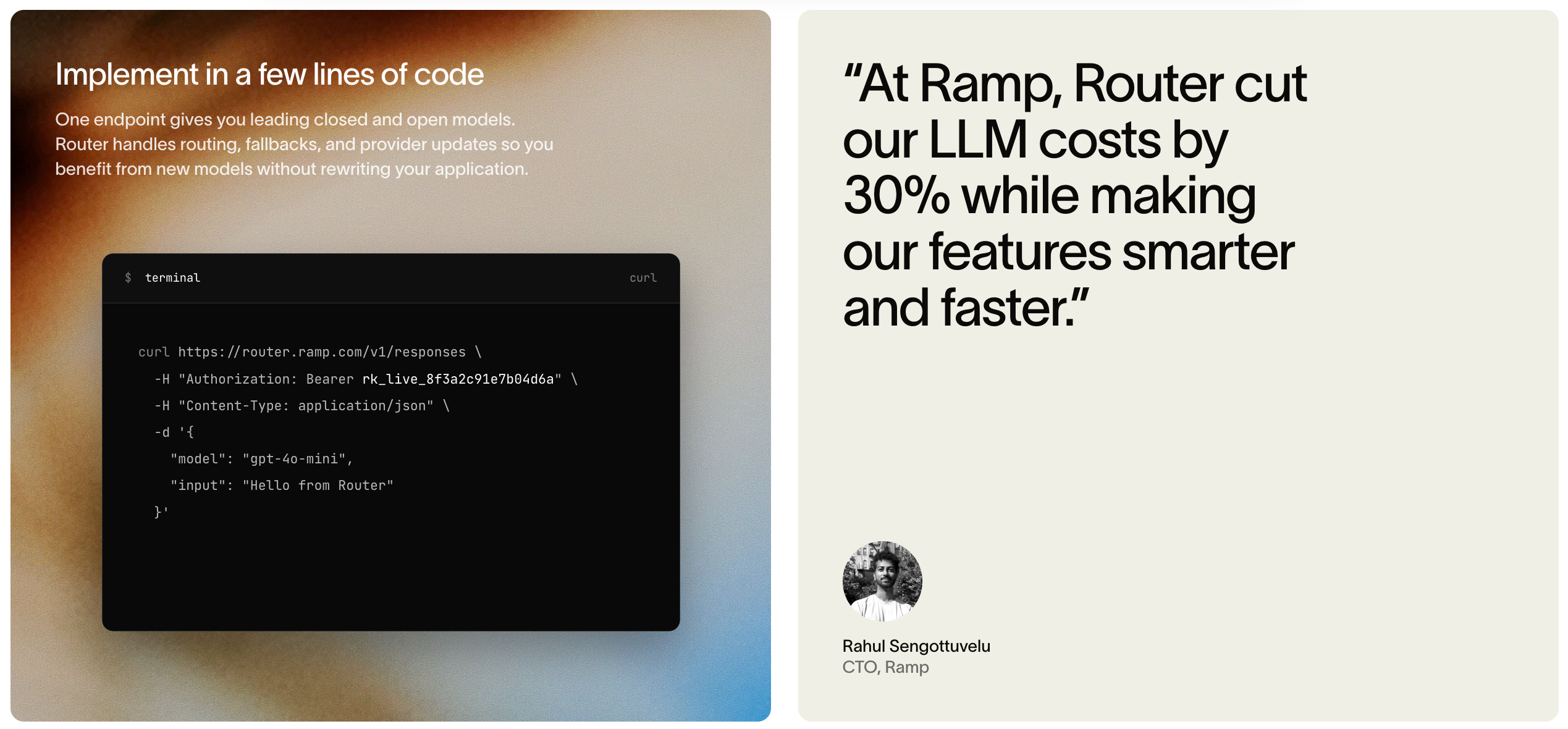
Zoom out 🔎 Of course, the router alone doesn’t explain why Ramp is giving it away for free. But the companion product does: AI Token Spend Management, a dashboard that gives finance teams visibility into AI costs by provider, model, team, and project, with anomaly detection, spend limits, and weekly savings briefings. The router optimizes in real time; the dashboard gives CFOs the same line-item control over inference costs that Ramp already provides for SaaS and T&E. Win-win 👏
And the timing is perfect here. Ramp’s data shows average monthly AI token spend across their customer base has grown 13x since early 2025. For companies running agentic workflows, where a single user action might chain dozens of model calls for planning, execution, and reflection, costs compound fast and unpredictably. That’s a finance problem dressed as an engineering one, and Ramp wants to own both sides.
THE TAKEAWAY ✈️
What’s next? 🤔 At the core, the playbook here is textbook Ramp: give away the infrastructure, capture the data, sell the controls. Free routing attracts developers → Developers generate usage data → Usage data feeds a dashboard that finance teams pay for. So if it works, Ramp becomes the default control plane for a spend category that barely existed two years ago. And it perfectly follows the pattern we covered in How to Build an AI Monopoly: pick a dominatable wedge, give away the tool that generates the data, build the moat from the flywheel. Ramp is basically running multiple plays from the framework at once, and doing it with 3 years of production data most competitors can’t replicate. Looking ahead, watch two key things. First and foremost, whether quality-routing holds up outside Ramp’s own workloads - internal benchmarks are the easiest ones to win. Second, how quickly advanced features move behind paid tiers. Because the speed of that transition will tell you whether this is still a growth play or already a revenue line.
ICYMI:


FinTech funding topped $29B in H1 2026, but most founders got left behind 📈💸

Following the money 💸 The fintech market just posted its strongest first half since the zero-rate era, and the number that matters most isn’t the dollars raised - it’s the 26% drop in deals.
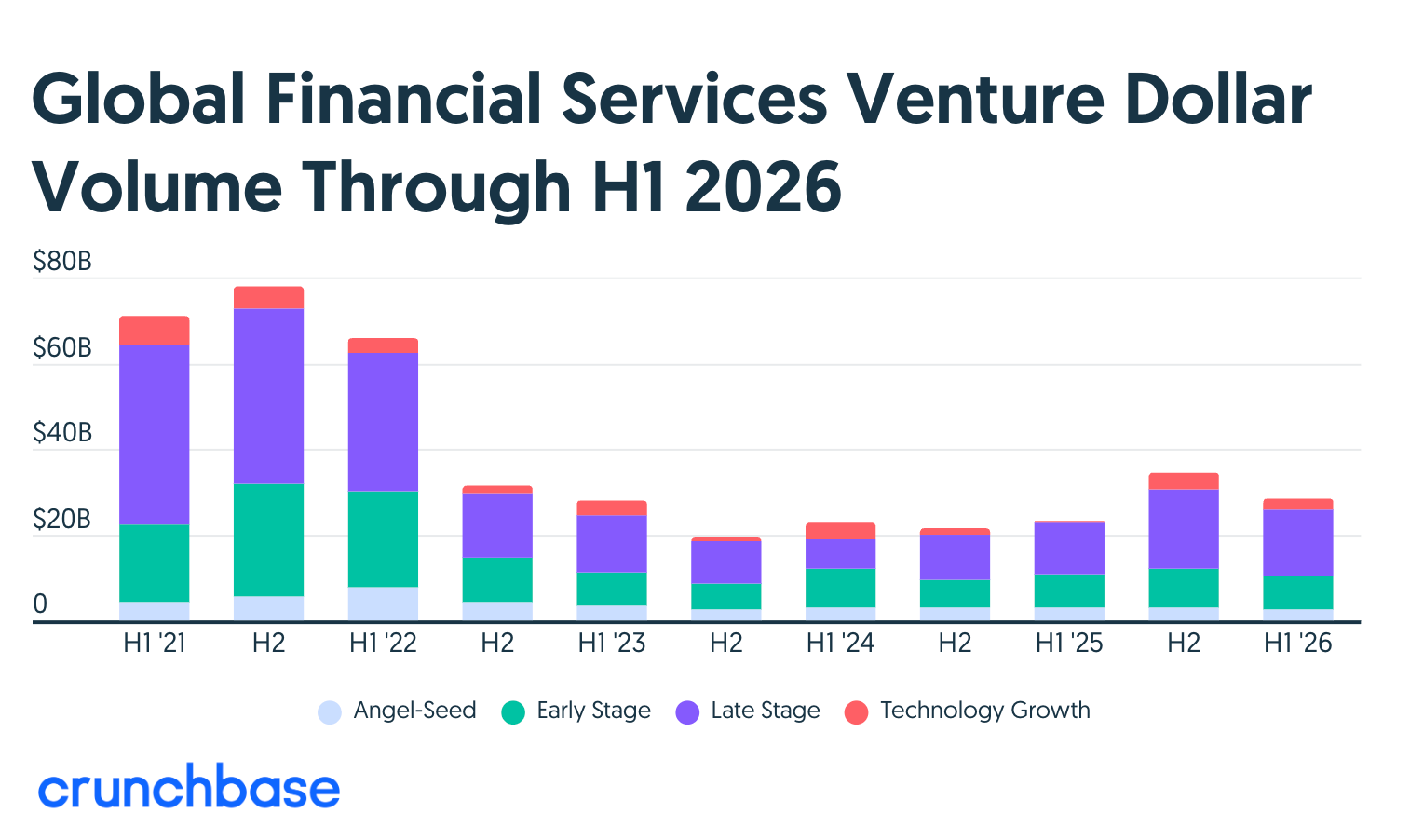
Global fintech venture funding topped a whopping $29 billion in H1 2026 while deal count fell to multi-year lows across every major data provider. Ouch 🤕
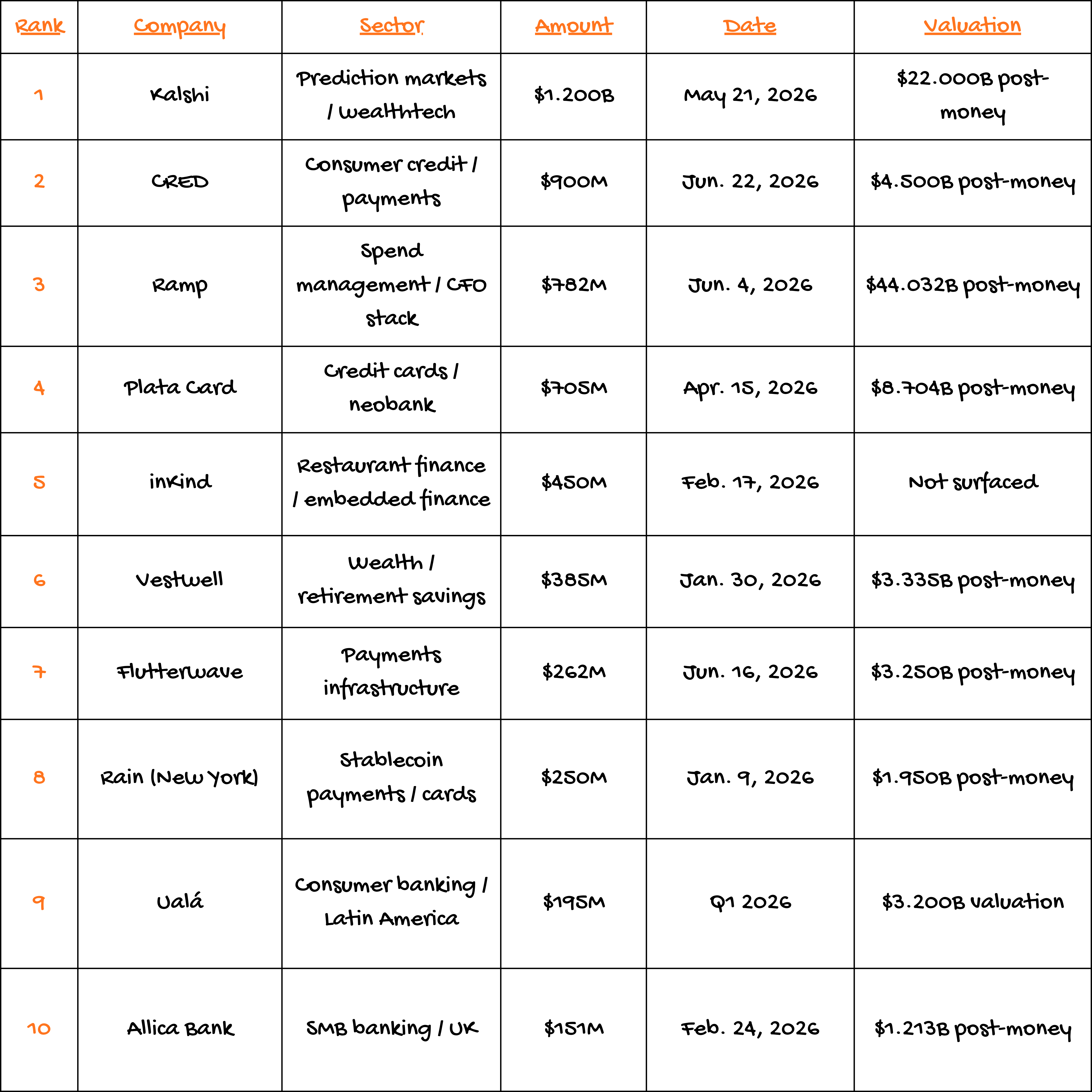
The first impression simply reads recovery. But the reality here is all about consolidation: capital is concentrating into a shrinking set of fintech startups at a pace that should worry anyone not already winning their category. A handful of mega-rounds (Kalshi at $1.2B, Ramp at $782M, CRED at $900M) pulled the totals up. Everyone else faced the tightest funding filter since the correction began… 😳
The full analysis below maps where fintech capital actually went by sector and geography, which categories earned valuation premiums and which got starved, how exits and IPOs played out in H1, and what founders and investors need to understand before raising in H2 2026.
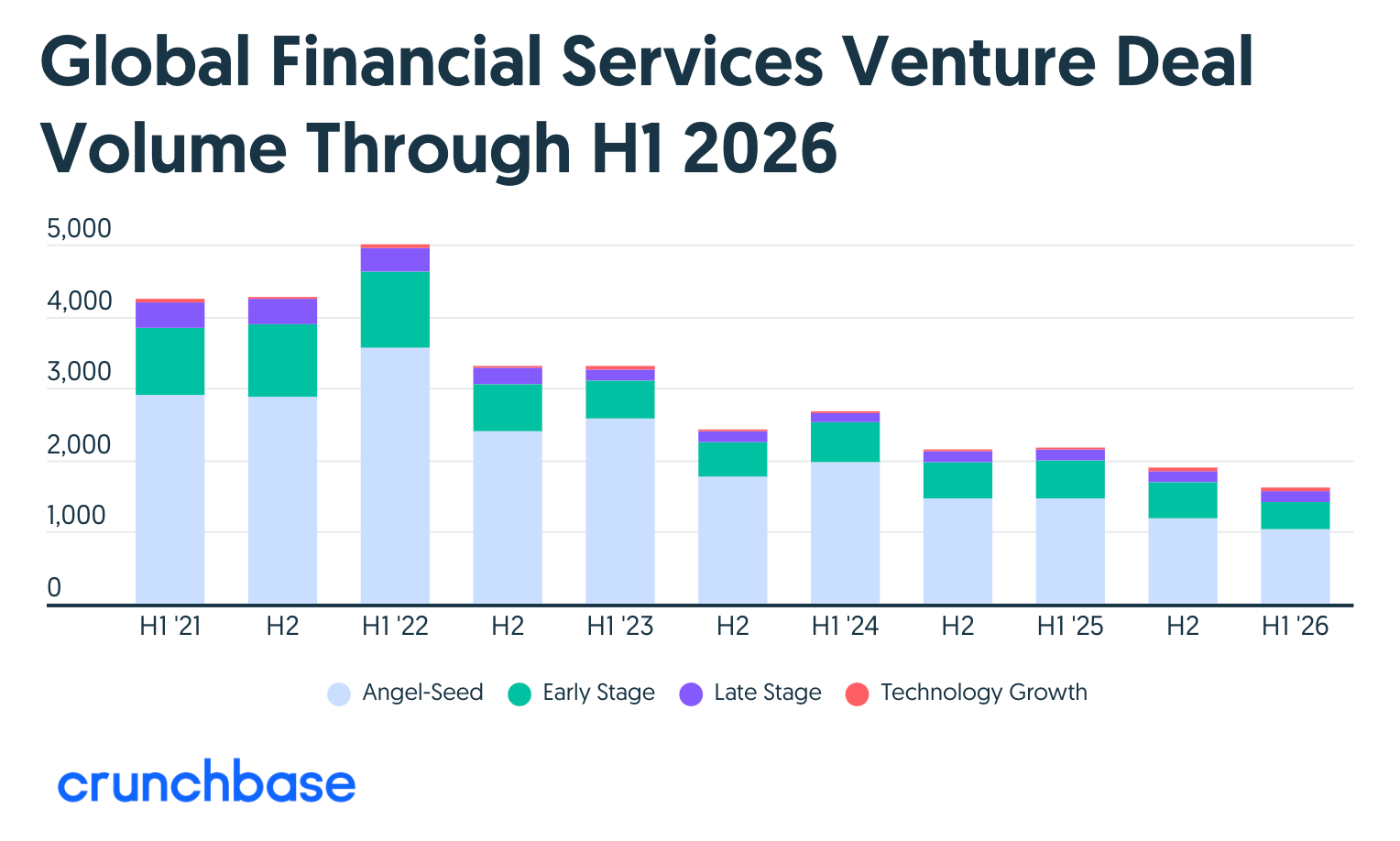
More on this 👉 Crunchbase reports $28.6B across 1,605 deals in H1 2026; PitchBook’s count is $31.4B across 1,640. Both databases tell the same story from different angles: dollars up 23-37% year over year, deal count down 26-27%. The average disclosed round nearly doubled in twelve months, from roughly $10-11M to $18-19M, depending on whose data you trust.
Those averages are doing a lot of work here. Kalshi’s $1.2B round valued it at $22B. Ramp’s $782M valued it at $44B. Add Plata Card ($705M), and the ten largest verified rounds alone account for over $6B of the half’s total. Strip them out, and the remaining 1,590-odd deals split something closer to $22-25B, with a very different average check.
CB Insights sharpens the picture from another angle: Q1 deal count fell to 762, a multi-year low, after declining in seven of the prior eight quarters. Banking funding dropped to $932M across just 34 deals, roughly half of Q1 2025’s total.
So the narrative running through most industry coverage is “fintech is back.” For maybe 50 companies globally, that’s true. For the other 1,550 that raised in H1, the swelling average round masks a tighter, more selective market. For the hundreds that sought term sheets and didn’t get them, “back” is simply fiction 🤷♂️
Zoom out 🔎 What’s happening right now is a phase change in how fintech gets underwritten. In 2021, the category itself was the thesis: if you were digitizing any piece of financial services, someone would fund you. In 2026, the thesis has inverted. Investors are no longer allocating to “fintech” as a sector. They’re underwriting control points: can this company become the system of record for a financial workflow that regulated institutions must run through? If yes, the check has no ceiling. If no, the market barely has a floor.
The companies that cleared the filter show what “control point” means in practice.
→ Taktile raised $110M from Goldman Sachs for an agentic decision platform sold into banks and insurers. The pitch wasn’t “we use AI.” The pitch was “this regulated process used to require weeks of manual review, and now it runs in minutes with a full audit trail.”
→ Ramp’s $44B valuation (roughly 44x its $1B in revenue, per PitchBook) reflects a market that has stopped seeing the company as a corporate card issuer and started seeing it as an operating system for enterprise financial operations: approvals, spend policy, procurement, accounting sync, treasury.
ICYMI:

→ Rain raised $250M at a $1.95B valuation for stablecoin card and wallet infrastructure, framing digital assets not as speculation but as a payments cost problem with an infrastructure solution.
CB Insights reported that spend-management funding grew 4x from 2024 to 2025, which explains why investors treated the CFO stack as a compounding platform bet rather than a narrow corporate-card play.
Stables 🪙 The stablecoin story deserves its own beat in this data. CB Insights found that digital-assets companies averaged $6.4M in valuation per employee in Q1, 83% above the $3.5M fintech-wide average, and that seven of the ten highest-valued fintech teams by that metric were crypto companies.
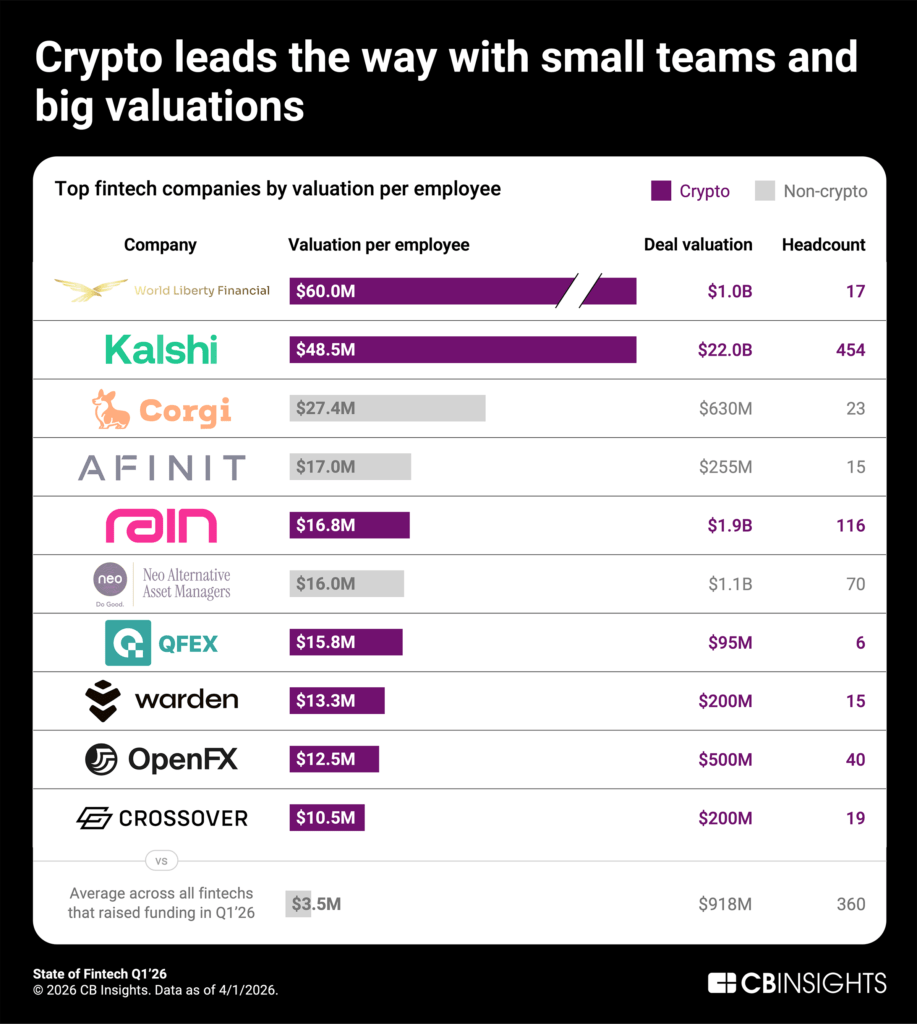
Crypto payment-processing funding grew 3.5x from 2024 to 2025; crypto accounting and tax-reporting funding tripled. Investors are paying a scarcity premium for regulated digital-asset infrastructure even while claiming caution on crypto as an asset class. The dissonance between what investors say about crypto and where they’re actually writing checks is one of the most underappreciated dynamics of this cycle.

M&As 💰 The exit landscape mirrored the same selectivity. Capital One completed its $5.15B acquisition of Brex. Mastercard announced a $1.8B deal for BVNK, pending regulatory approval. Both acquirers bought into categories where building internally would take years of regulatory patience.
The signal to founders: incumbents aren’t acquiring for innovation theater anymore. They’re buying workflow control they can’t build fast enough, and they’re doing it at real prices. Meanwhile, CB Insights counted just 199 fintech M&A deals in Q1, down 26% from Q4 2025. Only three fintech IPOs landed in H1 (Brazil’s PicPay and AgiBank, Japan’s PayPay), all outside the US. The public-market window is cracked, not open.


Global view 🌍 From a geo perspective, the US unsurprisingly captured 52% of global H1 funding at $15B, with the UK at $2.7B and India at $1.9B. But the deals with the clearest moats were often regional: Flutterwave at a $3.25B valuation for African payments rails no US platform can easily copy, Ualá at $3.2B for Latin American consumer banking, Allica Bank at $1.2B for UK SME lending.
THE TAKEAWAY ✈️
What’s next? 🤔 First and foremost, the key question for H2 is whether Q2’s acceleration ($16.5B, up from Q1’s $12B) can sustain without depending on a handful of mega-rounds. If deal count stays depressed while dollars stay strong, fintech venture is healthy for category leaders and structurally punishing for everyone else. That is a stable equilibrium, not a transitional one. Looking ahead, watch for the acquirers who showed up in H1 to pull more late-stage companies off the venture track before they reach IPO scale, especially in spend management, stablecoin infrastructure, and compliance tooling. That creates liquidity for founders who want it, but it thins the pipeline of independent fintechs large enough to go public and reinforces a market where venture-backed fintechs either exit at $20B-plus or get absorbed into incumbents. The middle outcome is thus disappearing. Zooming out, for seed and Series A companies, the clearest implication is that “fintech exposure” no longer earns a meeting. A narrow wedge into a specific financial workflow, with a credible explanation of why that wedge expands into a platform, is the minimum viable fundraise story. The founders who raise successfully in H2 will thus be the ones who stopped calling themselves a fintech company and started naming the exact financial workflow they intend to own. Because in this market, specificity is the pitch.
ICYMI:

🧠 What else I’m watching
PayPal Rejects Offer💳 PayPal’s board (unsurprisingly) deemed Stripe and Advent International’s $53 billion takeover bid, a 28% premium over its share price, insufficient due to concerns over undervaluation and regulatory hurdles, despite $50B in secured financing from JPMorgan & Morgan Stanley. The board is assessing the offer alongside its own turnaround strategy, led by CEO Enrique Lores, which includes restructuring into three core units, deploying AI to cut costs, and targeting $1.5B in savings over 2-3 years. The proposal would keep PayPal intact, with Stripe and Advent sharing equal equity, but the board remains open to higher bids or executing its independent plan. Will PayPal’s bet on itself pay off? I don’t know anymore… ICYMI:
24/7 Tokenized Trading 📈 Arcus has launched 24/7, zero-fee trading for over 95 tokenized US stocks on Robinhood Chain, alongside beta perpetual markets for equities, commodities, indices, and crypto, all accessible via a single self-custodied account. The platform, backed by Robinhood HOOD -5.05%↓ Crypto and built on an Ethereum Layer 2, offers exposure to major tech sectors like AI and semiconductors, with early adoption showing $3.1 billion in DEX volume in its first week. It will be interesting to see if this reshapes how we trade traditional assets. ICYMI: Robinhood Chain is live, but its best product isn’t available in the US ⛓️🇺🇸 [what Robinhood Chain is all about, why it matters & how it integrates into Robinhood’s broader infra strategy + bonus deep dive into Robinhood’s latest financials & AI initiatives, and a full guide to Building your First AI Agent inside]
New Payment Protocol 🌐 The Linux Foundation has launched the x402 Foundation, uniting 40 finance and tech firms to develop an open, interoperable protocol for embedding secure payments directly into web interactions, enabling AI agents and APIs to transact as seamlessly as they exchange data. Contributed by Coinbase, the x402 protocol supports traditional cards to stablecoins and is governed under vendor-neutral stewardship by members like Adyen, AWS, Mastercard, and Visa. It’s a clear bid to redefine how the internet handles money. ICYMI:


💸 Following the Money
Digital asset exchange Crypto.com has secured a $400M investment from Citadel Securities at a $20B valuation.
Tether disclosed a $20M stake in Ualá as part of the Argentine neobank’s previously announced $197M funding round, which values the company at $3.2B.
Digital payments and financial technology conglomerate Ant International has closed on a Series A equity financing of approximately $1.2B. Existing investors including Ant Group and Alibaba Group participated in the round, as well as other international investment institutions.
👋 That’s it for today! Thank you for reading, and have a relaxing Sunday! And if you enjoyed this newsletter, invite your friends and colleagues to sign up:
going to read this first thing tomorrow morning - thanks Linas as usual for all the great stuff that you do
Interesting. I also saw Stripe venturing into this area too...