
Revolut just gave AI Agents keys to its trading platform 🤖💸; Stripe & Advent bid $53B for PayPal, but Advent’s payments empire is the real story 💳👑; Monzo co-founder joins Anthropic 🤯🤖
You're missing out big time... Weekly Recap 🔁

👋 Hey, Linas here! Welcome back to a 🔓 weekly free edition 🔓 of my daily newsletter. Each day, I focus on 3 stories that are making a difference in the financial technology space. Coupled with things worth watching & most important money movements, it’s the only newsletter you need for all things when Finance meets Tech.
If you’re not a subscriber, here’s what you missed this week:
How to Build a Second Brain with Claude Fable 5 🧠 [The step-by-step playbook for building a Claude Fable 5 second brain: persistent AI memory with Obsidian and plain markdown, every prompt included]
The Most Practical Guide to Claude Fable 5 📚 [How to win with the most capable AI model Anthropic has ever released to the public, while you still have about 24 hours left]
How to Build an Agentic OS with Claude Fable 5 🤖 [The complete guide to building an autonomous AI agent operating system with Claude Fable 5 — architecture, working code, cost control, security, and the economics of agentic labor]
Attention Is the New Startup Infrastructure: The Founder’s Playbook for Winning in the AI Age 📚 [Inside a16z’s “go-direct as a service” model — and the exact moves founders need to turn attention into customers, hires, and capital]
Apple’s OpenAI trade secret lawsuit is a hardware play, not a legal one 😳📱 [what the lawsuit is all about and why it’s actually a hardware play, not a legal one at the core + bonus dives into OpenAI’s IPO plans and their Super App strategy inside]
Anthropic’s Claude Code just made SaaS dashboards disposable 🤖📊 [what Claude Code artifacts now calling your MCP connectors is all about, why it matters & how it changes the whole SaaS landscape + bonus guide on How to Build an Agentic OS with Claude Fable 5, and Anthropic that just told AI founders exactly what to build in 2026 inside]
Nubank built Mexico’s largest digital bank without a banking license 🏦🇲🇽 [why full Mexican banking licence matters for NU & what it unlocks + bonus dive into Klarna Bank inside]
Robinhood Chain is live, but its best product isn’t available in the US ⛓️🇺🇸 [what Robinhood Chain is all about, why it matters & how it integrates into Robinhood’s broader infra strategy + bonus deep dive into Robinhood’s latest financials & AI initiatives, and a full guide to Building your First AI Agent inside]
GLM-5.2: The ChatGPT Moment for Local AI 🤖 [Why the first open-weight model that rivals Claude Opus 4.8 and GPT-5.5 — and runs on a single Mac — changes the game for every founder, builder, and investor]
Loop Engineering: How to Design AI Loops That Build, Ship, and Improve While You Sleep 🔁 [From a three-line bash script to multi-day Claude Fable 5 autonomy — everything founders, builders, and investors need to stop prompting agents and start designing the systems that prompt them]
Anthropic Just Told AI Founders Exactly What to Build in 2026 🦄 [1 million conversations. 9 consumer AI domains. A full founder playbook - plus where Anthropic’s own products will and won’t compete]
Who Actually Makes Money When AI Eats the World? 💸 [$700 billion a year in AI capex. A 128x collapse in the price of intelligence. Converging models. Here is where the value actually goes, and the playbook for founders, operators, and investors]
As for today, here are the 3 really incredible FinTech stories that are changing the world of financial technology as we know it. This was yet another solid week in the financial technology space, so make sure to check all the above stories.
Before we dive in, a quick word from our sponsor.

The executive mandate for 2026 is clear:
Capture AI’s productivity gains without losing control of risk.
Yet many organizations cannot answer basic questions:
→ How many AI agents operate across the enterprise?
→ What systems and sensitive data can they access?
→ Where are governance gaps emerging?
You cannot govern what you cannot see or manage risk you cannot measure.
As AI adoption accelerates, static compliance is no longer enough. Organizations need continuous visibility into agents, permissions, identity controls, and exposure.
Okta’s AI Readiness Assessment provides that baseline.
It evaluates governance maturity, visibility gaps, and non-human identity risk, showing where AI initiatives intersect with sensitive systems and where safeguards must improve.
More than a compliance checklist, it is a strategic diagnostic that helps leadership teams prioritize action and scale AI confidently.
Boards increasingly expect both AI innovation and accountability.
The organizations best positioned for the Agentic Era will deliver both.
AI is becoming autonomous. Governance must become equally intelligent.
Establish your agentic security baseline with Okta’s AI Readiness Assessment here.
Revolut just gave AI Agents the keys to its trading platform 🤖💸

The news 🗞️ The most telling detail in Revolut’s new AI trading integration isn’t what it enables - it’s what it concedes: the trading app is no longer the interface that matters.
Let’s take a closer look at this, understand why it matters, and what’s next.
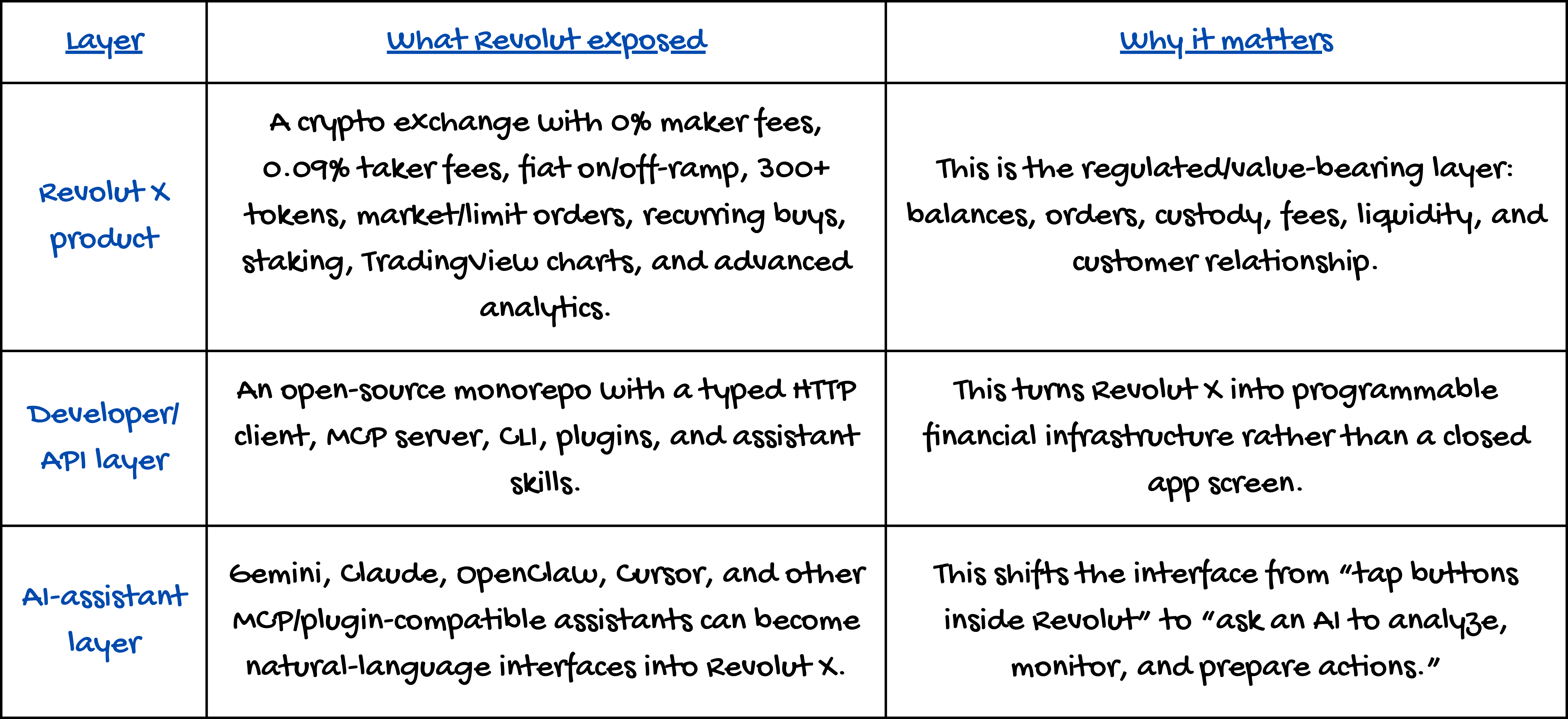
More on this 👉 Late last week, FinTech giant Revolut connected its standalone crypto exchange, Revolut X, to third-party AI assistants, including Claude, Gemini, OpenClaw, and Cursor.

Users can now pull portfolio overviews, set price alerts, backtest strategies, and prepare trades entirely through natural language. Every order still requires explicit human approval before execution.
The mechanism is worth pausing on here. Revolut exposed its trading API through Anthropic’s Model Context Protocol, a standard released in 2024 that lets large language models call external tools without bespoke integrations. Their engineers reportedly prototyped a full market-making workflow in about thirty minutes.
MCP turns what would have been months of partnership negotiation into a plug-and-play connection. Win-win!
Zoom out 🔎 Of course, Revolut isn’t alone here.
↳ Gemini launched its own agentic trading feature in April, claiming first-mover status among regulated U.S. exchanges.
↳ Liquid shipped live trade execution through ChatGPT and Claude a month later.
↳ Robinhood announced crypto-focused Agentic Accounts rolling out imminently.
ICYMI: Robinhood’s Q1 2026: the best brokerage, the wrong price 🤷♂️💸 [breaking down the most important facts & figures from Robinhood’s Q1 2026 to see whether Robinhood is worth your time & money + bonus deep dive into the latest financials of its biggest competitor Coinbase, and why Robinhood’s Agentic AI play is exactly what Anthropic recently told AI founders to build in 2026]
Four platforms in three months, all converging on the same playbook: become the best backend for someone else’s interface.
Importantly, we should look at what Revolut is choosing here. It has 75 million retail customers and over 16 million crypto users, but it’s voluntarily routing engagement through Claude and Gemini rather than keeping users inside its own app.
The key bet here is that accessibility beats exclusivity. In simple terms, the exchange capturing the most AI-routed volume wins, even if users never open the native app again.
THE TAKEAWAY ✈️
What’s next? 🤔 First and foremost, we must note that the move tracks with Revolut’s broader AI posture. They launched AIR, a conversational banking assistant, for UK users in April 2026 and are building/improving PRAGMA, a proprietary foundation model trained on billions of internal financial events for fraud and credit risk. The logic is hybrid: own the model where proprietary data creates an edge, defer to frontier models for reasoning and tool use. Zooming out, the second-order effect worth watching is liquidity fragmentation. When users trade through AI agents instead of exchange UIs, order flow follows whichever model the user prefers, not whichever exchange has the stickiest app. Exchanges thus become interchangeable execution layers. Differentiation collapses into execution quality and pricing, a race that compresses margins fast. Looking ahead, the liability question is equally live here. Revolut explicitly disclaims responsibility for AI-generated errors and losses, pushing risk onto users. That framing won’t survive the first high-profile loss caused by a hallucinated strategy recommendation. That said, expect regulators to start defining what “human approval” actually means when an AI is framing every decision the human sees. All in all, the winners here aren’t necessarily the exchanges moving fastest. They’re the ones building the thickest data moats underneath.
ICYMI: Interactive Brokers just let Grok, Claude, and ChatGPT into your portfolio - on purpose 🤖📊 [what IBKR’s new AI capabilities are all about, how it compares to what Robinhood & eToro have launched, and why it might be the most defensible play + bonus deep dive into Coinbase pivot to Financial OS for AI Agents, how Anthropic wants to be Wall Street’s OS, and AI Playbook for Finance inside]
Anthropic’s Claude Code just made SaaS dashboards disposable 🤖📊 [what Claude Code artifacts now calling your MCP connectors is all about, why it matters & how it changes the whole SaaS landscape + bonus guide on How to Build an Agentic OS with Claude Fable 5, and Anthropic that just told AI founders exactly what to build in 2026 inside]

Stripe and Advent bid $53 billion for PayPal, but Advent’s payments empire is the real story 💳👑

The BIG News 🔥 The company once worth a whopping $360 billion just got offered $53 billion, and the buyers couldn’t even get a meeting.
Stripe and Advent International have jointly bid $60.50 per share for PayPal, backed by $50 billion in committed bank financing, in what would be the largest fintech takeover attempt in years 😳
Most people will treat this as a Stripe goes after PayPal story. It’s not.
Advent is the main architect here, which has spent 18 months quietly assembling a full-stack payments conglomerate through Nuvei and Payoneer, and the 50/50 deal structure tells you exactly how both buyers are pricing risk, reach, and the next era of payments M&A.
Let’s unpack this.
More on this 👉 The offer, reported by Reuters on July 14, comes at a 28% premium to PayPal’s Tuesday close. The two would own the company equally with no plans to break it up.
All three parties declined to comment. PayPal has been reluctant to engage.
Easy to see why. The stock was in the $70s a year ago and peaked above $300 in 2021. New CEO Enrique Lores is mid-turnaround: reorganizing PayPal into three focused units, targeting $1.5 billion in AI-driven cost savings, and planning to cut roughly 20% of the workforce over the next two to three years. Accepting a bid at these levels means selling into weakness before the restructuring thesis gets a chance to work 🤷♂️
Zoom out 🔎 But more importantly, the bid reveals more than the price tag. Look at what Advent has been building.
→ In late 2024, the PE firm took Nuvei private for $6.3 billion.
→ In June 2026, Nuvei agreed to acquire Payoneer for $2.75 billion, adding cross-border payouts and marketplace seller infrastructure.
→ The combined entity targets $3 billion in revenue and over $500 billion in payment volume.
→ Now add PayPal: 400-plus million consumer accounts, Venmo’s P2P network, Braintree’s merchant stack, a growing stablecoin business, and $5 to $6 billion in annual free cash flow.
In other words, Advent isn’t buying companies. It’s assembling a payments conglomerate, one deal at a time.

Stripe’s interest is different but equally legit. At a $159 billion private valuation, Stripe dominates developer-facing and embedded payments. What it lacks is consumer reach.
PayPal and Venmo deliver that instantly, and in a world moving toward AI-driven Agentic Commerce, where bots handle purchasing, owning the consumer checkout layer becomes a distribution moat, not a legacy liability. I wrote about this in depth when Bloomberg first reported Stripe’s interest in February: PayPal’s decline is architectural, not managerial, and its 434 million consumer accounts are worth more as raw material for an infrastructure company than as a standalone business. The full analysis - covering the closed-loop network thesis, the stablecoin full-stack play, and why Stripe is valued at nearly 4x PayPal despite a fraction of the revenue - is here:

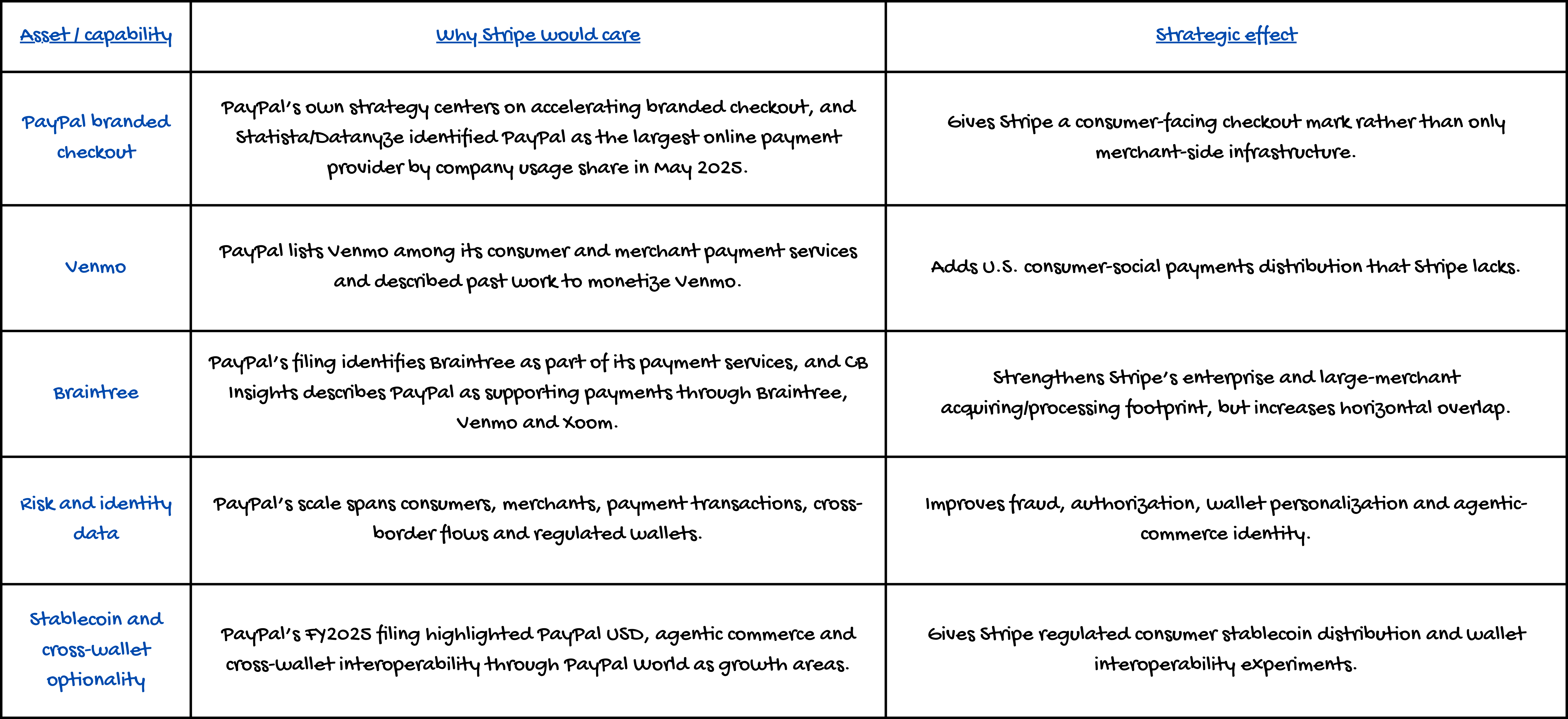
The 50/50 structure is the quiet tell. Neither party wants to absorb this alone.
↳ Stripe gets reach without bearing the full integration risk.
↳ Advent gets Stripe’s tech credibility to de-risk a PE play on a complex, public-market-bruised asset.
Sharing the financing burden is math. Sharing the execution risk is strategy 👏
THE TAKEAWAY ✈️
What’s next? 🤔 First and foremost, PayPal almost certainly will reject at this price, but the bid has reframed the conversation. A public offer creates a reference point that activists, competing bidders, and PayPal’s own board now can’t ignore. And Lores’ background is worth watching here: at HP, he orchestrated the split into HP Inc. and Hewlett Packard Enterprise. Thus, if he announces a strategic review or begins separating Venmo, Braintree, and branded checkout into distinct units, the acquisition dynamics change entirely. Looking ahead, expect at least one more suitor to kick the tires, whether a card network or a Big Tech player. More broadly, this accelerates a pattern already visible in Global Payments/Worldpay and other combinations: payments is consolidating into fewer, larger platforms that span acceptance, payouts, cross-border, and digital assets. The companies that can’t reach that scale on their own will be bought by those that can. So the current offer price may be wrong. The thesis behind it isn’t.
ICYMI: Adyen and Stripe push deeper into Agentic Commerce after OpenAI’s checkout failure 🤖💳 [what Adyen Agentic is all about, how it compares with Stripe’s Agentic AI initiatives, & what’s one thing nobody talks about here + bonus dives into Visa & Mastercard’s AI challenges & how to build your first AI Agent from scratch inside]
Monzo co-founder Tom Blomfield joins Anthropic’s compute team 🤯🤖
The BIG News 🔥 Turns out, the most revealing hire in AI this quarter isn’t a researcher.
Tom Blomfield - co-founder of GoCardless and Monzo, former YC Group Partner - just joined Anthropic as a Member of Technical Staff on the compute team, reporting to co-founder and Chief Compute Officer Tom Brown. Blomfield has never designed a chip or optimized a kernel. He scaled a digital bank through heavy regulation and capital constraints to serve millions of customers.
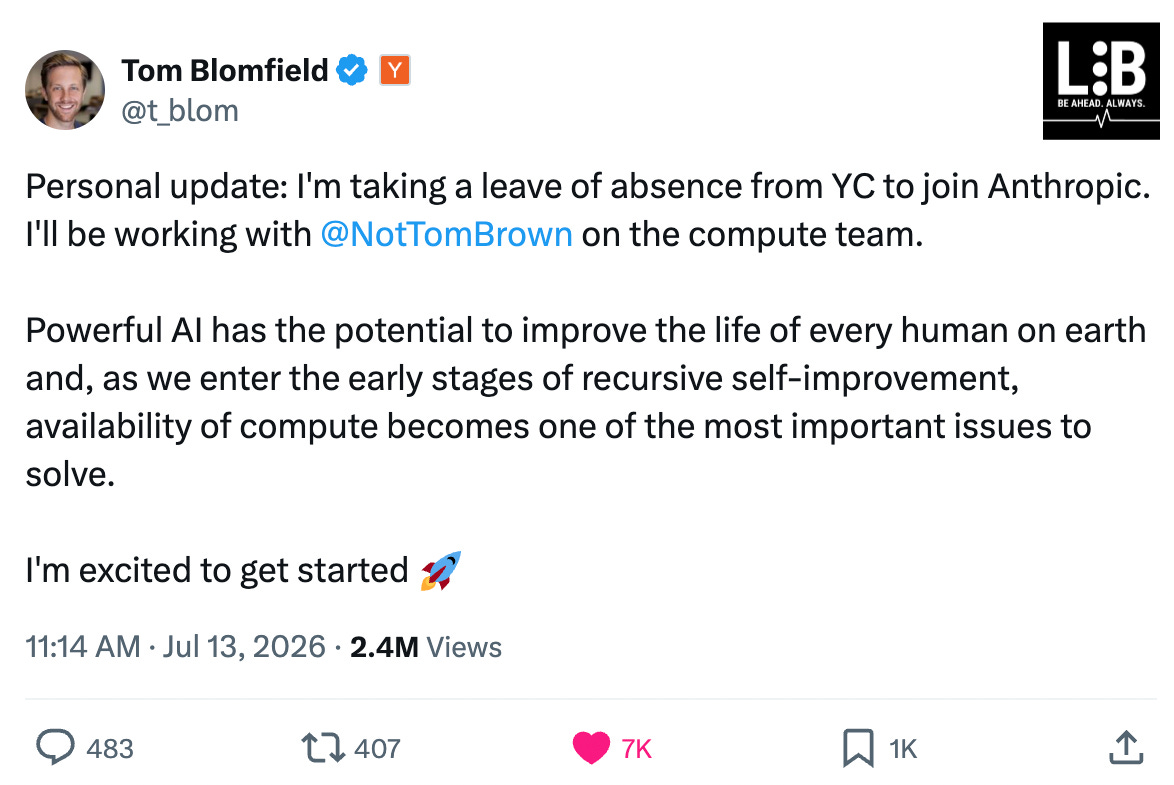
And that’s exactly why Anthropic wants him. Let’s unpack this.
More on this 👉 The hire only makes sense if you accept that compute has become a founder-level operating problem.
Anthropic isn’t short on technical depth. They’ve brought in ex-Google data center engineers, custom chip leads from OpenAI, and Rahul Patil as CTO (formerly Stripe) to oversee infrastructure. What they needed was someone who’s built and run a capital-intensive, operationally complex business at scale. Blomfield has done it twice.
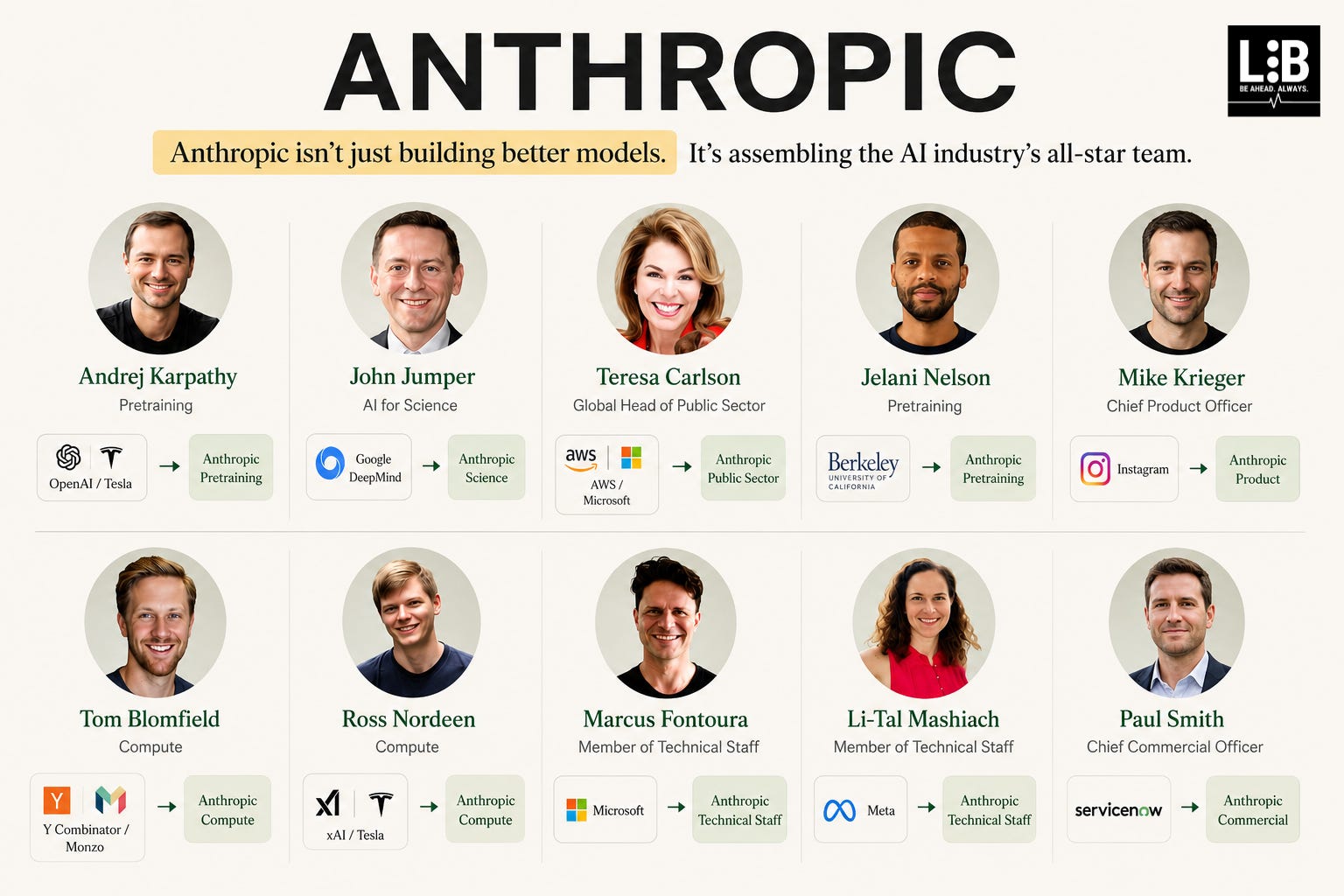
Zoom out 🔎 The broader hiring pattern makes the strategy legible.
↳ Andrej Karpathy for pre-training research.
↳ John Jumper (DeepMind) for scientific capabilities.
↳ Eric Boyd (Microsoft Azure) for cloud-scale infrastructure.
↳ Patil for reliability engineering at volume.
↳ Now Blomfield for operational execution.
Roughly 40% of Anthropic’s engineering team comes from infrastructure backgrounds, and they’re diversifying across Nvidia GPUs, Google TPUs, and AWS Trainium simultaneously.
In other words, the AI giant is assembling a compute organization that looks less like a research lab and more like a vertically integrated utility.
THE TAKEAWAY ✈️
What’s next? 🤔 Looking ahead, here’s what to watch. First and foremost, as models grow and agents run longer, the bottleneck is no longer training capability. It’s serving millions of inference requests reliably without hemorrhaging cash. Blomfield’s career was built on exactly that problem: making complex, regulated systems work for millions of daily users while keeping the economics viable. Ultimately, Anthropic is betting that the lab winning the infrastructure layer, not just the benchmark layer, will own the next decade of AI. Thus, the talent war is no longer about the models. It’s about ops. And most of the market hasn’t caught up yet.
ICYMI:

🧠 What else I’m watching
Visa Travel Companion ✈️ Visa launched Visa Destinations, a mobile-first travel platform offering curated experiences in 10 cities including Paris, London, and New York. With offers like Michelin menus and West End tickets, Visa is shifting from payment provider to travel companion. Partners include Santander, Global Blue, Star Alliance, and Trip.com. Can this redefine Visa’s role in travel? 🤔 ICYMI: Visa and Mastercard’s Agentic AI payment platforms have a volume problem 🤖📊 [what it’s all about, why it matters & why payment titans have a volume problem here + bonus reads into other Visa & Mastercard’s agentic AI moves, & how Google wants to be the OS for all commerce inside]
BBVA AI Insights 🤖 BBVA is using generative AI to analyse customer conversations, moving beyond surveys to build a comprehensive view of user experience. In Spain, AI analyses call transcripts to identify contact reasons, while in Mexico it processes 220,000+ monthly calls. The system identifies friction points, tracks interactions, and links abandoned app transactions to support contacts. Relationship managers get automatic summaries before calls. Hopefully, this will redefine the customer service in banking. ICYMI:
ABN Amro Cuts Jobs 👋👥 ABN Amro’s ICS, the Netherlands market leader with 2.6 million clients, will outsource core operations to Worldline from Q2 2028, affecting 450 of its 850 staff. That’s more than 50%! The deal transfers credit card issuing, transaction processing, IT, and customer services. ABN Amro will consider attrition and redeployment as well. The move follows Worldline’s recent losses of Tier 1 bank deals. While outsourcing might boost Worldline’s turnaround, it is yet another reason you should productize yourself. ICYMI:


💸 Following the Money
Financial crime prevention platform Tangos AI has closed a $20M Seed financing round led by Red Dot Capital Partners.
Stablecoin treasury and settlement platform Velocity raises $38M.
Float, the Stockholm-founded revenue-based financing platform for tech SMEs, has secured a €4.5M Series A funding round led by Hamburg-based Chapters Group AG.
👋 That’s it for today! Thank you for reading, and have a relaxing Sunday! And if you enjoyed this newsletter, invite your friends and colleagues to sign up:
Super packed issue - will have a lot of fun reading
My favourite read on Sunday - thanks as always!