
Cloudflare just made every URL billable 🌐💸; OpenAI is now paying Wall Street bankers $500K to train AI, not close deals 😳🤖
You're missing out big time... Weekly Recap 🔁

👋 Hey, Linas here! Welcome back to a 🔓 weekly free edition 🔓 of my daily newsletter. Each day, I focus on 3 stories that are making a difference in the financial technology space. Coupled with things worth watching & most important money movements, it’s the only newsletter you need for all things when Finance meets Tech.
If you’re not a subscriber, here’s what you missed this week:
The Most Practical Guide to Claude Fable 5 📚 [How to win with the most capable AI model Anthropic has ever released to the public, while you still have about 24 hours left]
How to Build an Agentic OS with Claude Fable 5 🤖 [The complete guide to building an autonomous AI agent operating system with Claude Fable 5 — architecture, working code, cost control, security, and the economics of agentic labor]
Attention Is the New Startup Infrastructure: The Founder’s Playbook for Winning in the AI Age 📚 [Inside a16z’s “go-direct as a service” model — and the exact moves founders need to turn attention into customers, hires, and capital]
Claude Managed Agents Quietly Became the Most Important AI Infrastructure Bet of 2026 🤖 [Anthropic shipped autonomous, self-scheduling AI agents. AWS and Google copied the architecture within two weeks. The race to own the agent runtime just started]
Klarna applied for a US bank charter. It’s all about funding costs, not trust 🏦🇺🇸 [what Klarna Bank is all about & why it’s a smart play + bonus deep dives into SoFi, and The Founder’s Playbook for Winning in the AI Age inside]
Coinbase clearly doesn’t want to be a crypto exchange anymore 👋📱 [what their UK investment services authorization is all about & how it stacks with the Everything Exchange play + bonus deep dives into Coinbase’s new AI Agent OS strategy and Robinhood’s latest financials inside]
Fable 5 got five more days. Some users have to show ID to get in 🤖🪪 [what it’s all about & what it tells us about the future of AI + bonus dives into exactly what to build with Claude Fable 5 while you still have time, and The Most Practical Guide to Fable 5 inside]
GLM-5.2: The ChatGPT Moment for Local AI 🤖 [Why the first open-weight model that rivals Claude Opus 4.8 and GPT-5.5 — and runs on a single Mac — changes the game for every founder, builder, and investor]
Unlock Claude Fable 5 Lite on Claude Opus 4.8 🔓 [The full Fable 5 system prompt and the step-by-step guide to turn Claude Opus 4.8 into a Fable-class AI assistant after Anthropic shut it down]
Loop Engineering: How to Design AI Loops That Build, Ship, and Improve While You Sleep 🔁 [From a three-line bash script to multi-day Claude Fable 5 autonomy — everything founders, builders, and investors need to stop prompting agents and start designing the systems that prompt them]
Coatue’s May 2026 Report: The $12 Trillion AI Bet and Who Ends Up on the Wrong Side 📊 [Coatue’s latest public markets report reveals the most extreme winner/loser split in tech stock history, a $12 trillion AI capex wave, and one brutal framework that predicts exactly who wins]
Anthropic Just Told AI Founders Exactly What to Build in 2026 🦄 [1 million conversations. 9 consumer AI domains. A full founder playbook - plus where Anthropic’s own products will and won’t compete]
As for today, here are the 2 really fascinating FinTech stories that are transforming the world of financial technology as we know it. This was yet another wild week in the financial technology space, so make sure to check all the above stories.
Before we dive in, a quick word from our sponsor.

For decades, enterprise security had a clear model.
Protect users.
Defend the perimeter.
Control access to systems and data.
AI agents change that.
They move across applications, APIs, cloud environments, and data layers. They interact with other agents, trigger workflows, and execute tasks — often without direct human oversight.
The problem: identity was built for people, not autonomous actors.
When an AI agent accesses sensitive data or performs a business action, security teams need to know what acted, under whose authority, and with which permissions.
Without that, attribution, auditability, and blast-radius analysis become much harder.
The winners of the Agentic Era won’t be the companies deploying the most agents.
They’ll be the ones that can govern them at scale.
That means distinct identities, least-privilege access, time-bound permissions, continuous verification, and ongoing oversight.
Okta’s AI Readiness Assessment helps enterprises evaluate whether their identity infrastructure is ready before agents move from pilot to production.
Evaluate your infrastructure with Okta’s AI Readiness Assessment here.
Cloudflare just made every URL billable 🌐💸

The news 🗞️ HTTP 402, “Payment Required,” has sat unused in the protocol spec since 1997 - a placeholder for a payment layer the web never built. On July 1, Cloudflare turned it on.
Let’s take a look at this.
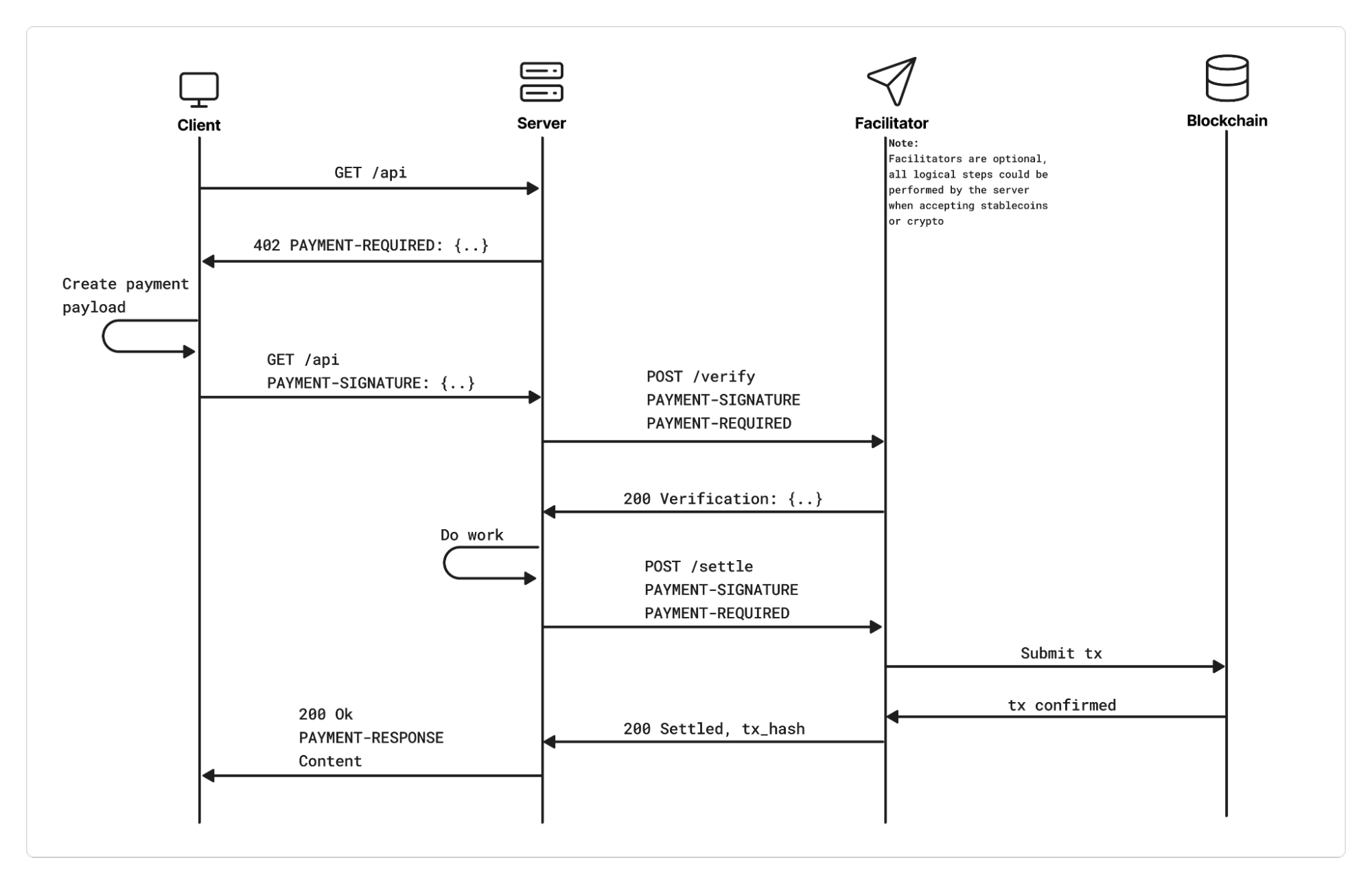
More on this 👉 The company’s new Monetization Gateway brings the x402 protocol to any resource behind its network. The mechanics are simple: a client requests a URL, gets back a 402 with pricing details, signs a stablecoin payment (USDC on Base, typically), and retries with proof attached.
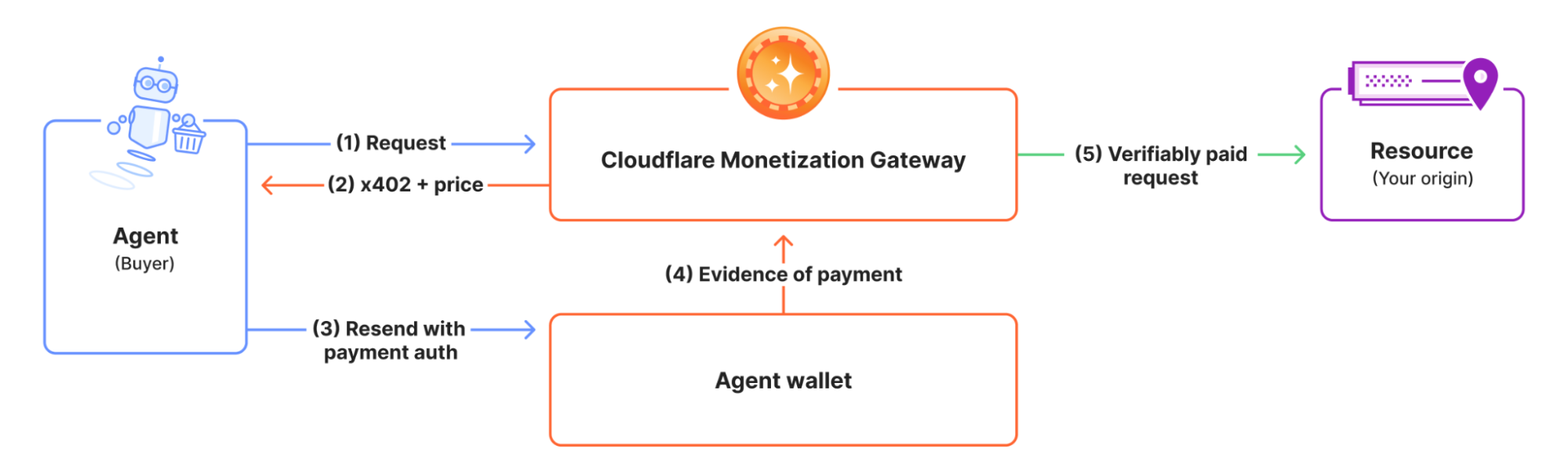
The server delivers the content. No accounts, no API keys, no subscriptions, no human approval. The whole exchange happens in standard HTTP.
We must remember that Coinbase originally built x402 and open-sourced it in May 2025 before handing governance to the Linux Foundation in April 2026.
ICYMI: Coinbase is replacing the crypto exchange model with a Financial OS built for AI Agents 🤖⚙️ [Coinbase’s System Update with a focus on key products & launches, what does it all tell us & which competitors should worry the most + bonus deep dive into Coinbase’s latest financials & how Anthropic wants to be the AI OS for Wall Street inside]
The foundation’s member list tells you where the wind is blowing: Stripe, Visa, Mastercard, Amex, AWS, Google, Microsoft, Circle, Shopify. When every major payments incumbent joins the same open standard, they aren’t experimenting. They’re positioning around something they expect to become the default infrastructure.
Zoom out 🔎 Early traction backs that up. Kinda.
→ Roughly 155 million cumulative transactions have settled through x402, totaling about $41 million in volume.
→ The most recent 30-day window: 75 million transactions, $24 million.
→ The mix is shifting from crypto-native experimentation toward utility-driven transfers.
ICYMI: Visa and Mastercard’s Agentic AI payment platforms have a volume problem 🤖📊 [what it’s all about, why it matters & why payment titans have a volume problem here + bonus reads into other Visa & Mastercard’s agentic AI moves, & how Google wants to be the OS for all commerce inside]
More importantly, what separates Cloudflare’s entry from yet another payments announcement is distribution. The company routes a massive share of global web traffic. By embedding x402 at the edge, per-request monetization becomes a configuration option rather than an engineering project. A solo developer with a useful dataset can thus charge AI agents per query without ever building billing infrastructure. And that’s really cool!
And AI agents are the real customer here. Systems that fire thousands of API calls per task can’t manage subscriptions or handle approval flows. x402 gives them a wallet and a protocol. Agents become paying customers, autonomously.
THE TAKEAWAY ✈️
What’s next? 🤔 First and foremost, the first-order effect here is a new revenue channel for content and data owners who’ve watched AI companies scrape their work for free. The second-order effect is more interesting: if every HTTP request can carry a price, the economics of AI training and inference change. Data providers therefore gain real pricing power. Agent orchestration frameworks will need embedded payment logic, creating a new middleware category. That said, watch for MCP tool marketplaces where agents comparison-shop for capabilities by price and quality. Looking at the bigger picture, the risk worth tracking here is fragmentation. If pricing becomes too granular, agent costs turn unpredictable, and the open web splinters into a bazaar where every request has a toll. So how platforms handle freemium tiers and spending caps will matter as much as the protocol itself. The web has always moved data for free and charged for everything around it. That default just flipped.
ICYMI:

OpenAI is now paying Wall Street bankers $500K to train AI, not close deals 😳🤖
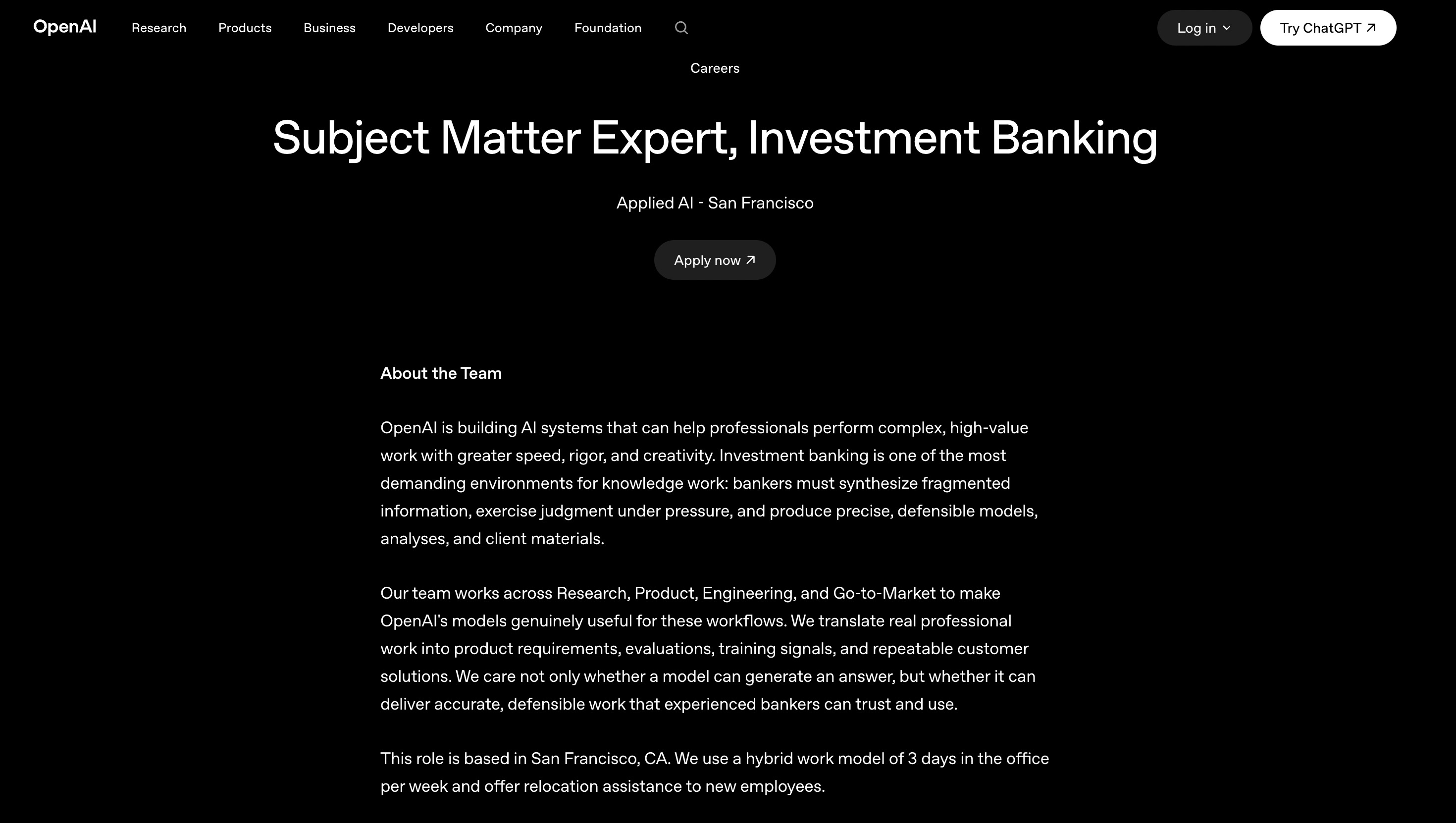
Following the money 💸 The most telling hire in finance right now isn’t the one at Goldman Sachs or JPMorgan. It’s a subject-matter expert role on OpenAI’s finance team, paying up to $500K in total comp, requiring just two years of deal experience, and asking the candidate to do one thing: teach an AI what good investment banking looks like.
The position grew out of a secretive 2025 contractor program called Project Mercury, and it’s the clearest signal yet that the AI arms race in finance has moved past the model layer.
OpenAI, xAI, and Anthropic are all now converging on the same scarce resource, and it isn’t compute or data. It’s the handful of people who’ve sat on live deals and can translate that judgment into something a machine can learn from.
Most importantly, how each lab is attacking that problem, and what it means for Wall Street’s junior ranks and the banks trying to keep up, tells you more about where AI in finance is actually headed than any product launch or benchmark.
More on this 👉 The role sits on Ryan Brewer’s vertical finance team. Brewer joined OpenAI around March 2026 to wire models into analysts’ actual workflows, tools, and data. His team’s first product was the ChatGPT for Excel add-in with financial data integrations.
The SME position is the full-time evolution of Project Mercury, a late-2025 effort that brought on 100+ ex-bulge-bracket bankers as contractors at roughly $150/hour to build Excel models, write prompts, and critique AI outputs across IPOs, LBOs, restructurings, and pitch decks.
But Mercury was about teaching formatting and basic deal logic. The SME role raises the bar: building evaluation rubrics that test not just whether numbers are right, but whether the analytical judgment behind them would survive a managing director’s review.
Zoom out 🔎 Of course, OpenAI is not alone here.
→ xAI is running a parallel playbook, posting multiple “Investment Banking Expert” contractor roles across M&A, ECM, and DCM at $45–100/hour.
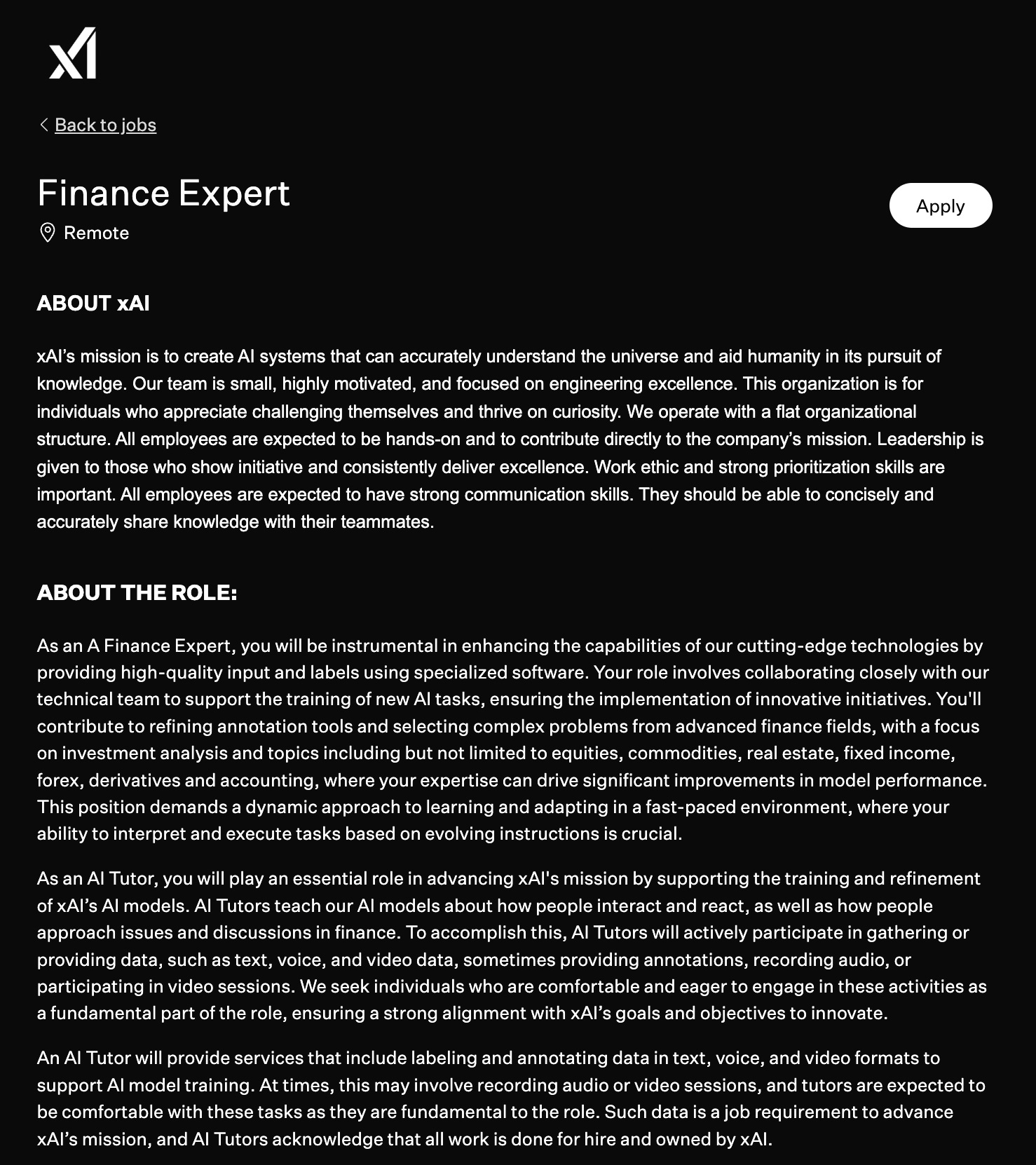
→ Anthropic has taken a different path, shipping Claude for Financial Services with FactSet, S&P, and PitchBook connectors, pre-built agents for DCFs and pitchbooks, and enterprise deployments at JPMorgan, Goldman, and Citi.
ICYMI: Anthropic stopped selling AI to Wall Street and started becoming Wall Street’s Operating System 🏦🧠 [what the 10 finance AI agents actually do, why FactSet dropped 8.1% the same day, what the FIS infrastructure deal and $1.5B Blackstone/Goldman JV mean for distribution & what to expect next + bonus Guide on Claude Managed Agents, Claude Code Routines, & How to Build Your First AI Agent from Sratch inside]

The strategies differ, but the bottleneck is identical: people who can translate professional judgment into training signal that models can learn from.
Most importantly, what’s happening here isn’t AI companies dabbling in finance. It’s the deliberate industrialization of domain expertise. All three labs have concluded that the next moat isn’t model scale. It’s the quality of the human feedback loop in specific verticals.
Finance is the beachhead because the work is structured enough to evaluate, expensive enough to justify automating, and already running on tools that AI can plug into directly.
THE TAKEAWAY ✈️
What’s next? 🤔 First and foremost, watch for Brewer’s team to expand into adjacent verticals like PE, equity research, and credit within the next year. Second, the comp premium tells you how few people currently sit at the intersection of live deal exposure and the ability to codify it for machines. That scarcity will thus create a new class of finance professional: someone whose primary job is evaluating AI output, not producing analysis themselves. Which means that the junior analyst role doesn’t disappear as such, but it forks. One path leads toward client-facing judgment. The other leads toward training and evaluation infrastructure. Banks that invest in the second track early will therefore have a structural edge. Everyone else will be licensing the same model and wondering why the outputs aren’t as sharp.
ICYMI: OpenAI’s Codex just became a Wall Street analyst, and the moat belongs to FactSet & Moody’s 🤖📊 [what OpenAI exactly shipped and why it matters, how this hands the durable moat to companies most people aren’t even watching, and the 4 shifts we’d bet on over the next 2 years + bonus deep dives into OpenAI’s Super App strategy & how Anthropic just told AI founders exactly what to build in 2026 inside]
The Claude Finance Playbook: How CFOs Use AI to Build Models, Forecast Cash, and Close Books Faster 📊 [A practical guide to setting up Claude for real finance work, with battle-tested prompts optimized for Claude Opus 4.7]
🧠 What else I’m watching
Starling Cuts Jobs ✂ Starling Bank plans to cut around 130 jobs to eliminate duplicate roles and speed up product launches, restructuring its banking and tech operations while increasing AI investment. This follows a 5.6% revenue drop to £887M and a 3% profit decline to £217M. Starling cites agility as key to maintaining its competitive edge over legacy banks. It will be interesting to see whether automation drives its recovery. ICYMI: Starling Bank’s 2026 financials: 2.5x Monzo’s profit on half the revenue, and a £70M SaaS pipeline that changes the IPO math 📈🧠 [unpacking the most important financial facts & figures, how it stacks against Monzo & Revolut, & why Starling’s balance sheet is a fortress + bonus deep dives into the latest financials of Monzo & Revolut inside]
ECB Warns on AI 🛡️ The European Central Bank ordered banks to submit action plans by October to address AI-enabled cyber threats from models like Anthropic’s Mythos. Short-term, banks must accelerate patch management, enhance monitoring, and verify third-party risks. Long-term, they should modernize infrastructure. The ECB also flagged quantum computing risks, while the ESRB warns that AI currently advantages threat actors. ICYMI:
AI Shops for You 🤖 CaixaBank and Visa completed Europe’s first AI-initiated transaction, with an agent executing a purchase on behalf of a cardholder using existing payment infrastructure. Part of Visa’s Agentic Ready programme, the transaction maintains cardholder consent, issuer oversight, and security safeguards like tokenisation and real-time fraud monitoring. This marks a step toward integrating AI into everyday commerce. ICYMI:


💸 Following the Money
Crédit Agricole has bought out Worldline to take 100% ownership of Cawl, the merchant payment services joint venture that the two established in 2023. Financial terms were not disclosed.
LinqAlpha raises $22M to build an alpha intelligence layer for global public markets.
Flutterwave, Africa’s leading payments technology company, announced a strategic investment from Circle Ventures, the corporate venture arm of Circle Internet Group. ICYMI:

👋 That’s it for today! Thank you for reading, and have a relaxing Sunday! And if you enjoyed this newsletter, invite your friends and colleagues to sign up:
Nice one, thx
Wow, so packed - thanks Linas, saving for later for sure.