

👋 Hey, Linas here! Welcome back to a 🔓 weekly free edition 🔓 of my daily newsletter. Each day, I focus on 3 stories that are making a difference in the financial technology space. Coupled with things worth watching & most important money movements, it’s the only newsletter you need for all things when Finance meets Tech.
The Age of the One-Person Company 🦄 [What the latest data reveals about solo founders building million-dollar companies with AI agents instead of employees, and where the next big opportunity is in 2026]
The Power Shift: Why Electricity Is AI’s Real Bottleneck ⚡️ [AI’s bottleneck is shifting from chips to gigawatts. Who secures power, and on what terms, will decide who captures value from the next phase of AI infrastructure]
Y Combinator’s QM: The Complete Guide to YC’s Open-Source AI Agent Harness 🤖 [The step-by-step guide for the AI agent harness YC uses to run itself: setup, 15+ copy-paste prompts, the highest-impact workflows for startups & small teams, and the security realities you must know]
The Ultimate Guide to Qwen3.8-27B 🤖 [How to run Alibaba’s 27B open AI model locally: a step-by-step guide to the settings, hardware requirements, & prompts that deliver frontier AI results for founders, builders, and investors]
Are We Bullish Enough on Revolut? 🦄💸 [deep dive into Bullhound Capital’s 56-page report on Revolut, breaking down whether the report is actually bullish about the right things, the 3 options it leaves completely unpriced, including PRAGMA, the in-house AI foundation model quietly becoming the bank’s operating system, plus the 2 numbers most likely to break the $400B path, & actionable takeaways for founders, operators & investors + bonus deep dives into the AI Monopoly Playbook, the latest financials of Monzo & Starling Bank, and The New Enterprise AI Go-To-Market Playbook inside]
The New Enterprise AI Go-To-Market Playbook 📚 [The a16z framework that decides which AI startups win the enterprise, and how founders can use it in 2026]
Nubank’s Q2 2026: the best-run bank on Earth, and the $1 billion quarter that wasn’t 🏦👀 [breaking down the most important facts & figures from Nubank's Q2 2026, including the $500M buyback nobody mentioned & the AI flywheel incumbents can't copy, to see whether NU 0.00%↑ is still worth your time & money + bonus guide on how to Turn Claude Opus 5 Into a Financial Analyst That Never Sleeps inside]
Ramp is building the CFO for AI Agents 📊🤖 [the Stripe vs Ramp routing war, how USDC agent wallets turn AI agents into controlled corporate spenders, who wins between developers and CFOs + bonus deep dives into How to Build an Agentic OS with Claude Fable 5 & The AI Monopoly Playbook inside]
The Everything Router: Stripe to acquire OpenRouter for more than $7 billion 🔀💸 [why the $3B haircut from July's price is the real tell here, what falling token prices reveal about OpenRouter's fee base, & whether this is Stripe's Instagram Moment + How to Build an Agentic OS with Claude Fable 5, and AI Monopoly Playbook inside]
PayPal rejected a $53B buyout bid. Now it’s negotiating 👀🤝 [why the Q2 "beat" was mostly arithmetic underneath and gives Lores less leverage than it looks, what a forced Braintree carve-out means for Advent's growing payments empire, & what’s next + bonus deep dive into PayPal’ Q2 2026 earnings & The New Enterprise AI Go-To-Market Playbook inside]
How to Build an AI Monopoly: The New Rules of Startup Strategy 🦄 [Anyone can build an AI product now. Almost no one can build an AI company. Here is how to escape competition, build moats that compound, and capture the value you create]
How to Build an Agentic OS with Claude Fable 5 🤖 [The complete guide to building an autonomous AI agent operating system with Claude Fable 5 — architecture, working code, cost control, security, and the economics of agentic labor]
As for today, here are the 2 incredible FinTech stories that are changing the world of financial technology as we know it. This was yet another wild week in the financial technology space, so make sure to check all the above stories.
Stripe’s leaked investor letter says the Singularity started January 1st 🤖😳
The news 🗞️ Patrick Collison just told Stripe’s investors that the singularity began on January 1, 2026, and that their company now manages two currencies, money and intelligence.
Let’s unpack this.
More on this 👉 Stripe’s August 19 investor update, written to announce the OpenRouter acquisition, goes past the deal. It identifies capital and intelligence as the two digital flows that run every business, then argues that managing inference spend requires the same discipline as managing financial capital: cost-of-return reasoning on every unit and granular billing against time-value of delay.
Stripe built the pipeline for the first flow. OpenRouter is the pipeline for the second.
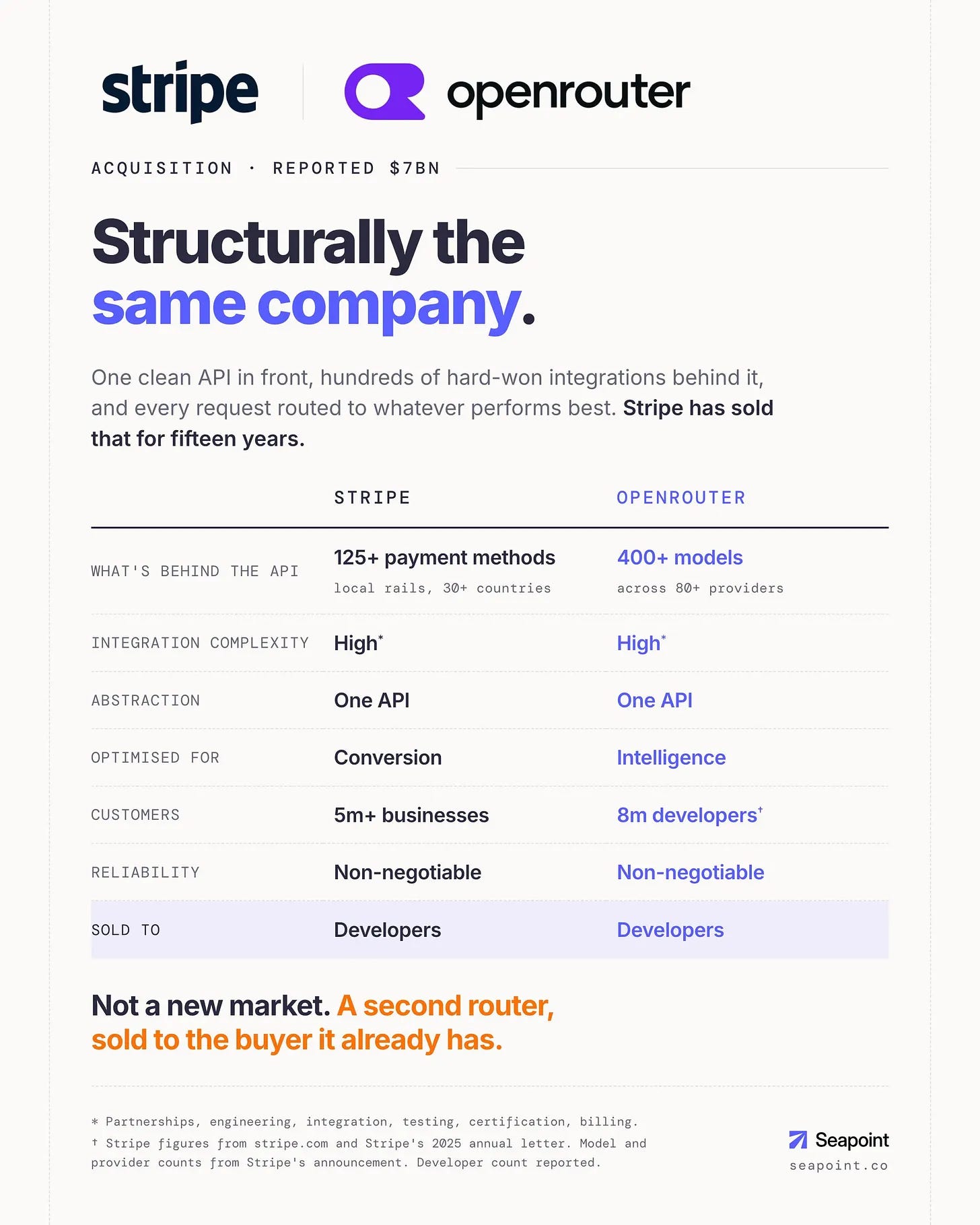
Nobody else describes OpenRouter that way. The market calls it a router. Stripe’s own CEO calls it an intelligence pipeline, and the letter treats tokens as a parallel currency to dollars: expensive, heterogeneous, and constantly changing. Accept the framing and the $7 billion price stops looking like a premium for routing. It becomes the entry cost for a second Stripe-shaped business running on a second currency.
The Collisons are careful to strip the word of its apocalyptic baggage. They mean an observed inflection, especially in the rate of new firm creation, and they decided to take it seriously. The numbers back the posture.
H1 2026 net revenue grew 41% year over year, free cash flow grew 43%, and Stripe Billing grew 71%.
Atlas now accounts for more than a quarter of all Delaware incorporations, and Link passed 300 million users.
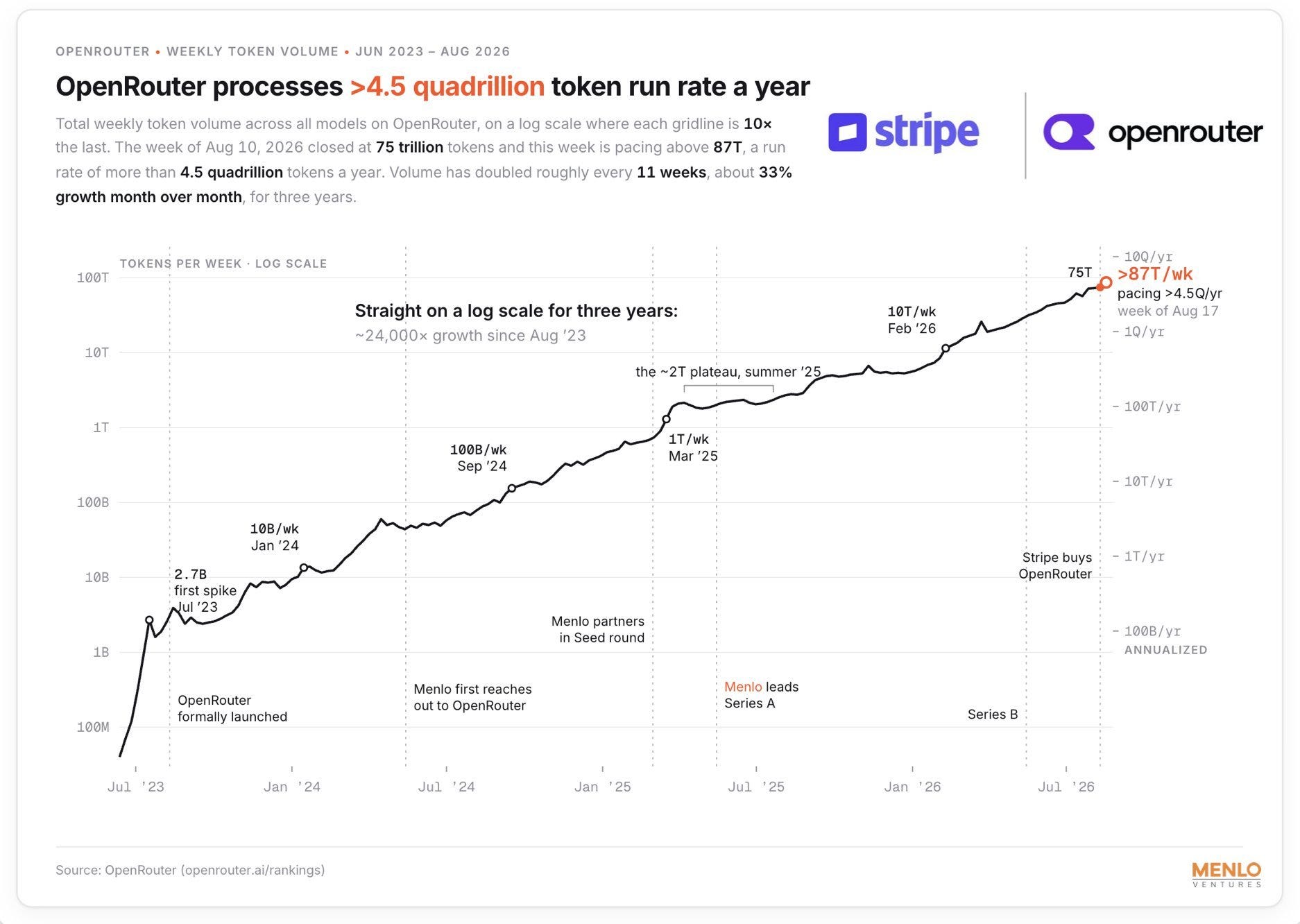
Token consumption on OpenRouter has been compounding at 9% per week year-to-date, which annualizes to roughly 90x.
Zoom out 🔎 The product stack the letter maps out is the Khala Research diagram we published earlier this week, made official.

Discovery and onboarding for agents through Stripe Projects, Directory, and a Provisioning API.
Usage management through Metronome.
Payments through Bridge, MPP and Tempo.
Fund storage through Privy and a new stablecoin.
OpenRouter slots in as the routing and metering layer that feeds every stage downstream.
The letter confirms that Radar, originally built for payment fraud, is already being used to detect token fraud at major AI companies, which is yet another product that deepens lock-in without a new sale.
The letter also answers the dilution question we raised two weeks ago. Stripe’s share count is lower today than three years ago, despite Bridge, Metronome, Privy and now OpenRouter. In other words, the core payments engine prints enough cash to absorb all four without net dilution. Share price has compounded at 31% annually since the Series D a decade ago, against 14% for the S&P 500.

THE TAKEAWAY ✈️
What’s next? 🤔 The deal should close in the coming weeks, and the framing debate closes with it. OpenRouter is not a model router that Stripe overpaid for. It is, in Stripe’s own words, the other half of what every developer needs. And whether the world agrees depends entirely on whether tokens actually behave like a currency. If they do, Stripe just doubled its addressable surface. If they don’t, it bought an API aggregator for 50 times revenue. Our AI Monopoly Playbook readers know which side of that bet the infrastructure layer tends to win.
ICYMI:


Razorpay launches Vulcan, India’s first AI payments foundation model 🤖🇮🇳
The news 🗞️ The most valuable AI models of 2026 may not speak a word, and Razorpay just built one that only reads money.
Let’s take a closer look at this.
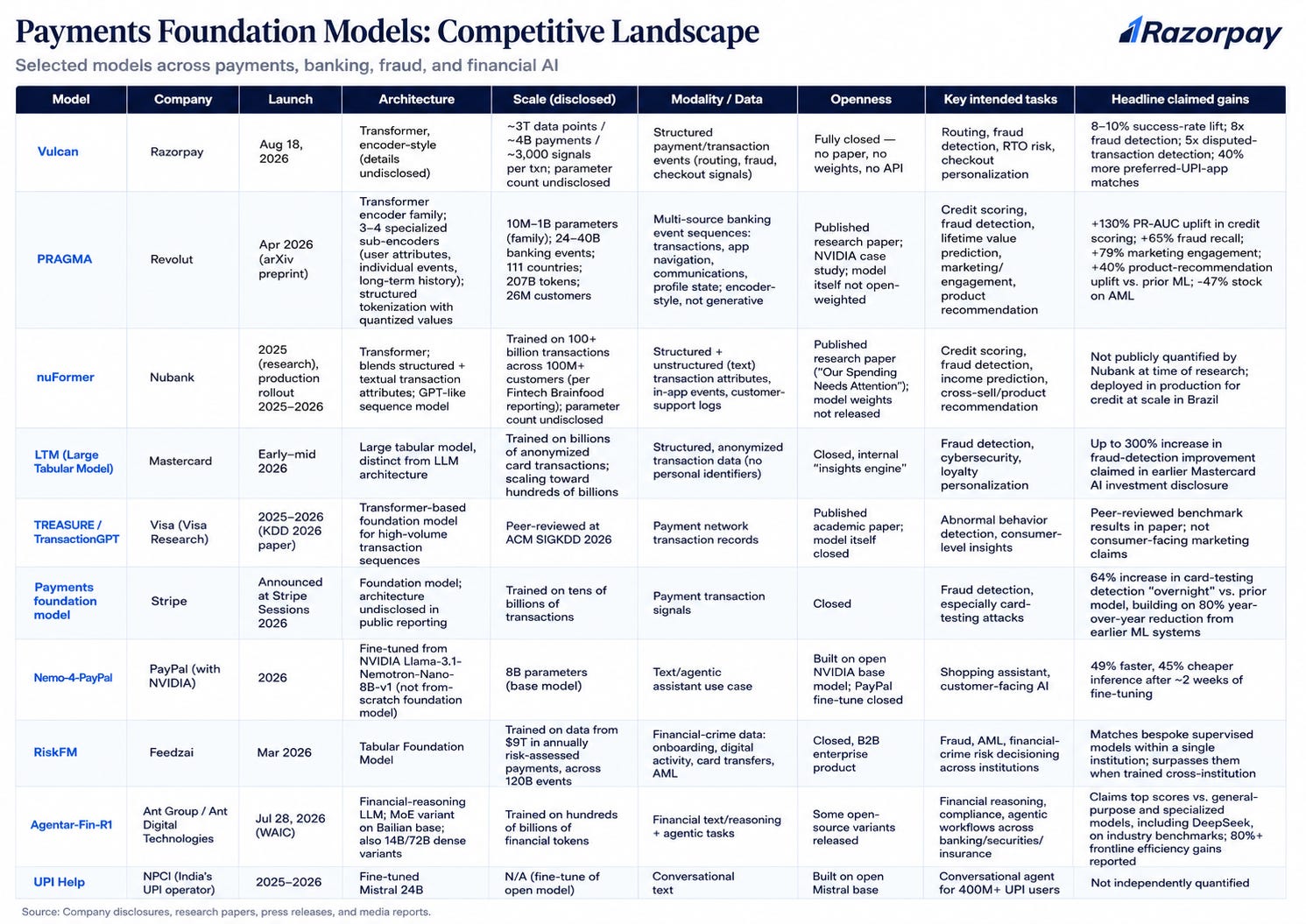
More on this 👉 On August 18, Indian FinTech giant Razorpay launched Vulcan, a transformer foundation model trained on roughly 3 trillion data points from 4 billion payments, weighing about 3,000 signals per transaction. It is not an LLM. It treats each payment as an unordered set of fields, tokenizing even missing ones. That design fits India’s mess of UPI apps, cards, netbanking, and cash-on-delivery better than the sequence models Nubank (nuFormer) and Revolut (PRAGMA) built for user histories. One self-supervised backbone now feeds routing, cross-merchant fraud detection, risk scoring, and checkout personalization, replacing siloed single-task models.
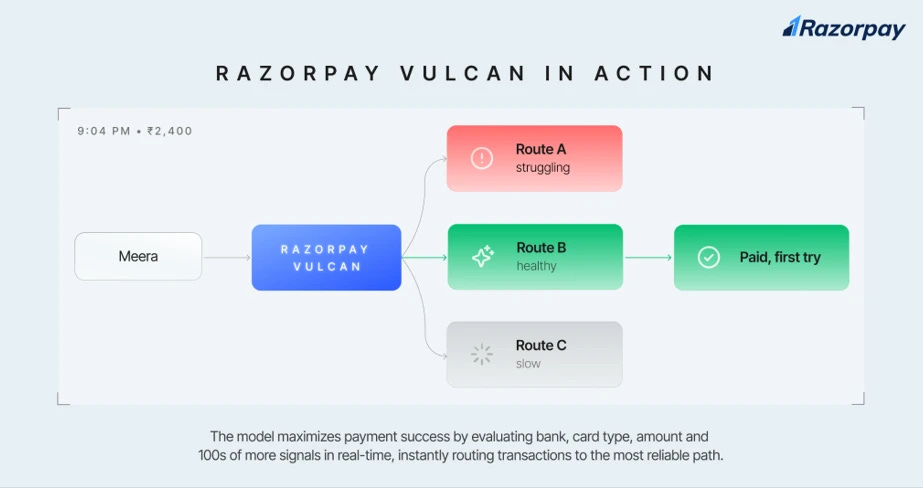
The beta numbers, across 51,000+ businesses including Blinkit and redBus, are the story: payment success rates up 8-10%, international card fraud caught 8x more often, and 100,000-200,000 extra completed purchases per month just from showing shoppers their preferred UPI app.
In high-volume Indian e-commerce, where a failed payment sends cash-first shoppers straight back to cash, an 8-10% success lift is worth more than most product launches. And because the model learns from every transaction on the network, patterns invisible to any single merchant, like one stolen card hitting unrelated sellers, become visible. In other words, it’s a moat that compounds with volume- exactly what an IPO-bound company wants investors staring at.
Zoom out 🔎 Vulcan also confirms a pattern: Stripe, Adyen, Mastercard, Nubank, and Revolut are all building domain foundation models on proprietary transaction data, because general LLMs cannot do millisecond, high-stakes tabular reasoning under regulatory constraints. Trained and hosted in India for RBI localization rules, Vulcan turns compliance into a competitive filter foreign models cannot easily pass.
ICYMI: Inside Revolut’s PRAGMA: The Foundation Model Trained on 40 Billion Banking Events 🧠 [Architecture, performance benchmarks vs. Stripe, Mastercard, and Visa, regulatory risks, and why PRAGMA may be the most consequential AI bet in consumer finance]
THE TAKEAWAY ✈️
What’s next? 🤔 Looking ahead, here’s what to watch: whether the gains hold outside a curated beta, and whether Razorpay extends the backbone into lending and credit risk, where the real margin lives. The second-order effect most will miss is agentic commerce. When AI agents start initiating payments, they will route through whichever rail decides fastest and fails least, and a self-improving payments brain is the natural counterparty. Zooming out, the losers here are pure-play gateways and banks without a real-time payment graph; their classical ML now competes against a network effect. Of course, we must note that the honest caveat is that all reported lifts are Razorpay’s own numbers, measured against its own prior models. Directionally, though, the era of fintechs renting intelligence is ending. The data-rich ones are minting their own. AI continues to eat fintech 🤖
ICYMI:


🧠 What else I’m watching
Binance Launches AI Trading 🤖 Binance has launched Agent OS, a platform enabling AI agents to connect to its systems and execute trades on behalf of users. Users can authorize agents via tools like ChatGPT to access market data and perform trading activities within set permissions, supporting both custom and ready-made integrations across crypto and traditional markets. It seems that AI-driven trading is becoming the new norm on exchanges. ICYMI:
Z.ai Unveils GLM-5.3 🤖 Z.ai is upgrading its GLM-5.3 model with improved coding to rival Anthropic and OpenAI, releasing its weights within two weeks and outperforming its predecessor. Despite a 9% stock dip, the move underscores China’s push for cost-effective, high-performance AI, with Z.ai’s market cap still at $75 billion and $1 billion in annual recurring revenue. ICYMI:
Revolut Seeks Finnish License 🇫🇮 Revolut has applied for a banking licence in Finland to establish a branch, enabling its 250,000 Finnish customers to access IBANs and local banking services. The move follows its recent full European banking licence in France and is part of a €1 billion investment to expand across Europe, including a new HQ in Paris by 2027. ICYMI:


💸 Following the Money
British alternative credit scoring technology startup Noggin HQ has raised £2.3M in an oversubscribed seed round.
Sterling, the New Zealand AI startup building an autopilot for finance teams, has raised $3.8M (NZD) in a round led by trans-Tasman venture capital firm Blackbird.
Indian digital financial services firm Navi is set to receive a $100M funding boost from Dutch asset manager Prosus.
👋 That’s it for today! Thank you for reading, and have a relaxing Sunday! And if you enjoyed this newsletter, invite your friends and colleagues to sign up:
What’s interesting, is that Stripe is first company to declare the beginning of the singularity and it isn’t an AI company. Also and as usual, Great Share Linas. Gracias.
Wow, this one is super packed - so Stripe is really going to become $1 trillion company, huh?