
Your next broker is a chatbot 🤑🤖; Catena Labs wants a bank charter for AI Agents, and the OCC said “We’ll Listen” 🏦🤖
You're missing out big time... Weekly Recap 🔁

👋 Hey, Linas here! Welcome back to a 🔓 weekly free edition 🔓 of my daily newsletter. Each day, I focus on 3 stories that are making a difference in the financial technology space. Coupled with things worth watching & most important money movements, it’s the only newsletter you need for all things when Finance meets Tech.
If you’re not a subscriber, here’s what you missed this week:
Claude Opus 4.8: The Complete Prompting Playbook for 2026 🧠 [How to get the best results from Anthropic’s most powerful model every single time, including the new Dynamic Workflows feature]
Claude for Small Business: Setup, Workflows, and the Prompts That Make It Work 💼 [The complete guide to Anthropic’s Claude for Small Business - covering setup, all 30 capabilities, 8 integration deep-dives, and the exact prompts that turn Claude into your most productive employee]
SpaceX IPO: Why the Biggest Listing in History Might Be Uninvestable at $1.75 Trillion 🪐 [The S-1 reveals a $7 billion Starlink profit machine subsidizing $30B in annual AI cash burn, while Elon Musk holds 85% of the vote with no sunset, no independent board, and no path to remove him]
The Claude Finance Playbook: How CFOs Use AI to Build Models, Forecast Cash, and Close Books Faster 📊 [A practical guide to setting up Claude for real finance work, with battle-tested prompts optimized for Claude Opus 4.7]
Ex-OpenAI’s Aschenbrenner Bet $5.5B on AI Chips. Now He’s Betting $8.5B Against Them 💸 [Leopold Aschenbrenner’s AI hedge fund Situational Awareness went from pure AI long to 62% short semiconductors in one quarter. Here’s what changed and why the thesis still holds]
Monzo’s 2026 financials: the £1.7 billion revenue machine that still has to prove it can escape the UK’s Orbit 🏦🇬🇧 [breaking down the unit economics that matter, the Revolut comparison investors keep getting wrong, the governance drama, IPO chances & what’s next for Monzo + bonus deep dive into Revolut’s latest financials & their foundational AI model for money inside]
Starling Bank’s 2026 financials: 2.5x Monzo’s profit on half the revenue, and a £70M SaaS pipeline that changes the IPO math 📈🧠 [unpacking the most important financial facts & figures, how it stacks against Monzo & Revolut, & why Starling’s balance sheet is a fortress + bonus deep dives into the latest financials of Monzo & Revolut inside]
Coatue’s May 2026 Report: The $12 Trillion AI Bet and Who Ends Up on the Wrong Side 📊 [Coatue’s latest public markets report reveals the most extreme winner/loser split in tech stock history, a $12 trillion AI capex wave, and one brutal framework that predicts exactly who wins]
Anthropic Just Told AI Founders Exactly What to Build in 2026 🦄 [1 million conversations. 9 consumer AI domains. A full founder playbook - plus where Anthropic’s own products will and won’t compete]
The Complete Claude /goal Guide for AI Agents 🤖 [What Claude /goal actually is, why most invocations fail, and how to write production-grade goal conditions for financial research, backtesting, and live market monitoring]
How to Build an AI Agent from Scratch (With Working Code) 🤖 [The design framework, working code, and hard-won lessons that take you from “I want to build an AI Agent” to a working one - in under 60 minutes]
Claude Cowork Commands, Scheduled Tasks & Automation Workflows: The Operator’s Playbook 🤖 [Every real slash command, the exact prompts that run deal flow and investor updates on autopilot, and the failure modes that will cost you hours if you don’t know them first]
As for today, here are the 2 fascinating FinTech stories that are changing the world of financial technology as we know it. This was yet another wild week in the financial technology space, so make sure to check all the above stories.
Your next broker is a chatbot 🤑🤖

The news 🗞️ The gap between “AI can analyze markets” and “AI can execute trades” just closed, and it happened inside a chatbot.
Let’s take a look.
More on this 👉 Liquid Co-Invest, built by ex-Two Sigma quant Franklyn Wang, ships as a ChatGPT App Store plugin and Claude connector that turns a conversation into a full trading workflow.
Fund an account, pull institutional-grade analysis (on-chain flows, funding rates, liquidation maps, macro context with sourcing), build a multi-asset portfolio, and execute live trades.
→ Crypto perps with leverage, US equities, FX, commodities, Polymarket positions, and pre-IPO secondaries in names like OpenAI, Anthropic, and SpaceX.
→ Over 500 markets, available in all 50 states, setup in about a minute.
→ Non-custodial, so funds stay in the user’s wallet, and the AI can’t move money without an explicit tap on a confirmation card showing exact position details.
Zoom out 🔎 Looking at the bigger picture, the smart observation here isn’t about the interface. It’s about where the moat sits.
Liquid doesn’t own the AI. OpenAI and Anthropic do, and every model upgrade makes Liquid’s product better at zero marginal cost. What Liquid owns is the hard, unglamorous infrastructure underneath: deep venue integrations across Hyperliquid, Lighter, and Ostium, regulatory positioning that sidesteps custody headaches, and access to private-market secondaries that most retail investors can’t touch. And that’s exactly what Anthropic itself recently told AI founders to build:

Most importantly, they’re not competing with the likes of Robinhood, Coinbase, etc. They’re making their interface feel like a fax machine 😬
The incumbents won’t sit still, of course.
Robinhood already has the regulatory licenses, 24 million funded accounts, and a mobile-native DNA that rewired retail trading once before. Coinbase sits on the deepest institutional crypto rails in the US and has been quietly building agent-friendly APIs.
Both will almost certainly ship their own LLM connectors or acquire someone who has. Their real advantage is custody: they already hold the assets. But that’s also their constraint. Building conversational execution on top of legacy brokerage architecture is a different engineering problem than building it natively, and incumbents tend to bolt on what insurgents build in.
The race therefore now is whether Robinhood and Coinbase can move fast enough to own the agentic layer themselves, or whether they get relegated to dumb pipes that infrastructure players like Liquid route through.
THE TAKEAWAY ✈️
What’s next? 🤔 First and foremost, we must note that the risk profile is real here, though. Leverage in the hands of someone who has just learned to prompt is a rough combination. Herding effects from thousands of users feeding similar queries into the same models could amplify volatility rather than dampen it. And regulators haven’t even begun to wrestle with liability when an AI’s suggestion leads to a blowup… Looking ahead, I’d watch two things. First, whether traditional brokers scramble to build their own LLM connectors or try to acquire the infrastructure layer. Second, the pre-IPO access angle. If conversational AI makes illiquid private secondaries feel as tradable as spot crypto, that reprices how late-stage companies think about liquidity timelines entirely. The first-order story is a better trading UI. The second-order story is a new distribution channel for capital markets, and that’s the one worth tracking. Either way, this is a perfect glimpse into the future of agentic finance.
ICYMI:

Catena Labs wants a bank charter for AI Agents, and the OCC said “We’ll Listen” 🏦🤖
The news 🗞️ The first serious regulatory test for agentic finance is now on the clock.
Catena Labs, founded by Circle co-founder Patrick Neville, emerged from stealth last week with a $30M Series A from Acrew Capital and a16z crypto, bringing total funding to $48M.
But the money isn’t the story here.
The story here is that the OCC accepted Catena’s filing for a national trust bank charter - a de novo institution designed from scratch to let AI agents custody assets, settle payments, and manage money under federal supervision.
Let’s take a quick look to see what it’s all about, why it matters, and most importantly - what’s next.
More on this 👉 Every major player in payments is now racing to build agent infrastructure.
→ Stripe launched its Agentic Commerce Protocol with OpenAI, then joined Google’s UCP.
→ Coinbase shipped AgentKit and x402.
→ Google partnered with Coinbase and AmEx on agent payments.
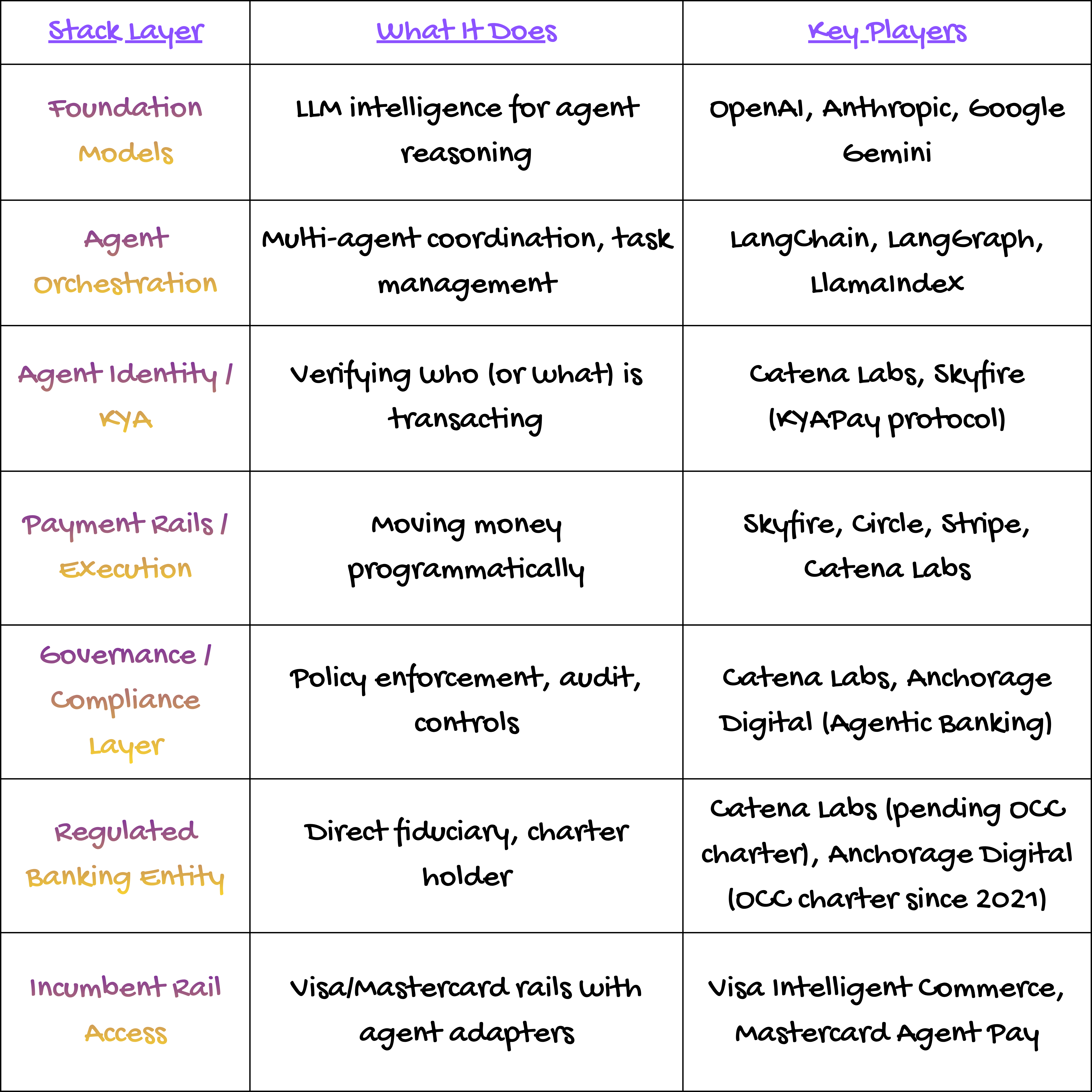
All of them are API layers and protocols that ride on existing banking relationships. Catena is the only one trying to become the bank. That’s a slower path, but if the charter clears, it’s a moat that no SDK can replicate.
Zoom out 🔎 The entity, Catena Trust Bank, N.A., would be a limited-purpose uninsured trust company headquartered in New York: no branches, no deposits, no lending. Pure custody, conversion, and settlement for fiat, stablecoins, and digital assets under the GENIUS Act framework.
Think Anchorage Digital’s charter playbook, rebuilt for non-human clients. Agents get verifiable identities, deterministic spending policies, kill switches, and full audit trails. Operators keep a control plane. The bet is that enterprises won’t hand agents real budget authority without a regulated fiduciary on the other side.
THE TAKEAWAY ✈️
What’s next? 🤔 First and foremost, we must note that the 30-day public comment window closes around late June 2026. If you want to gauge how seriously Washington takes autonomous AI as an economic actor, watch this docket. Of course, charter approvals typically take 12-18 months, and approval is far from certain. But acceptance of the filing alone tells you something: regulators are engaging with the premise that AI agents need their own financial identity framework, not a retrofit of human-centric KYC. Looking ahead, the second-order question nobody’s asking yet is this: if Catena gets chartered, who’s liable when an agent makes a bad trade? The charter creates a fiduciary wrapper, but the case law doesn’t exist. The first dispute will matter more than the first transaction. Either way, agentic finance is the future 🤖
ICYMI: Google Universal Cart and the Universal Commerce Protocol are Google’s bid to become the operating system of e-commerce ⚙️🛍️ [what Google Universal Cart is all about, why it matters & how it can transform e-commerce forever + bonus deep dives into Google’s UCP, how it just won Agentic Commerce & why AmEx skipped the protocol race altogether inside]


🧠 What else I’m watching
AI Banking Companion 📱 CommBank is testing a conversational AI interface, CommBank Companion, within its app to help customers manage spending, savings, and financial goals. The tool analyzes live data to provide insights on budgets, subscriptions, cash flow, and business projections. Currently in employee and select business banking trials, it aims to shift banking from customer navigation to proactive, relevant information delivery. ICYMI: ChatGPT’s new personal finance feature is OpenAI’s bid to kill the fintech app economy 🤖📲 [what it’s all about, which fintechs should worry the most, how it connects to OpenAI’s Super App Play & what’s next + bonus deep dives into Anthropic & how it’s becoming Wall Street’s OS, their SME OS play, and what AI startup founders should build in 2026]
TD AI Mortgage Boost 🏠 TD Bank’s new agentic AI model, developed at its Layer 6 R&D center, automates mortgage and home equity loan pre-adjudication, slashing processing time from 15 hours to under 3 minutes. The AI classifies documents, extracts data, validates income, and flags discrepancies before generating underwriter summaries - improving both accuracy and speed. This marks a foundational step in TD’s AI strategy, aiming to generate $1 billion in annual value by combining human expertise with AI efficiency. ICYMI:
BNP-Mistral AI Defense 🛡️ BNP Paribas has renewed its three-year partnership with Mistral AI to bolster cyber defenses against vulnerabilities exposed by tools like Anthropic’s Mythos. With Mythos inaccessible to European banks, BNP is collaborating with Mistral to develop a similar cyber-focused AI model, addressing the speed and scale of emerging threats. The partnership also aims to simplify internal knowledge access, deploy an AI employee assistant, and create on-premises AI tools for sensitive processes like KYC. BNP emphasizes a multi-model approach, prioritizing performance, data sensitivity, and geographic alignment to drive operational and regulatory impact. ICYMI:

💸 Following the Money
Scapia, an Indian outfit that combines co-branded credit cards with travel booking, has raised $63M in a funding round led by General Catalyst.
Relay, a business banking and money management service for SMEs, has secured $50M in growth investment from General Catalyst.
MoonPay announced its fourth acquisition of the year with Decent, as it launches MoonPay Trade.
👋 That’s it for today! Thank you for reading, and have a relaxing Sunday! And if you enjoyed this newsletter, invite your friends and colleagues to sign up:
great read as always
thanks for this one