
AI Agents finally got a bank account. 20 of crypto’s biggest names just agreed on what it looks like 🤖🏦; Anthropic stopped building a Chatbot and started building an AI Operating System 🤖📲
You're missing out big time... Weekly Recap 🔁

👋 Hey, Linas here! Welcome back to a 🔓 weekly free edition 🔓 of my daily newsletter. Each day, I focus on 3 stories that are making a difference in the financial technology space. Coupled with things worth watching & most important money movements, it’s the only newsletter you need for all things when Finance meets Tech.
If you’re not a subscriber, here’s what you missed this week:
The Ultimate Guide to Claude Skills 🧠 [You’re typing the same instructions every morning. After reading this, you’ll never do it again]
Andrej Karpathy’s Method To 10X Your Claude Skills 🧠 [You built the Skills. Now here’s the step-by-step system that makes them dramatically better while you sleep]
The File That Turns Claude Code Into Your Best Engineer 🧠 [A complete guide to CLAUDE.md, rules, skills, subagents, and hooks - everything you need to make Claude Code your 10X Engineer]
Sequoia’s “Services: The New Software” Thesis Will Mint Billionaires and Bankrupt Copycats 📈 [The autopilot playbook, the margin trap, the $0.03 problem, and a practical framework for AI builders, investors, and operators who need to decide what to do next]
Revolut is the most profitable FinTech on Earth, and it hasn’t even started lending yet 🤯📈 [unpacking the fee-income fortress that makes Revolut structurally different from every competitor, the lending optionality coiled inside that balance sheet, the regulatory dominoes now falling in sequence, and whether $75B is expensive or whether the market is about to find out it was way too cheap + more bonus reads on Revolut, how it’s leveraging AI & bonus deep dives into the latest financials of Nubank, SoFi, Robinhood, and Coinbase inside]
The Quiet Compounder: Wealthfront’s automated flywheel is real, but the cash engine has one BIG problem 🧐💸 [breaking down Wealthfront’s Q4 & full 2026 year financials, understanding what they mean, what’s next & whether cash engine’s problem is big enough + bonus deep dive into Revolut’s 2025 financials inside]
Turn Claude Cowork Into Your Personal COO 🧠 [Most people are using the most powerful AI agent ever released to answer questions. Here’s the framework that turns Claude Cowork into an operator that runs your work while you sleep]
More FinTech companies are becoming media companies: Plaid bought a newsletter because plumbing isn’t enough anymore 💸📰 [what’s the bigger play here and why it matters & a recap of how more and more FinTech companies are turning into media companies]
Everything Anthropic Teaches Its Claude Certified Architects (Full Production Guide) 📚 [Full Claude Stack - agentic loops, multi-agent orchestration, Agent SDK, Claude Code, & MCP - reverse-engineered from Anthropic’s closed certification & rebuilt around 5 systems you’ll really ship]
The One-Person Unicorn 🦄 [I built an AI operating system to run a startup with Claude]
Productize Yourself 🧠 [Naval Ravikant’s framework for building a one-person company is the best startup strategy of 2026. Here’s the operating system, and 13 AI prompts to run it]
As for today, here are the 2 fascinating FinTech stories that are transforming the world of financial technology as we know it. This was yet another wild week in the financial technology space, so make sure to check all the above stories.
AI Agents finally got a bank account. 20 of crypto’s biggest names just agreed on what it looks like 🤖🏦

The news 🗞️ The agent economy has had payment rails for months. What it hasn’t had is a wallet.
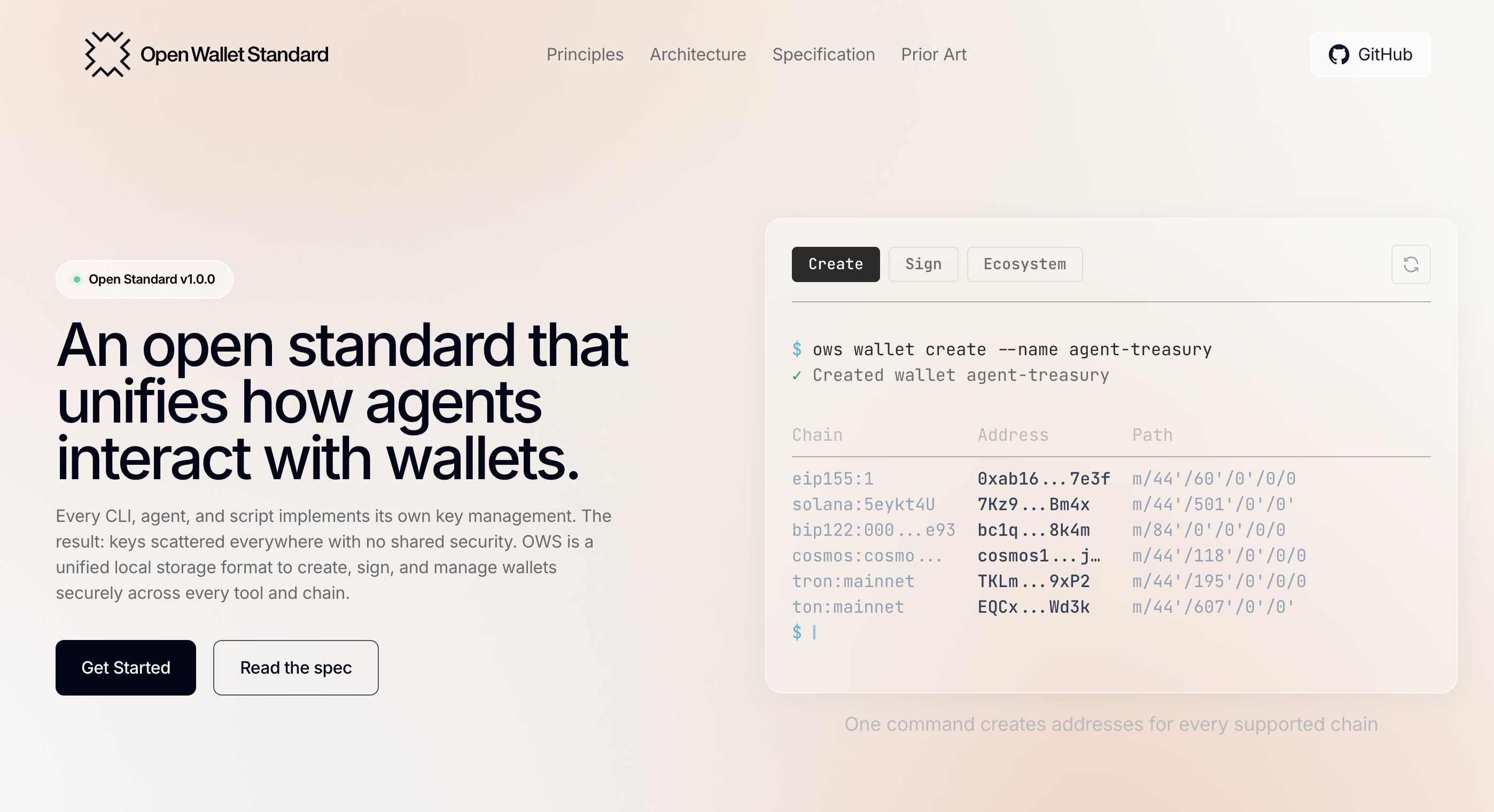
MoonPay just shipped the Open Wallet Standard - an MIT-licensed, open-source protocol that gives AI agents a single encrypted vault for holding funds, signing transactions, and paying for services across every major blockchain. It launched with backing from PayPal, Circle, Ripple, OKX, the Ethereum Foundation, the Solana Foundation, Base, Polygon, Sui, Tron, TON, Filecoin, LayerZero, and more than a dozen others.
That contributor list matters more than the code.
Let’s unpack this.
More on this 👉 Here’s the problem OWS solves. Over the past year, Coinbase built x402 for HTTP-native stablecoin payments. Google launched AP2 for agent commerce. Stripe and Tempo shipped MPP for streaming micropayments.
All three assume the agent already has a wallet. None of them define where keys live or how agents access them. In practice, most agent frameworks today stuff private keys into environment variables or plaintext config files. A user running three agent tools has funds scattered across three wallets that can’t see each other.
OWS collapses that into one vault per machine: AES-256-GCM encryption at rest, keys decrypted only in locked memory to produce a signature, then immediately wiped. The agent never touches the raw key. A policy engine enforces spend limits and allowlists before any signing happens.
Where OWS Sits in the Agent Payment Stack
┌─────────────────────────────────────────────────────────┐
│ INTENT LAYER: A2A (Google), MCP (Anthropic)             │
│ Agents discover capabilities, coordinate tasks          │
├─────────────────────────────────────────────────────────┤
│ PAYMENT PROTOCOL LAYER: x402 (Coinbase), MPP (Stripe)   │
│ Defines WHAT to pay, HOW MUCH, to WHOM                  │
├─────────────────────────────────────────────────────────┤
│ WALLET LAYER: OWS ← THIS IS THE MISSING PIECE           │
│ Secure key storage, policy enforcement, signing         │
├─────────────────────────────────────────────────────────┤
│ SETTLEMENT LAYER: EVM, Solana, Bitcoin, etc.            │
│ USDC, USDT, and other stablecoins settle on-chain       │
└─────────────────────────────────────────────────────────┘
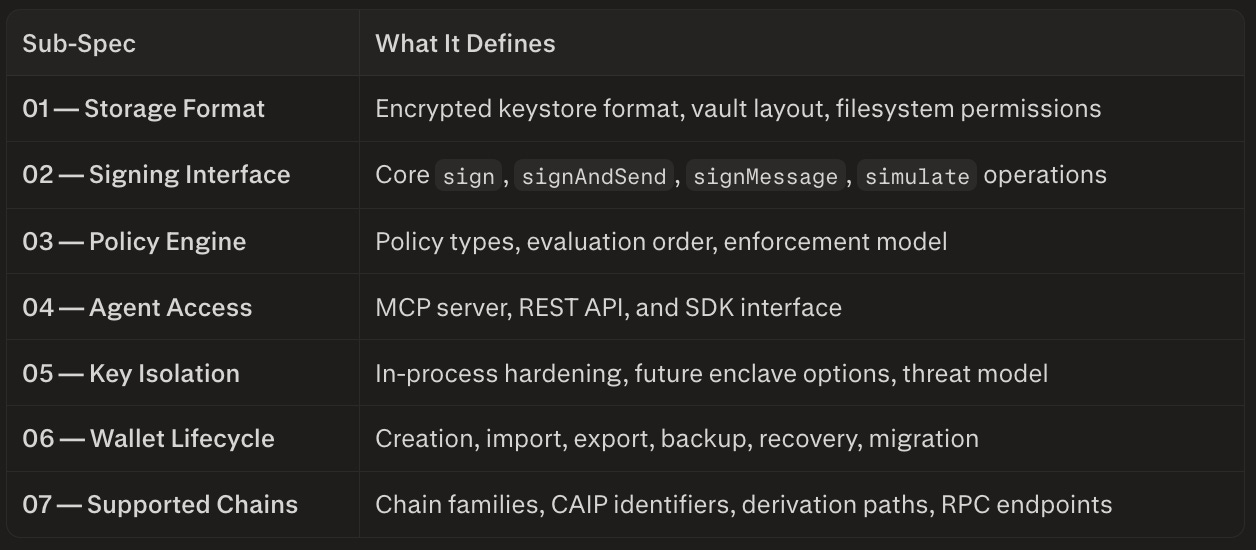
The spec covers seven modules - storage, signing, policies, agent access, key isolation, wallet lifecycle, and chain support - each adoptable independently. One seed derives addresses across EVM chains, Solana, Bitcoin, Cosmos, Tron, TON, and XRP Ledger. SDKs ship for Node.js and Python.
Integration is three lines of code or one CLI command.
THE TAKEAWAY ✈️
What’s next? 🤔 Looking ahead, here’s what to watch next: the wallet primitive was the last missing piece in the agent payment stack. With OWS underneath and x402/MPP on top, the plumbing for machine-to-machine commerce is now complete enough for real deployment. The immediate second-order effect is that stablecoin volume from autonomous agents could become a measurable share of on-chain activity within the next twelve months. The harder questions - liability when an agent loses funds, regulatory treatment of machine-held balances, whether twenty-plus contributors can actually maintain consensus on an evolving spec - are still unanswered. And those will thus determine whether OWS becomes the SMTP of agent payments or another well-backed standard that fragments on contact with production.
ICYMI: Stripe just built the toll booth for the machine economy 🤖🪙 [breaking down the Machine Payments Protocol, why it’s huge & how MPP stacks against other Agentic Protocols + bonus deep dive into Stripe building the infra for AI-driven payments and how Google wants to become the Android of Commerce]
Anthropic stopped building a Chatbot and started building an AI Operating System 🤖📲

Following the AI moves 🤖 One of the most important AI product announcements this week wasn’t about a model. It wasn’t about the new funding either.
Yesterday, AI giant Anthropic shipped a Claude mobile update that embeds live, interactive instances of Figma, Canva, Amplitude, and other enterprise tools directly inside the chat interface.
Not screenshots. Not summaries. Functional canvases you can prompt, edit, and push changes back to the source tool - all from your phone.
This is yet another strong signal that Anthropic has stopped building a chatbot and started building an AI OS. The endgame is probably to turn Claude into a Super App for all knowledge work. Something close to WeChat but built for the AI era…
Let’s dive deeper into this, unpack Anthropic’s strategy, see why it could be huge, and what’s next.
More on this 👉 The 52-second demo shows a designer tweaking a Figma file, a PM assembling a Canva deck, and an analyst querying Amplitude dashboards without opening a single other app. The plumbing underneath is MCP, the Model Context Protocol Anthropic launched in January, which standardizes how Claude talks to third-party software.
Read that list of launch partners again: Figma, Canva, Slack, Asana, Box, and Amplitude. These aren’t consumer toys. They live behind corporate firewalls, handle sensitive data, and require permissioned access. Getting them to open up to an AI agent is a trust sale, and Anthropic’s constitutional-AI-first brand is what closed it.
OpenAI is also building a competing desktop super app (Atlas + Codex + ChatGPT), but it still feels like a chat window with plugins.
ICYMI:

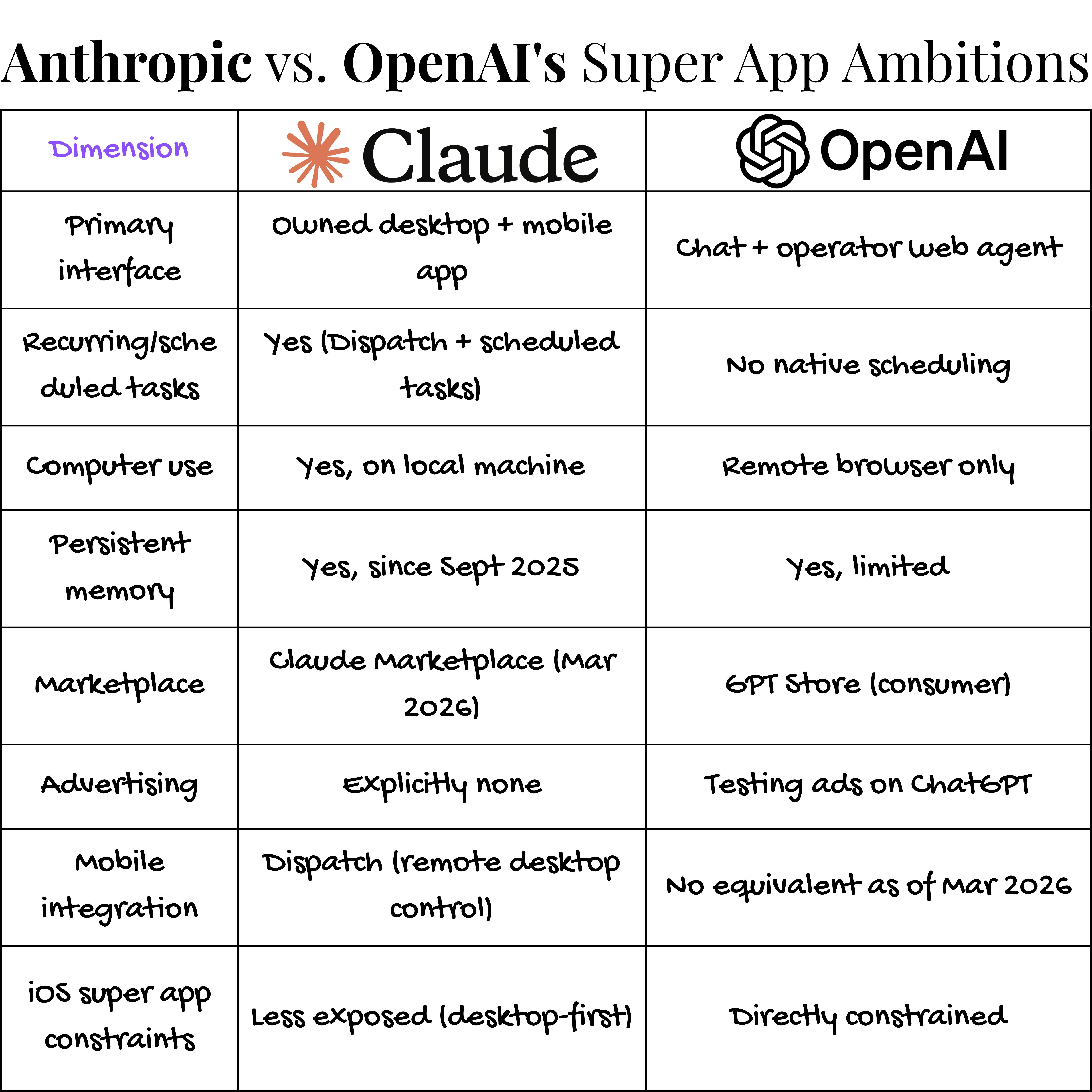
Claude is becoming the rendering layer for the tools themselves. The difference is subtle but structural: a plugin retrieves information for a conversation, while an embedded tool turns the conversation into a workspace.
ICYMI:

Zoom out 🔎 HCI research has shown for decades that every app switch costs 20 to 40 seconds plus a measurable spike in cognitive load. For a knowledge worker toggling between Slack, Figma, a spreadsheet, and a project tracker dozens of times per hour, that tax compounds into hours of lost output per week.
Anthropic’s bet now is that collapsing those tools into a single AI-mediated surface eliminates the tax entirely. The mobile-first angle sharpens the pitch further. Laptops are where work gets done; phones are where work gets stuck. If Claude can turn a phone into a legitimate workspace for visual design, data analysis, and project management, it captures the 80% of a knowledge worker’s day that currently leaks into “I’ll deal with it when I’m back at my desk.” And that’s huge.
The economics are worth watching closely here. Each new MCP integration makes every other integration more valuable because the user’s context graph gets richer. Claude doesn’t just know your Figma file; it knows your Figma file in the context of the Slack thread where your team debated the design, the Asana ticket that prompted it, and the Amplitude data that justified the change.
Once that web of context is built, the switching cost isn’t the $20/month subscription. It’s reassembling a fragmented workflow across ten apps and losing the connective tissue between them. That’s the WeChat playbook applied to knowledge work: win on distribution and habit, not raw intelligence.
THE TAKEAWAY ✈️
What’s next? 🤔 What comes next matters more than what shipped. If Anthropic can prove that embedded tool interactions reduce measurable context-switching overhead for enterprise teams, they graduate from AI vendor to productivity platform, and pricing power follows. The monetization path kinda writes itself: Pro and Max subscriptions for individuals, seat-based enterprise deals priced against the tool-stack complexity they replace, and API fees from the agents built on top. Thus, I’d now watch for two signals over the next two quarters. First, whether Anthropic introduces team-level workflow templates, shared MCP configurations that let an entire org standardize how Claude orchestrates their tools. Second, whether Figma or Slack start shipping “Claude-native” features that assume the agent is always present. The first would mean Anthropic is selling to IT buyers, not just individual users. The second would mean the super app thesis isn’t just Anthropic’s ambition. It’s becoming the ecosystem’s default assumption. That’s when the moat gets real big time.
ICYMI:


What else I’m watching
Aviva Brings Insurance to ChatGPT 📱 Aviva has launched an insurance app on ChatGPT’s App Store, enabling new customers to get initial quotes for its Signature Home Insurance by answering a few questions. Those interested can then customize their policy, choose coverage, and complete the purchase on Aviva’s website. CEO Owen Morris highlights the app as a new way to meet customer preferences and anticipates broader adoption of LLM-based purchasing as AI becomes more commonplace. ICYMI:
Aveni Forms AI Oversight Council 🏛️ Scottish AI fintech Aveni has launched the Agent Assurance Expert Council (AAEC) to address oversight challenges in agentic AI innovation. The council, formed by fintech and AI leaders, aims to establish protocols for security, transparency, and control as AI agents reshape financial services. The move follows Aveni’s 2025 launch of a domain-specific large language model, backed by Lloyds and Nationwide, reinforcing its commitment to responsible AI innovation. ICYMI:
Bank of Ireland Invests in AI Skills 🤖 Bank of Ireland is proactively upskilling its workforce for an AI-driven future, with AI-immersion learning planned for all staff in 2026. Already, 20% of employees are engaged in AI or data literacy programs, including over 1,100 who completed Data Fluency courses and 1,200+ in the AI Academy. A select group is also enrolled in the Cambridge Spark AI programme for advanced skills. The bank’s research shows 72% of people expect organizations to train employees in AI, with customers prioritizing fraud detection and faster query resolution. ICYMI:
💸 Following the Money
Prediction market platform Kalshi has raised more than $1B in an ongoing funding round led by Coatue Management, valuing the company at approximately $22B, according to people familiar with the matter.
Spade, a data and AI platform designed to turn messy transaction strings into structured, verified records, has raised $40M in Series B funding led by Oak HC/FT.
Payy, a stablecoin startup focused on private transactions using zero-knowledge technology, has raised $6M in a seed funding round led by FirstMark Capital.
👋 That’s it for today! Thank you for reading, and have a relaxing Sunday! And if you enjoyed this newsletter, invite your friends and colleagues to sign up:
Was waiting for this one the whole week - what a gem. Thanks for all the hard work Linas!
The headline framing captures something important: AI agents getting a "bank account" via x402 and stablecoin wallets is the missing infrastructure link that transforms agents from passive tools into active economic participants.
The coalition of 20 crypto names agreeing on the x402 standard is also significant, because payment infrastructure becomes more valuable the wider the adoption. A fragmented set of competing agent payment standards would slow adoption for everyone. The convergence on x402 under the Linux Foundation umbrella removes that coordination problem. The remaining open questions are on the regulatory side: what happens when an autonomous wallet triggers AML thresholds, and who is the responsible party? That's the next frontier the industry needs to address collectively.